

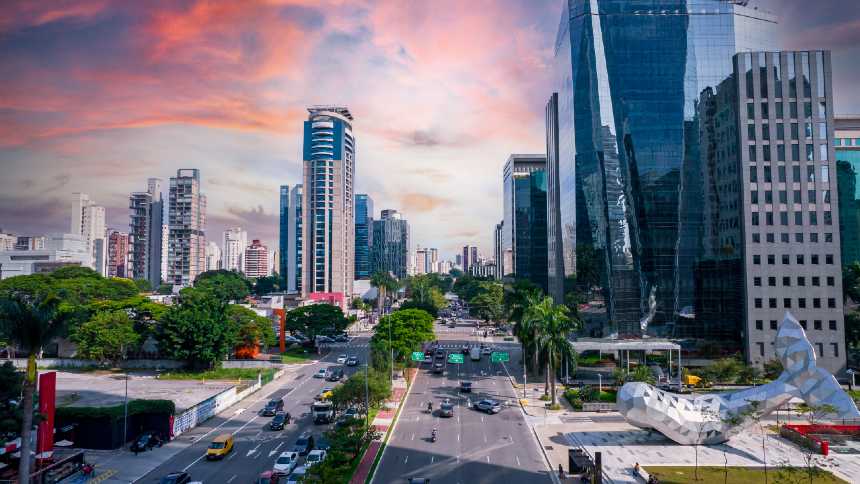

The city of São Paulo is about to receive the largest volume of new corporate office space in over a decade. But this shouldn't affect the vacancy rate, given the strong demand for developments, especially high-end ones, in the São Paulo capital.
A survey conducted by the consulting firm RealtyCorp for NeoFeed indicates that the city of São Paulo is expected to receive approximately 287,800 square meters (m²) of new inventory in the second half of the year. Of this total, 90% falls into categories A, AA, and AAA.
The volume surpasses the approximately 268,400 m² delivered in the second half of 2015, which was the highest semester in the historical series analyzed by RealtyCorp. It is also equivalent to approximately 2.9 times the volume delivered in the first half of the year and more than double all deliveries recorded in 2025.
According to Christofer Mariano, leasing director at RealtyCorp, a large part of the volume expected to be delivered is not the result of a recent excess of launches, but of the maturation of projects started years ago that were accelerated to take advantage of the recovery in demand after the shock caused by the pandemic.
"The delivery date has more to do with the market than with the project itself, which was already an idea conceived before the whole crisis," he says.
"When the developers started construction, the pandemic hit, and strategically, they carried out these projects at the pace the market was moving," the executive added.
This is the case in the Chácara Santo Antônio and Chucri Zaidan regions, both in the southern zone, which were quite hot until 2020.
With ample available land for construction, both cities received large projects, many of them planned between 2018 and 2019. The pandemic and the arrival of remote work increased vacancy rates, which slowed the development of these projects.
With the return to in-person work, these projects have resumed and are beginning to reach the market. According to RealtyCorp, the two regions will account for the majority of deliveries, with approximately 156,600 m² of new offices, equivalent to 54.4% of the total planned for the semester.
But Mariano points out that the backlog of projects is not the only explanation for the high volume of deliveries expected in the second half of the year. On Faria Lima Avenue , which is expected to receive around 33,500 m², new buildings have been developed to address the scarcity of space in the region.
In areas like Pinheiros, with approximately 59,800 m² of planned deliveries, boutique projects predominate, featuring smaller square footage and distinctive architecture, although the neighborhood, in the western zone, also houses the Cyrela Oscar Freire Corporate , one of the largest buildings planned for delivery, which will house Cyrela 's headquarters and some of Nubank 's employees.
According to Mariano, the common denominator is the improvement of the market. "Each region in São Paulo has a different identity, and will have different strategies, mainly due to the market, prices, and sizes. Each asset has a slightly different history," he states.
Stable vacancy rates, construction booming.
Despite the projected entry of hundreds of thousands of square meters in the coming months, the market is experiencing a period of strong demand, with significant absorption of areas and developments that are already partially occupied when they enter the market. Therefore, it is unlikely that the vacancy rate will change considerably.
"Even with these new deliveries, vacancy rates tend to, at the very least, stabilize, because the pace of new leases remains strong. If there is no new crisis, the trend is for the market to continue absorbing these spaces," says Mariano.
The survey indicates that, if net absorption in the second half of the year repeats the performance of the first six months, around 186,000 square meters, the vacancy rate in the high-end market could, at most, show a slight increase, rising from approximately 12.7% to something close to 13%.
According to Mariano, the market has returned to absorption levels similar to those of the pre-pandemic period, between 400,000 and 500,000 m² per year. This volume is sufficient to offset a good portion of the new supply expected.
Chucri Zaidan, which previously struggled with high inventory levels, is seeing absorption accelerate. Vacancy rates, which reached approximately 32% during the pandemic, have fallen to around 12% thanks to the pace of new leases.
Furthermore, some developments enter the market with already lined-up tenants, as is the case with projects like Cyrela Oscar Freire and buildings such as Ester Towers and Alto das Nações, both in the southern zone, which attract the interest of large companies. "Increasing the inventory doesn't necessarily increase vacancy, because some of these buildings may be delivered already occupied," he says.
This situation tends to keep developers working. According to Mariano, there are still more than 500,000 square meters of high-end corporate office space under construction in the city, in addition to several plots of land already approved, just waiting for the right time to start construction.
"The corporate market demands long-term planning. Developers can't simply stop building because there's supply today. If they do that, when demand picks up again, they'll be too late," he says.