


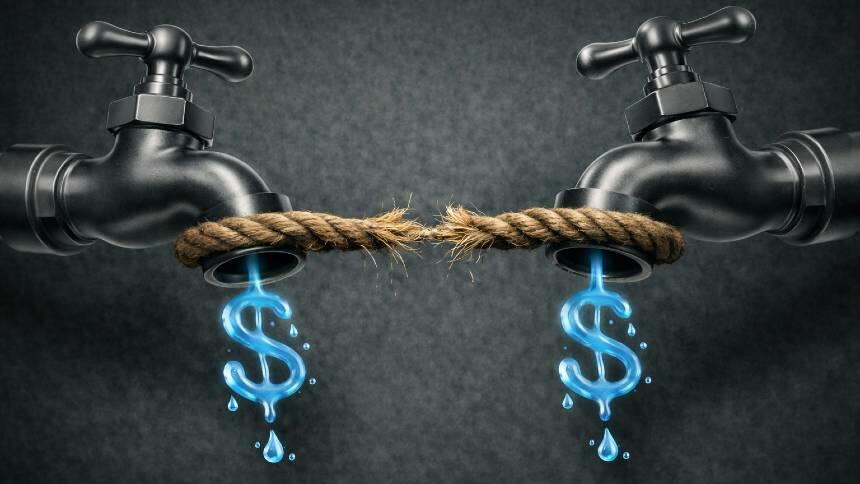
Brasilia - The water and sewage bills for millions of Brazilians could become more expensive in 2027. And it's not due to a lack of investment, but to excessive legislation.
A tug-of-war between concessionary companies and the National Congress, fueled by bills that alter tariffs and the arrival of tax reform, is creating a zone of legal uncertainty that puts pressure on the balance of concession contracts in the sanitation sector.
The pressure comes from two simultaneous fronts. On one hand, there's the tax reform, which comes into effect in 2027 and is expected to increase the tax burden on companies in the sector by an average of 18%. Currently, basic sanitation companies are only subject to PIS and Cofins, that is, a rate of 9.25%. After the tax reform, they will start paying the new CBS and IBS taxes, which incorporate ICMS and ISS and can reach 28%.
The second front involves a series of bills currently being processed in Congress. They aim to eliminate or reduce fees charged for services, affecting the revenues already projected by the companies when they signed the concession contracts.
According to lawyers and industry entities consulted by NeoFeed , the result is a situation of lower projected revenue and higher taxes to pay (contracts will need to be rebalanced). In the end, consumers tend to pay more for their water bill.
The most pressing case is being processed in the Chamber of Deputies. A bill presented by Congressman Carlos Jordy (PL-RJ) changes the way water rates are calculated in condominiums with multiple units that use a single water meter.
The proposal stipulates that the tariff be calculated by dividing the total consumption by the number of units and eliminates the so-called "minimum tariff" - currently charged to each resident. The Chamber has already approved the urgency of the project, and the rapporteur, Deputy Kim Kataguiri (Missão-SP), states that he intends to bring it to a vote next week.
In his report, Kataguiri redesigned the proposal to replace the minimum tariff with a lower basic fee, following recommendations already adopted by the National Water and Sanitation Agency (ANA). The difference is that, if approved, the new model would become mandatory by law — with a two-year period for companies to adapt.
"The report doesn't address the tax issue. Our discussion is about infrastructure payments. It doesn't increase costs; it's a redesign of the system so that those who don't pay will start paying," Kataguiri told NeoFeed .
"I will propose it to the leaders at the next board meeting and try to get it voted on next week. So far, no party has disagreed, and I haven't been approached by any company," he added.
The rapporteur himself admits that the current model is more favorable to companies, but argues that it generates "socially unfair effects." By charging for volume not necessarily consumed, the minimum tariff can "penalize low-consumption users, such as lower-income families or people living alone, and encourage waste, since the marginal cost of consumption up to the franchise limit is zero," the report says.
The sector disagrees. "This worries us, because when you commit to the investment, you count on that revenue. If that changes, you have to financially rebalance the contract," says Felipe Cascaes, Legal and Legislative Director of the Brazilian Association of Sanitation Companies (Abcon). "If the revenue is not achieved, the cost has to be redistributed. If this project goes through, it will indeed generate a tariff increase for the whole of society."
Jordy's bill is just the most urgent. Abcon has mapped at least five bills under consideration in both houses that alter the tariff structure of the sector — among them a proposal that establishes a social water tariff for micro-entrepreneurs and religious temples.
Industry reaction
Given this scenario, the sector is organizing in Brasília. The main focus is to push for the approval of a proposed constitutional amendment (PEC) by Senator Eduardo Gomes (MDB-TO) that equates sanitation services with healthcare services within the tax reform—reducing the impact of the new system on tariffs. The opposition's PEC needs to be approved this year so that companies can calculate their requests for contractual rebalancing in a timely manner.
"People are going to pay a higher bill next year. And all of this affects companies' cost centers," says Cascaes. "We are trying to convince Congress and the Executive branch to show that the adjustment needs to be made."
The fear is that both the tax reform and the draft laws will compromise the progress made in the sanitation legal framework, approved in 2020, which encouraged the entry of private capital. From 2019 to 2025, the number of municipalities with private participation in the sector jumped from 291 to 1,820 – a growth of 525%. In 2024, the sector hit a record for investments, with R$ 29.1 billion invested.
"Any project that alters the tariff structure triggers an alert in the sector. Our concern is interfering with what is already underway," says Cascaes.
It is in the legal field that the scenario becomes more complex - and where the risk of passing the cost on to the consumer becomes more evident.
Lawyer Bruna Brites, a partner at Andrade Maia Advogados, explains that many concession contracts and public-private partnerships were structured under the logic of current tax legislation. With the reform and potential tariff changes approved by Congress, these contracts will need to be reviewed—and the timeframe is short.
"These contracts will have to be adjusted, and the concessionaires will have to rush to restore the balance, taking the CBS into account," she says. "If these contracts are not rebalanced by the end of this year, there will be a pass-through to water tariffs."
For Daniela Poli Vlavianos, partner at Poli Advogados e Associados, the problem goes beyond immediate rebalancing. Legislative changes that modify the remuneration logic of concessionaires could increase the perception of regulatory risk for national and foreign investors — precisely in a sector that still needs strong private investment to meet the universalization goals of the legal framework.
"Infrastructure investors analyze regulatory stability, long-term returns, and the ability to renegotiate contracts. Any sign of legislative unpredictability tends to increase financing costs and reduce competitiveness in new auctions," he emphasizes.
The sanitation framework established the goal of universalizing access to water (99%) and sewage (90%) by 2033. In the view of companies, the legal uncertainty that is now arising could jeopardize the progress that took years to build.
"Next year is likely to mark the beginning of an intense discussion about reconciling tax reform, contractual balance, and affordable tariffs for essential public services," says Vlavianos.