

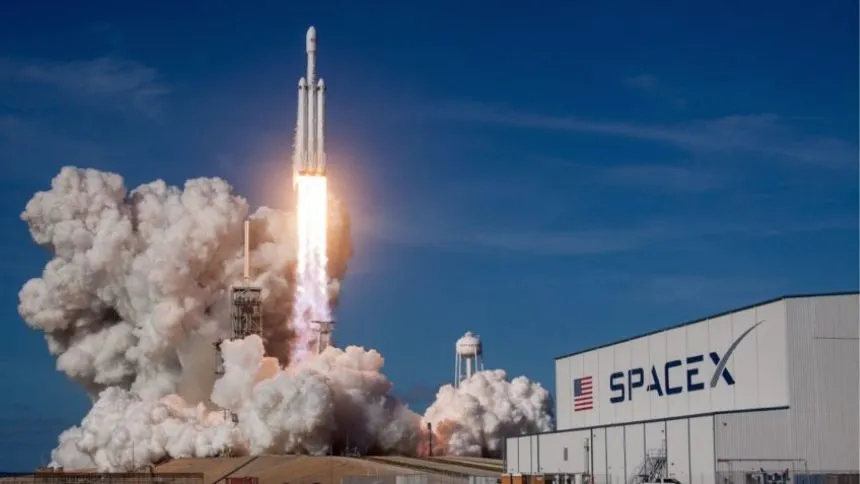
SpaceX , the rocket manufacturer led by Elon Musk , has been shaking up the market with preparations for its IPO , one of the most anticipated of 2026 and with the potential to be the largest initial public offering in history.
Whether this milestone will be reached, only time will tell. But there are already those who are projecting the company's performance in the capital markets after its listing. And who, in this process, foresee the effects, for better or for worse, of its association with the billionaire.
This is the case of Franco Granda, an analyst at the consulting firm Pitchbook, which specializes in data from private companies, who published an extensive 84-page report on SpaceX, in which he makes some comparisons between the company and Tesla , another Musk company traded on the stock exchange.
“SpaceX will perform similarly to Tesla, only turbocharged,” writes Granda. “The combination of lower liquidity, early-stage technologies, and concentrated exposure to Musk suggests volatility that exceeds Tesla’s historically turbulent patterns.”
At the same time, Granda notes that Musk's dual role as CEO creates a correlation between the two companies, amplifying volatility in both directions. And that negative news about Tesla, such as production delays and political controversies, will put pressure on SpaceX's stock.
Conversely, Granda points out that positive catalysts from the automaker could boost SpaceX by mere association. "SpaceX investors can't diversify Musk's specific risk by avoiding Tesla. They are exposed to its entire ecosystem," he states.
The analyst points out, however, that many investors have learned to deal with Musk's optimistic narratives and interpret the deadlines set by the billionaire, in what he calls the billionaire's "credibility balance." And that this lesson will likely be applicable in the case of SpaceX.
“Investors navigating the Tesla market understand the strategy: maintain conviction during dips, apply two- to three-fold discounts to management's projection timeline, focus on directional progress rather than quarterly precision, and accept volatility as the price of asymmetric opportunity,” Granda points out.
He cites, for example, Tesla's promise to produce 5,000 units per week by the end of 2017. In his words, after "failing miserably" due to a "production hell," the goal was only met in mid-2018.
"The stocks fluctuated violently – falling 40% during periods of low production and then soaring 150% as production volume increased," the analyst writes.
Granda notes that SpaceX has experienced similar delays before. Among them, the development of the Starship rocket, which faced several setbacks. Another example cited was the deadline set – and not met – by Musk to send an unmanned mission to Mars.
Weighing the pros and cons of this partnership, the understanding is that SpaceX shares will likely also benefit from the so-called "Musk premium," which helped Tesla keep its shares high even with the sharp decline in its main business, electric cars.
In this context, taking into account the last 12 months, during which Tesla's performance in the segment was significantly challenged, the company's shares have registered a cumulative increase of more than 50%, giving the company a market value of US$ 1.51 trillion.
However, there are also those who point to the risks of Musk's companies becoming overly dependent on the billionaire's image. In its annual report, Tesla itself warned that its shares could suffer a sharp drop if he had to sell his stake in the company.
Aside from these issues, Granda, from Pitchbook, projects that SpaceX will be able to reach revenues of US$150 billion by 2040, in addition to an adjusted profit of US$95 billion. In 2025, the company reported revenues of US$16 billion and profits of US$8 billion.
The analyst estimates that around US$42 billion of the projected revenue for 2040 could come from Starlink, SpaceX's satellite internet service. According to Granda, this operation will be the engine of the company's cash flow.
He did not include xAI , however, the artificial intelligence company that is also part of Musk's portfolio. And which, in February, merged with the rocket company, but is still operating at a loss.
According to the analyst, xAI's financial contribution will be incremental in the first few years after the merger. He points out, however, that artificial intelligence companies at this stage already achieve significant multiples. And he adds:
"The synergies between SpaceX's infrastructure and xAI's computational ambitions reinforce a platform proposition that competitors have deemed virtually impossible to replicate."