


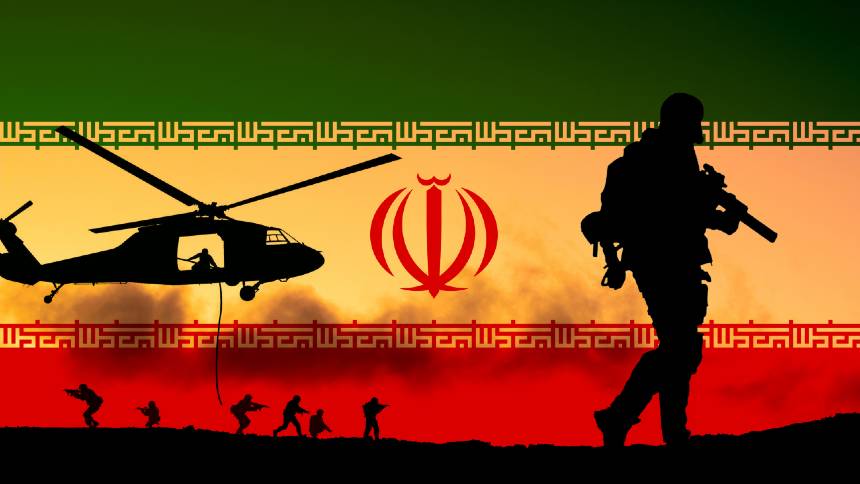

The military offensive launched by the United States and Israel against Iran goes far beyond nuclear containment. The central and most difficult objective is to provoke regime change in Tehran, directly targeting the top of the Iranian power structure.
For Ian Bremmer, president of the Eurasia Group, this is an ambitious strategy with a high degree of uncertainty. “Destroying facilities is one thing. Toppling a regime from the air is something else entirely,” Bremmer stated in a video (watch below).
The difficulty lies in the fact that the Iranian political system does not depend solely on individual figures. Even with leaders dead or incapacitated, the regime can quickly reorganize. "Eliminating the leadership does not mean eliminating the power structure," said Bremmer.
According to the president of Eurasia, the Islamic Revolutionary Guard Corps, a central pillar of the Iranian state, remains a force capable of maintaining internal control, administering the country, and absorbing losses in command. “Regime change is the most difficult objective there is,” said Bremmer. “And when it fails, the cost is usually high.”
Recent history shows that regime change wars without ground troops rarely produce quick or stable results. In the Iranian case, the challenge is even greater. The country has entrenched repressive institutions, robust internal intelligence networks, and a long history of surviving under external pressure.
“The regime may lose people, but it doesn’t automatically lose its ability to govern,” Bremmer stated. “Without territorial occupation, there is no guarantee of institutional collapse. On the contrary: external pressure can reinforce the internal cohesion of the security apparatus and legitimize harsher repressions.”
This is the weakest point in the American strategy, according to Bremmer. The bet is that the combination of military attacks, intelligence operations, and surgical actions against leaders will generate a political implosion. But there is no clear evidence that this will be enough.
While regime change is divisive, the attack on the Iranian nuclear program enjoys broader consensus. According to Bremmer, "almost no one in the international system wants to see Iran with a nuclear weapon."
Even after previous conflicts, Tehran continued expanding its program, hindered the work of international inspectors, and ignored UN Security Council resolutions.
The destruction of nuclear facilities is therefore seen as a defensible objective by the international community. European countries, as well as Canada and Australia, have expressed support for the US in this regard. The problem is that the exclusive focus on nuclear weapons does not explain the scale of the current offensive.
From a military standpoint, Iran has little room to directly escalate the conflict. Its navy is limited, its radar systems have been degraded, and its missile stockpile tends to deplete quickly. "The Iranians have more capacity to cause disruption than to win a war," Bremmer stated.
Alternatives include indirect actions: temporary closure of the Strait of Hormuz, attacks by allied groups such as the Houthis, or sabotage of regional energy infrastructure.
These measures could put pressure on the oil market, but they would be difficult to sustain and would likely escalate the conflict. "It's a reaction driven more by desperation than by real force," said Bremmer.
Another key element, according to Bremmer, is the essentially unilateral nature of the American decision. Unlike Iraq and Afghanistan, there is no broad international coalition. The offensive was designed by Washington, in coordination with Israel, without significant consultation with European allies.
In Bremmer's view, the decision reflected a shift in the internal process within the US. Sectors opposed to escalation were gradually sidelined, and the president opted to act with a reduced decision-making circle. "The US is using its military power without seeking collective legitimacy," he stated.
Beyond Iran, the conflict exposes a broader risk: the use of American military power for political objectives. In previous interventions, such as in Venezuela, the targets were more limited. In Iran, the ambition is greater, the terrain is more unstable, and the consequences are unpredictable.
The result is a scenario of high instability, where destruction is immediate, but the political outcome remains uncertain. And it is precisely in this gap between military power and political control that the greatest risk of the American gamble on Iran lies.