

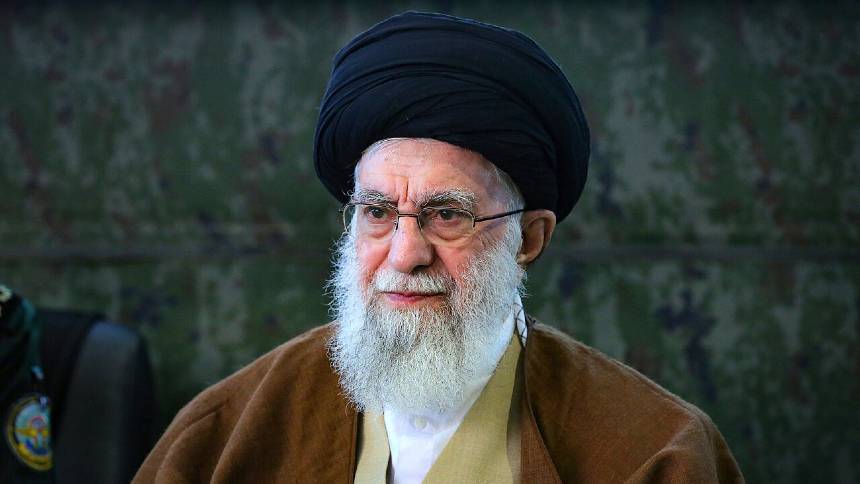

At 86 years old, Ayatollah Ali Khamenei is today the axis around which the Islamic Republic of Iran revolves. In office since 1989, he is not only the de facto head of state: he is the final arbiter of all the country's strategic decisions, with direct control over the Armed Forces, the nuclear program, foreign policy, and intelligence services.
This is a power that goes beyond traditional politics. The Iranian system is structured on the principle of velayat-e faqih – the “guardianship of the Islamic jurist” – which grants the supreme leader almost unquestionable religious and political authority, equivalent to a “pope” of Shiism, with influence that extends beyond the borders of Iran.
Khamenei, the target of US attacks this Saturday, February 28, and who, according to Iran's Foreign Minister Abbas Araghchi, is alive, was one of the central figures in the 1979 revolution that overthrew Shah Mohammad Reza Pahlavi and ended the US-backed monarchy.
Since then, Khamenei has navigated four decades of sanctions, regional conflicts, nuclear negotiations, and recurring waves of internal protests—always opting for harsh repression when the regime has felt threatened.
Throughout this period, he consolidated a power structure based on the loyalty of the Revolutionary Guard Corps (IRGC) and the Basij paramilitary forces, which function as the regime's life insurance. These groups guarantee Khamenei's political survival in the face of economic crises, international isolation, and popular uprisings.
This time, however, Khamenei faces a wave of protests that has eroded his power and whose main trigger is a severe economic crisis, marked by the devaluation of the rial by about 50% in just six months and by annual inflation of around 40%.
The sanctions imposed by the United States since withdrawing from the nuclear agreement in 2018 have stifled the Iranian economy, isolating the country from the international financial system and preventing regular access to foreign currencies.
As a result, the state lost effective control over its own currency and foreign exchange reserves, and began operating through a parallel financial system accessible only to groups linked to the regime.
Despite Iran possessing enormous oil reserves and being one of the largest producers in OPEC, this wealth does not translate into well-being for the population.
The economy is functioning in a distorted way. Most citizens face food shortages, rationing of water, electricity and fuel, in addition to wages eroded by inflation.
Members of the regime, however, benefit from subsidies, smuggling, and corruption, especially in the energy market. Food prices exceed family incomes, forcing reduced consumption and depleting savings.
This economic collapse has affected all social classes, including traditional merchants of Tehran's Grand Bazaar, historically allied with the regime, giving the protests an unprecedented dimension.
Unlike previous uprisings, the current demonstrations brought together the poor, the middle class, young people, the elderly, and different ethnic groups, reflecting the widespread perception that the Iranian economy has reached its breaking point and that the regime has lost the ability to govern the country and guarantee minimum living conditions for the population.