



The Ministry of Ports and Airports (MPor) has decided to put aside the problems with indigenous communities in the Amazon, which in February threatened to jeopardize the General Plan for Waterway Concessions even before the initiative was implemented.
Even under pressure from the election year calendar, the ministry is resuming institutional steps to enable, as soon as possible, the auctions aimed at granting concessions for two waterways located far from the Amazon and with more advanced planning – the Paraguay Waterway, in the Central-West Region, and the Lagoa Mirim Waterway, in the South Region.
This is what the Secretary of Waterways of the Ministry of Planning, Otto Luiz Burlier, reveals in an interview with NeoFeed . "We understand that the concession of waterways is a public policy that is here to stay," he says, regarding the waterway concession plan – the last large-scale transport mode in the infrastructure sector to be integrated into the current government's concession policy.
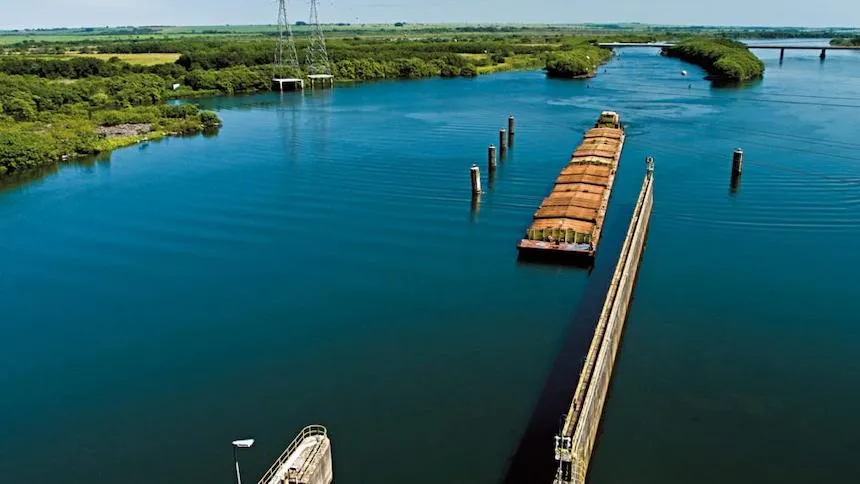
Brazil has 42,000 kilometers of navigable waterways, of which approximately 19,000 kilometers are economically viable – meaning that ships and barges use them to transport grains, liquid bulk and fuels; vehicles; fertilizers; containers and general cargo.
The goal of waterway concessions is to triple the capacity of rivers in an economically viable way. Currently, highways account for 62.2% of the total cargo transported in the country, while 27% circulates on railways and only 4.3% passes through waterways, according to a study by the Dom Cabral Foundation.
“As has already happened with other modes of transport, the first steps to enable new concessions are always more difficult, because everything new generates resistance and questioning,” says the secretary, referring to the pressure from indigenous leaders, who organized an invasion of an area linked to the Cargill terminal in Santarém (PA), interrupting the progress of concessions for the Madeira, Tapajós and Tocantins waterways.
In a controversial decision criticized by the productive sector, the federal government, through the Civil House, decided to revoke the decree that included three Amazon waterways in the National Privatization Program (PND) after the incident.
According to Burlier, the ministry decided to act in two directions. One of them was to adopt a conciliatory approach to the criticism from indigenous communities and environmental NGOs regarding the Amazon waterways.
“There is a great lack of information about how the Amazon waterways will operate; there is no such thing as 'privatization of the rivers,' as many claim, but we will discuss with them the prioritization of operational solutions, paying attention to environmental demands, focusing on maintaining draft and signage, avoiding large-scale works to deepen the channel and straighten it,” reveals Burlier, implying that the government is open to receiving suggestions.
The aim of the document is to demonstrate the benefits of the concession. In the case of the Madeira waterway, for example, it foresees charging a modest fee for transporting large loads - R$ 1.50 per ton - with a projected reduction in freight costs of 24%.
"The magic is that, with the concession, the winner will have predictability for more than 20 years to offer a range of services, including security, in addition to being exempt from charges for passenger transport," he says.
On another front, the Ministry of Planning, Budget and Development (MPor) intends to accelerate the schedule for waterway concessions, advancing wherever possible. In this respect, the processes to organize the auction of the Paraguay Waterways and the Lagoa Mirim (RS) waterway are leading the way.
Burlier explains that the most technically advanced project is the Paraguay Waterway , with studies completed at the beginning of last year, consultations and hearings in the first half of the year, and the process submitted to the Federal Court of Accounts (TCU) in October. "This waterway involves stretches in Brazil, Bolivia, and Paraguay, requiring a tripartite agreement," he says.
Therefore, a meeting is scheduled in Brasília in early May to advance the draft, with the intention of obtaining approval in the Parliaments of the three countries in the second half of the year and resuming negotiations with the TCU (Brazilian Federal Court of Accounts) after that.
The estimated investment for the concession auction of the Paraguay River Waterway is R$ 63.8 million for the first years of the contract. The project aims to improve navigability, including dredging and signage, covering a stretch of approximately 600 km between Corumbá (MS) and the mouth of the Apa River.
“There is a possibility that we will publish the tender notice this year, despite it being an election year,” the secretary continued, emphasizing that occasional delays in the process would be normal. “It is necessary to ensure governance and technical security; this is a 25-year concession.”
Innovative modeling
The other project under consideration, the Lagoa Mirim Waterway , still has to meet a series of requirements, including a public consultation scheduled for this month or early May, followed by the consolidation of contributions and submission to the TCU (Brazilian Federal Court of Accounts).
The chosen model, however, is innovative. "The idea is to integrate the waterway concession auction into a single bidding process that would include those for the access channels to the ports of Rio Grande, Pelotas, and Porto Alegre," says Burlier, adding that the bidding notice may even be released this year, but the auction is unlikely to take place within the same period, given the sequence of steps.
The project is part of an integrated system that connects Lagoa Mirim, the São Gonçalo Canal, Lagoa dos Patos, and the ports of Rio Grande, Pelotas, and Porto Alegre. In practice, it functions as a single logistics route, including a link between Brazil and Uruguay.
“By concentrating the concession of the waterway and port access channels into a single package, we intend to capture synergies between waterways and ports and improve viability,” he reveals. “Most of the dredging investments are concentrated in Rio Grande, and integration with the waterway improves operations and planning, strengthening the logistical competitiveness of the South.”
The final figures will be detailed in the public consultation. However, the ministry estimates a total investment of R$ 134 million, with R$ 90.5 million earmarked for works on the Lagoa Mirim Waterway concession. The operating cost over 25 years is R$ 5.7 billion, with estimated project revenue in the range of R$ 7.5 billion. The projected grain movement is 1.7 million tons in year 10 and 2.1 million tons in the final year of the concession.
A recent study by the Global Real Estate & Infrastructure Institute (GRI Institute), a think tank focused on infrastructure projects, shows that logistics costs consume 15.5% of Brazil's GDP annually, with more than half of that total corresponding to transportation. The study proposes a series of strategic actions to make waterways viable.
"Despite Brazil's vast network of rivers, this privilege is not synonymous with a network of ready-made waterways," says an excerpt from the report. "Furthermore, a large part of the waterways do not connect to the sea, and those that do often do not have the necessary draft for the navigation of large vessels," it adds, emphasizing the need for significant investments for the implementation of works (mainly dredging and connection to other modes of transport).
According to the study, investment financing can be made possible through various sources, such as the Climate Fund, the Merchant Marine Fund – whose contributions extend to inland navigation and waterway infrastructure projects – and mixed financing models, that is, a combination of public, development or philanthropic resources and private capital to finance projects with social impact, prioritizing, for example, waterways with greater potential for mitigating carbon emissions.
“Additionally, part of the resources from the privatization of Eletrobras, according to Law 14.182/20219, are earmarked for investment in improving the navigability of the Madeira and Tocantins Rivers, amounting to R$ 2.95 billion over ten years, and should be considered,” the study suggests. “The implementation of emblematic pilot projects for PPPs and concessions in this area can help demonstrate their viability and unlock other initiatives.”