


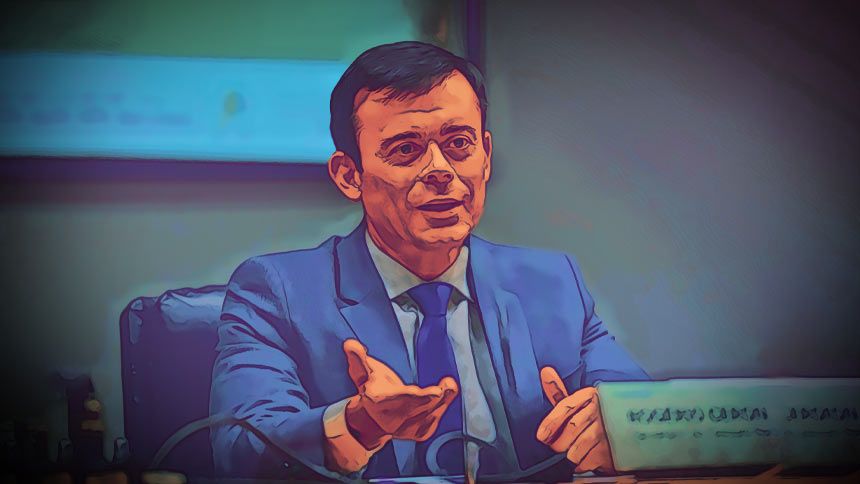

A likely candidate to assume the executive secretary position at the Ministry of Finance, the current National Treasury Secretary, Rogério Ceron, advocates adjustments to the fiscal framework, launched in August 2023 by the federal government, to accelerate the process of reducing spending. In his view, it's a matter of "tightening the screws."
Today, fiscal rules stipulate that expenses can only increase by 70% of the real variation in revenues, with limits of 0.6% to 2.5% per year. And it is on these points that Ceron believes it is necessary to focus for the next cycle, which he sees starting in 2027, in a likely scenario of re-election of President Luiz Inácio Lula da Silva.
“Today, expenses can only grow by 70% of revenues. For the next cycle, we can set a limit of 60%, or even 50%, to ensure a faster recovery of the fiscal situation and stabilize the debt trajectory sooner,” says the secretary, in an exclusive interview with NeoFeed .
He spoke after the awards ceremony for the Direct Treasury Financial Education Olympics (Olitef), an initiative promoted by the National Treasury and B3, in São Paulo.
According to Ceron, the new global level of interest rates indicates the need to change some parameters of the fiscal program. He argues that, given this global scenario, it is important to accelerate the pace of the pursuit of a surplus in order to ensure that the debt trajectory stabilizes more quickly.
“The medium- and long-term interest rates in the United States, for example, are at a much higher level than last year. This affects all economies, including Brazil's. And it needs to be evaluated,” he says.
In the secretary's view, the analysis, echoed in Faria Lima, that Brazil spends too much and invests too little is incorrect. He believes it is necessary to recognize the importance of income transfers in the country.
"For some people, income transfers make no difference, but for others, it's the difference between having food or not. We need to have a balanced perspective," he says.
The secretary also expressed his opposition to possible compensation for companies resulting from the likely reduction of the 6x1 work schedule. "Since slavery, there has never been any kind of compensation for a right that belongs to the worker. It makes no sense to grant compensation so that the company provides a decent work schedule. This right is a worker's achievement."
Regarding the possibility of becoming the number 2 in the Ministry of Finance, with the hypothesis that Dario Durigan, the current executive secretary of the Ministry, would assume Haddad's position, Ceron has adopted a sober tone, without hiding that he is willing to join the new team.
“I have been performing my work at the Treasury with great seriousness for over three years and I am available to help. The Minister of Finance and the President of the Republic know they can count on me. And it is up to them to assess where I can best contribute.”
Read below the main excerpts from the interview:
With the election period approaching, discussions have resurfaced regarding the lack of effective progress on the fiscal framework, which has failed to guarantee a balance in controlling spending. What is your view on this debate?
This discussion has already evolved. These issues have been arising since last year, but there's no point in discussing very radical models and changes. I've always maintained that Brazil cannot withstand very abrupt movements. It's better to stay firm on one path, even if it means trying to accelerate the process, than to make major shifts. What the country needs is to continue the fiscal recovery process, as has been happening, but it needs more. It's necessary to maintain the essence of the framework.
But doesn't this debate raise the need to discuss possible changes to the framework?
Brazil shouldn't waste time discussing the essence of the framework, but rather the possibility of changing parameters, especially regarding the year-on-year growth rate limit. Several parameters can be adjusted. Expenditure items that are not currently within the framework's dynamics could be included. And the economic debate is shifting in this direction, which I consider healthier.
And what would these framework adjustments look like?
Minister Fernando Haddad has always said that it is a medium- and long-term model. And it can be adjusted with each government cycle. The spending limit, which currently varies from 0.6% real growth to 2.5%, could change. It could be set at 2% or 1.5%. Currently, expenses can only grow by 70% of revenues. For the next cycle, we could set it at 60%, or even 50%, to ensure a faster recovery of the fiscal situation and stabilize the debt trajectory sooner.
"Brazil should not waste time discussing the essence of the framework, but rather the possibility of changing parameters, especially regarding the year-on-year growth rate limit."
Furthermore, what are the main topics of discussion within the government?
What has changed now compared to when we launched the framework [August 2023] is that global interest rates have risen. This affects everyone, including Brazil. Back then, it was at a different level. And if this upward trend becomes more permanent, we may need to accelerate the process to prevent the debt from growing too much.
What does it mean, in practice, to accelerate this process?
The recovery process. We are trying to recover the primary surplus. It has always been in deficit over the last decade, and now it's almost zero. Now we need to generate a surplus. This is a gradual process year by year. Perhaps we need to start generating a surplus faster to ensure that the debt trajectory stabilizes more quickly. The medium and long-term interest rates in the United States, for example, are at a much higher level than last year. This affects all economies, including Brazil's. And it needs to be evaluated. These adjustments are necessary for the next cycle.
Should we tighten our fiscal belts even further?
It's a matter of calibration. Brazil doesn't need any kind of chainsaw. It's more a matter of screwdriver work, tightening screws. And correcting some issues. The Continuous Benefit Payment (BPC), for example, may be operating at an exaggerated level, so some care is needed with this expense. We need to go down this path. In this way, the country can withstand the pressure and still guarantee the results that have already been achieved, such as economic growth, low unemployment, full employment, and low inflation. We need to maintain this and recover what is lacking.
The prevailing discourse on Faria Lima, and replicated mainly by bankers, is that spending is seen as "death" and investment as "life."
It's important to remember that the majority of federal government spending is on income transfers, for health, education, and social assistance. This saves lives. Of course, care must be taken to avoid excess and to maintain efficiency. Spending on education is an investment that transforms the next generation. Of course, public investment is very important. I am also a proponent of that.
But what is the challenge?
The challenge for the next cycle, from a fiscal point of view, is to continue recovering the primary surplus, but to ensure that mandatory spending grows less. This will create room for investment. But I don't agree with this kind of jargon. For some people, income transfers make no difference, but for others, it's the difference between having food or not. We need a balanced perspective.
And is the government succeeding in achieving this result?
We've already made great progress. We've achieved the best primary surplus in a decade, far superior to what happened under any other government. The level of public spending as a percentage of GDP is one of the lowest in 10 years. And we're guaranteeing economic growth, growth in family income, and full employment. Brazil has never experienced this with low inflation. It's a good balance. Do we want to go back to high inflation and slow growth? It's already possible to do that and continue with fiscal recovery.