

In just eight days, the $20 billion bailout of Argentina – announced last week by US President Donald Trump – has turned into an embarrassing political crisis in the United States .
On Friday, October 17th, Trump's stated objective of helping a staunch US ally, Argentine President Javier Milei , fell by the wayside amidst a torrent of criticism from all sides.
One of them, from the Democratic opposition, warned that lending money to another country is an aberration while American public employees are not receiving salaries because of the shutdown , the lack of agreement on the Budget in Congress that paralyzed the US public service.
Economists are already questioning Trump's "gift" to Argentina, a country facing currency instability and with a history of defaulting on its debts. American farmers are also complaining, recalling that they just lost the Chinese soybean market to the Argentinians, whose government waived export tariffs, lowering the price of the commodity.
Even Treasury Secretary Scott Bessent , a former hedge fund manager with a history of investing against other countries' currencies, was caught in the crossfire, becoming the target of suspicions that he facilitated aid to the Argentine currency driven by the interests of friendly investors in the South American country.
Trump's first announcement, on October 8, was initially seen as a typical move to show political support for Milei – a staunch US ally facing a currency crisis that has been draining the country's international reserves and threatening the gains of his economic reform.
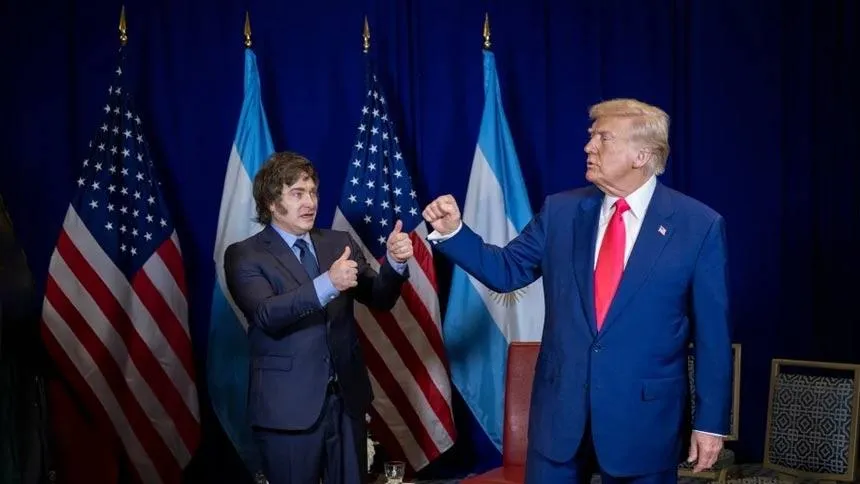
Upon receiving Milei at the White House on Tuesday, October 14, Trump reinforced that the objective was to support the Argentine currency with the aid – a $20 billion swap line with the Argentine central bank, in practice a loan, through which the US Treasury will exchange dollars for pesos.
"We just want to see Argentina do well," Trump said, standing next to his Argentine counterpart. "We are helping a great philosophy to dominate a great country, we want Milei to succeed."
The political tone adopted by the American president is explained by the delicate moment Milei is going through. Her government has been accumulating successive setbacks, including a defeat in the election in the Province of Buenos Aires – the most populous and influential in the country – amidst a corruption scandal involving her sister, Karina Milei, and a currency crisis, a weak point of her government.
Weakened on the eve of the strategic midterm election next week, October 26, Milei seized upon Trump's support to try and turn the tide. But the American president, already under pressure from domestic criticism of the generous stimulus package, warned at the same meeting that if Milei loses the election, the US will stop helping him.
Bessent Factor
Bessent's surprising announcement the following day, that the US is considering further aid to Argentina, financed by private banks and sovereign wealth funds, angered the opposition.
“It’s inexplicable that President Trump is supporting a foreign government while he paralyzes our own,” said Democratic Senator Elizabeth Warren, citing the more than 1 million federal employees who are furloughed or working without pay.
Discontent with the White House's support for the South American country worsened on Thursday, the 16th, when Bessent confirmed on social media that Argentina's bailout is progressing in two main ways. In addition to the $20 billion currency swap agreement, Bessent also stated that the government "directly" purchased an undisclosed amount of Argentine pesos.
The announcement alarmed economists. It is only the fourth time since 1996 that the United States has purchased currency from another country, according to the Federal Reserve Bank of New York.
“The Treasury’s decision to offer a swap in Argentina is really a sign that Washington is willing to use its financial tools for political purposes in ways that depart from past norms,” wrote Heidi Crebo-Rediker, former chief economist at the State Department, and Douglas Rediker, former U.S. representative to the International Monetary Fund, in an article in the British newspaper Financial Times .
According to them, the bailout of Argentina is not urgent and is happening at a difficult time, which does not justify Trump using billions of American taxpayer dollars just to support one of his personal allies.
Also noteworthy was the method used to transfer the money to the Argentinians – the Exchange Stabilization Fund, which holds dollars, foreign currency, and IMF assets controlled by the US Treasury Department. The Treasury Secretary has broad discretion to decide how to use this fund, which at the end of August had a net balance of approximately US$43 billion – slightly more than half of what will be transferred to Argentina.
"Spending that money in Argentina was practically the riskiest use imaginable of the Exchange Rate Stabilization Fund," says Brad Setser, a former Treasury official and now a consultant.
The White House claims it tried to sell the aid as a gamble with a financial return. At the heart of the strategy is the undervaluation of the Argentine currency — a debt-ridden country whose economy has already required more than 20 international financial bailouts.
If the move succeeds and the peso recovers, the United States could profit by acquiring pesos that would eventually be worth more and gaining access on favorable terms to Argentina's natural resources, which would be the real reasons behind the operation. If it fails, however, the US risks subsidizing yet another failed bailout for a country that has already defaulted nine times in the international financial community.
Friends in the crosshairs
Bessent also came under fire from critics because of Argentina's ties with some of his former colleagues in the financial world.
Rob Citrone, a billionaire who previously worked with Bessent, has substantial investments in Latin America and Argentina, according to documents from the SEC, the U.S. Securities and Exchange Commission. Billionaire Stanley Druckenmiller—a longtime friend of Bessent—publicly stated that he invested in Argentina after Milei's election.
The Treasury Secretary, however, denied last week that the agreement had any connection with his finance colleagues, stating that "the cliché that we are helping rich Americans with interest rates there couldn't be further from the truth."
The fact is, given his track record, it sounds strange for Bessent to support a bailout operation against a currency as vulnerable as the Argentine peso. As one of the major investors in liberal philanthropist George Soros in the 1990s, Bessent made a splash with a $10 billion bet on the overvaluation of the British pound.
This bet helped "break" the Bank of England with devastating operations against the pound. In 2013, Bessent raised $1 billion for Soros' fund with a gigantic bet against the Japanese yen.
Now, in an unconventional and unprecedented move, Bessent is betting billions of American taxpayer dollars on another type of currency gamble.
"The fact is that Trump and Bessent are putting their reputations at risk, especially Bessent," warns Martin Mühleisen, a former IMF official.