

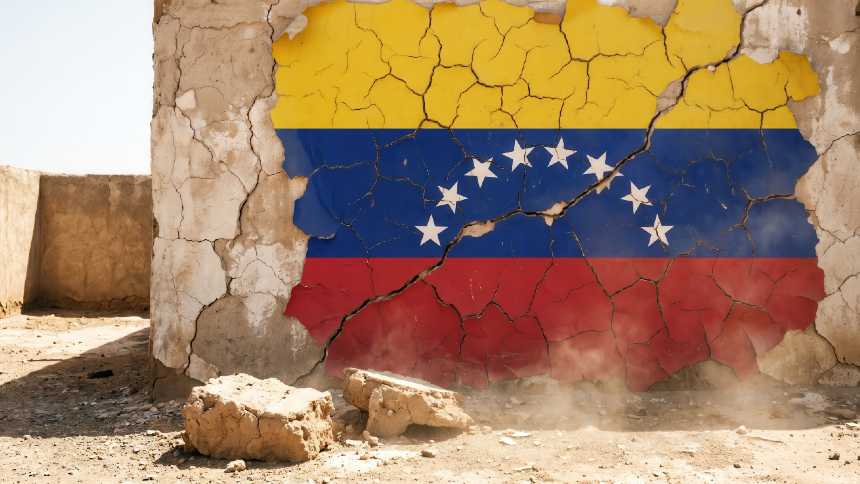
A day after registering two earthquakes in sequence, one measuring 7.2 and the other 7.5 on the Richter scale, Venezuela plunged into a new period of social and economic chaos on Thursday, June 25, with more than 30 aftershocks and a desperate search for survivors in several destroyed buildings in the capital, Caracas.
The number of casualties, initially announced at 165 dead and more than a thousand wounded, is expected to rise in the coming days, adding a tragic element to the economic situation in Venezuela, which is undergoing a turbulent reconstruction process after the ouster of President Nicolás Maduro following a US intervention in January of this year.
The destruction caused by the tremors – the largest in the country in 60 years – including disruptions in communications and damage to the country's main international airport, comes at a delicate time. The Venezuelan government is in negotiations with the International Monetary Fund (IMF) to restructure its public debt, estimated at US$240 billion.
If confirmed, this amount would constitute the largest sovereign debt restructuring in history – surpassing that of Greece, which was around US$200 billion in 2012 during the eurozone crisis.
Interim President Delcy Rodríguez announced on Thursday, the 25th, the creation of special funds for the comprehensive reconstruction of the affected territories and for assisting the victims. This initial funding includes an allocation of US$200 million from the country's assets at the IMF , which will be immediately redirected to the construction of public infrastructure, optimization of the health network, and the construction of new housing.
To finance reconstruction and balance the debt, Venezuela will need to significantly increase its oil production, which began to decline during the populist government of Hugo Chávez (who ruled the country from 1999 until his death in 2013) and literally hit rock bottom during the Maduro era.
Even though the country boasts the world's largest oil reserves (around 303 billion barrels), Venezuela maintains an exploration rate of 1.2 million barrels per day, far below the 3 million barrels per day of the golden age of PDVSA , the state-owned oil company that was gradually dismantled by Chavismo.
During Maduro's time in power alone, the country's economy shrank by 80%, about a quarter of the population emigrated, and those who remained struggle to survive, with more than 85% of Venezuelans living in poverty. In 2019, the country faced hyperinflation of 65,000% annually (today it is around 520% for the 12 months ending in May 2026).
Following the American intervention in January, investments in oil resumed, especially after the recent reform of the Organic Hydrocarbons Act, which allowed the renegotiation of agreements with major energy companies such as Chevron, Repsol, BP, Shell, Eni, Hunt Overseas Oil Company, and Crossover Energy Holding. This is in addition to other important investment agreements with General Electric.
Increased production
This week, the Central Bank of Venezuela announced that national revenues from oil exports reached US$5.491 billion in the first quarter of the year, a 21% increase compared to the same period in 2025.
Economic projections before the earthquakes indicated GDP growth of 15.2% in 2026, with oil GDP increasing by 20.8% and non-oil GDP by 13.9% - these superlative numbers are misleading, as they reflect a recovery after years of collapse.
The interim president intends to maintain the trajectory of oil production growth defined by the Ministry of Hydrocarbons and PDVSA, of 1.4 million barrels per day until the end of this year.
The good news is that oil giant Chevron has stated that its operations in Venezuela remain operational and that all its employees have been located following the consecutive earthquakes that struck the country.
“As a long-standing employer and partner in Venezuela, we express our solidarity with the country and its people during this difficult time,” the company said in a statement released on Thursday, the 25th. “We remain committed to supporting our employees and the communities surrounding our facilities, as well as ensuring the safe and continued operation of our assets.”
Venezuela's main refining center, near the epicenter of the earthquake in Paraguaná, and the export terminal in Anzoátegui are operating normally, with no impact on oil processing or loading.
It remains to be seen how much the renegotiation of Venezuela's sovereign debt will impact the resumption of investments in PDVSA's deteriorated infrastructure. This is because, within this renegotiation package, government and PDVSA bonds account for the largest share, around US$60 billion, in addition to approximately US$40 billion in post-default interest.
Furthermore, Venezuela owes between US$30 billion and US$50 billion to oil companies and creditors for unpaid invoices, in addition to more than US$20 billion in court-ordered compensation awarded to companies after Hugo Chávez's regime expropriated their properties.
The end of the stalemate in the Strait of Hormuz, blocked by Iran during the conflict with the US and recently reopened, is expected to increase the financial drain on PDVSA, which had been fattening its coffers with the increase in the price of a barrel of oil during the conflict, which fluctuated around US$100 in the last four months.
This week, with the agreement reached between the US and Iran, the price of a barrel of oil returned to the pre-war average of US$70. It is in this difficult scenario, amidst the devastation caused by the earthquake and the loss of revenue due to the fall in the price of oil, that Venezuela will have to renegotiate its gross debt with the IMF.