

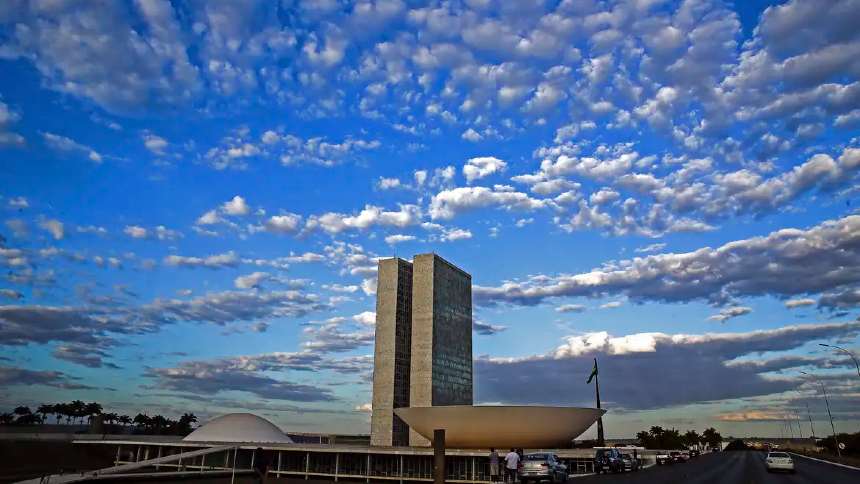
Although the international economic agenda includes relevant data such as inflation and fiscal policy performance in the US in July, as well as the quarterly GDP result for the Eurozone, the domestic political scenario tends to expand with the National Congress rolling up its sleeves.
The Chamber of Deputies and the Senate, which were supposed to resume work on August 3rd after the recess, will return to work on Monday the 10th. They will then begin a "concentrated effort" that is expected to extend until Friday the 14th. A second phase will take place between August 31st and September 3rd – exactly one month before the first round of voting in the mega-election .
Given the tight schedule the three branches of government have in the countdown to the election, the government needs to negotiate the agenda to be implemented in Congress. This includes voting on approximately 87 presidential vetoes that are blocking the agenda, and no fewer than 32 provisional measures, according to the Senate Agency .
And despite uncertain results, the government's priorities are widely known. Leading the pack is the dismantling of the 6x1 work schedule in the labor market , which reduces the workweek from 44 to 40 hours without a reduction in wages. Although it was a key campaign promise of Lula's, Senate President Davi Alcolumbre anticipates a vote on it after the election.
Also relevant is the new "Desenrola Brasil" program, outlined in a provisional measure that expires on August 31st, which stipulates that individuals with a monthly income of up to R$ 8,105 will be able to refinance debts of up to R$ 15,000 per bank with a maximum interest rate of 1.99% per month. The "Desenrola Adimplentes" program is awaiting a joint committee to begin discussions.
Considered extremely important in Lula's path to a fourth term, the Public Security Amendment promises to be challenging. It is currently in the Senate in a version different from the one submitted by the government.
The text approved by the Chamber redefines funding sources for the sector and includes the allocation of part of the revenue from sports betting to national security and prison system funds. Also removed from the text by the Chamber was the reduction of the age of criminal responsibility from 18 to 16 years for crimes involving violence or serious threats to a person.
Increasing the revenue ceiling for Individual Microentrepreneurs also depends on Congress. This is also true for revising the revenue brackets of the Simples Nacional (Simplified National Tax System); another round of the Sovereign Brazil Plan, which provides R$ 18.5 billion in credit for exporters and strategic sectors affected by Trump's tariff hikes and/or harmed by armed conflicts; and the renegotiation of debts for rural producers.
Still pending are measures regarding freight and passenger transport and financing lines for the purchase of vehicles by taxi drivers and app-based drivers . In the institutional field, the proposal for the financial autonomy of the Central Bank remains stalled, as does Lula's nomination of individuals to fill two positions on the institution's board and a Supreme Court Justice to fill the vacancy left by Luís Roberto Barroso's retirement.
Also in the voting "queue" is the 2027 Budget Guidelines Law (LDO) project, which guides the formulation of next year's budget, the Annual Budget Law (LOA), which must reach Congress by August 31st and – then – provide clearer information about Lula's objectives for the first year of his new administration, if he is re-elected.
Official speech
Despite the always relevant minutes of the Monetary Policy Committee (Copom), the release of July's inflation figures, and the volume of services provided and retail sales in June, respectively, on Tuesday, Wednesday, and Thursday, August 11, 12, and 13, the week will have an essentially political character, culminating in the launch of President Lula's campaign for a fourth term.
On Sunday the 16th, two weeks after the official announcement of his candidacy at the PT convention, the campaign launch will take place at the Vila Euclides Stadium in São Bernardo do Campo, Lula's political birthplace.
The event is generating anticipation for the announcement of the main lines of the economic program of the future government if Lula is re-elected , which, according to Faria Lima, will reinforce the commitment to fiscal austerity – a confirmation unlikely, however, on an occasion that should be festive, grand, and essentially pro-PT (Workers' Party) in Brazil.
Finance Minister Dario Durigan , chosen as the president's spokesperson on the outlook for economic policy, has already given and repeated a spoiler – both publicly and privately – by suggesting a reduction in the growth limit for public spending embedded in the current fiscal framework from 2.5% to 1.5% per year.
Banks and consultancies "buy into" the official narrative, while acknowledging that the future belongs to God. And just in case, they continue to raise projections of fiscal deficit and public debt relative to GDP – a condition cited as Brazil's greatest vulnerability in the eyes of investors.
In contrast, projections for economic growth remain in decline, despite the Selic rate falling for the fourth consecutive time to 14% on Wednesday, August 5th, at the end of the Copom meeting.
The widely expected result renewed bets on another interest rate cut in September, although the Committee made no indication of this in its statement released after the meeting. The Copom will continue to evaluate the data.
However, if additional elements regarding future decisions are in the pipeline, on Tuesday the 11th, they will be included in the Copom minutes – an instrument that can calibrate new bets on the pace of ongoing monetary easing. Why? The inflation scenario is more benign due to the fall in food prices and international oil prices being less sensitive to Donald Trump's diatribes .
Following a more favorable inflation trend – in the wake of July's IPCA-15 with a contained variation of 0.06% – the IPCA may decline slightly in the month and reach 4.48% over 12 months, compared to 4.52% in the previous reading. Therefore, it remains close to the upper limit of the 4.5% target. This is a resistance point to be broken downwards, but there is an "El Niño" event ahead .