


It was August 23, 1987. That Sunday would go down in the history of world basketball. Around 16,000 fans packed the Market Square Arena in Indianapolis to watch the Pan American Games final: United States against Brazil. The Americans were confident of victory. Absolute favorites, they had never lost at home, nor been defeated in a decisive game.
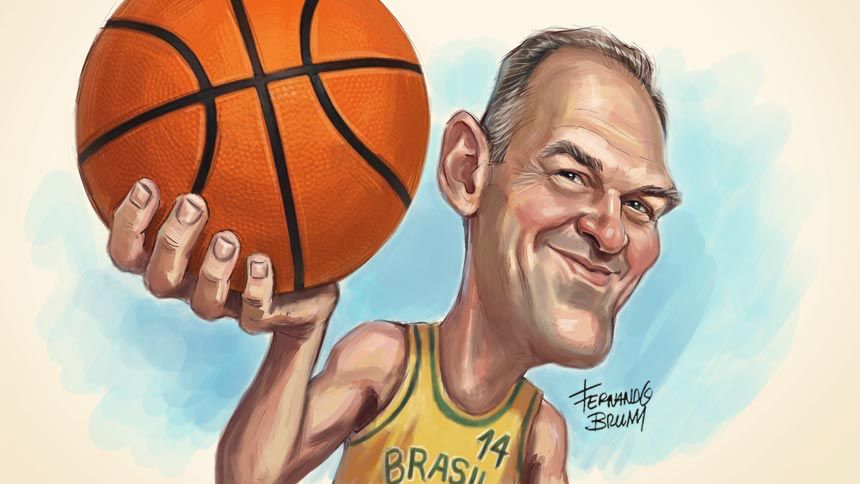
But they failed. They suffered an unforgettable setback because we Brazilians had Oscar Schmidt — the Holy Hand — wearing the number 14 jersey, his lucky number.
The American team started strong. Led by David Robinson, still a promising player, they showed their strength in the paint and finished the first half with a 14-point lead — 68 to 54. In the second half, the Brazilians took a while to get going, but once they did… ah, then it was a scoring fest.
At that time, the three-point line was still a novelty, adopted five years earlier. And it was there that Oscar shone. While he scored only 11 points in the first half, in the second he hit no fewer than six three-pointers. Brazil won 120-115, with 46 points scored by Oscar — 21 of them from long range.
Before the game, Denny Crum, the American coach, didn't seem too worried about the match against Brazil. Later, however, he would reveal that the only tactic to guarantee the gold was a defense against Oscar and Marcel — two players, according to him, who were very highly accurate in their shots.
Our rivals tried, but no one could compete. That medal was ours.
That Sunday in Indianapolis was transformative for Americans as well — “an offensive display that many will never forget,” reads the USA Basketball website. The defeat was the trigger for a series of changes in American basketball. There, the leaders realized that it was necessary to strengthen the national team to avoid further embarrassments. College players were replaced by professional athletes — a move that would later culminate in the formation of the Dream Team.
For Brazilians, August 23, 1987, represented the greatest achievement since the 1970 World Cup. The victory at Market Square Arena served as proof for us and the world: yes, Brazil was also the country of basketball.
Thus, with the memory of a time when Brazilian sport still inspired pride, the country bid farewell to Oscar on Friday, April 17th. At 68 years old, the athlete died from a brain tumor, diagnosed in 2011.
Born in Natal on February 16, 1958, he was a tenacious competitor, a compulsive shooter. After morning practice, he would make 500 shots. In the afternoon, another 500. Oscar challenged himself to make at least 20 consecutive baskets. If he couldn't, he would start all over again. Once, it took him two hours to complete the self-imposed mission. At home, he had to explain to his family why he was late for dinner.
It's no coincidence that Oscar was also a record collector. He had the longest career in world basketball, 26 years. The highest scorer in history, with 49,973 points, until 2024, when he was surpassed by LeBron James. One of the 50 best players on the planet, according to the list compiled by the International Basketball Federation in 1991. The best basketball player who never played in the NBA.
In fact, in the 1980s, he received an invitation to join the American league, but he refused. At that time, athletes from that organization were prohibited from competing in the Olympics—and Oscar would never give up competing wearing the Brazilian national team jersey.
Speaking of the Olympics, he remains the all-time leading scorer in the games—he participated in five editions, totaling 1,093 points.
Standing at 2.05 meters tall and possessing impressive baskets, Oscar won fans among the biggest names in world basketball. Kobe Bryant, for example, admired the Brazilian's ability to score from anywhere on the court.
And his name is inscribed in at least three halls of fame. In 2010, he was inducted into the FIBA hall of fame and, ten years ago, into the Italian hall of fame.
But it was in the United States that Oscar, already ill, gave an emotional and humorous speech (watch the video): "I always dreamed of being here." He thanked his family, coaches, and players he had worked with. He recalled the 1987 Pan American Games and joked with the American audience: "Excuse me."
In the 1990s, when athletes were being called upon to fill public positions, Oscar entered politics as a federal deputy for São Paulo, representing the then PPB (now Progressistas). Elected between 1999 and 2003, his main focus was the development of sports in Brazil. But he became disillusioned with Brasília—the bureaucracy, the backroom deals, the backroom agreements… that environment wasn't for him. The place for "Holy Hand" (Oscar 's nickname) was always the court. And on the court, the further the basket, the better.