


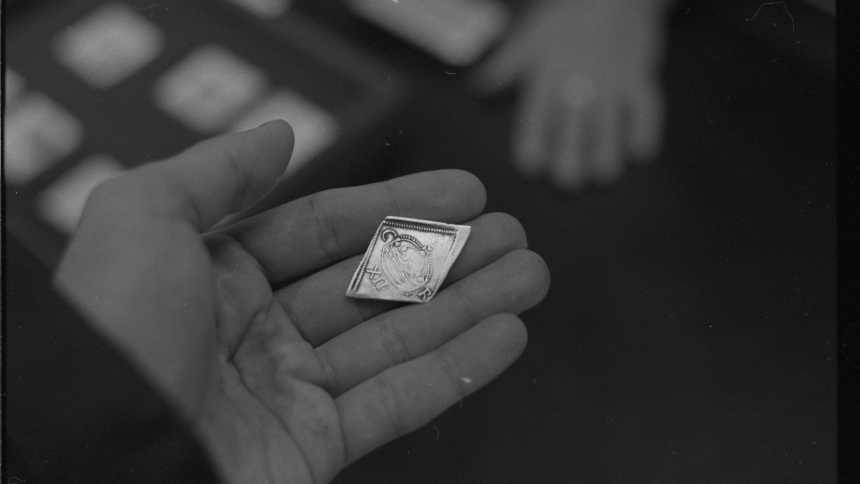
On March 20, 2023, artist Ilê Sartuzi visited the British Museum in London for the first time. In the numismatics room, he watched an educator handle coins in front of the public and tell their stories. “I thought of the ' cups and balls ' trick, a kind of trickster figure. And also of Bosch's painting The Conjurer . That's when it occurred to me: I should do a magic trick and steal a coin from the British Museum,” he told NeoFeed .
At the time, Sartuzi was pursuing a master's degree at Goldsmiths, University of London, and had been reflecting on how the collections of many European museums were formed: objects brought from other countries, often in contexts of colonization, plunder, or political asymmetry. This reflection led him to conceive Sleight of Hand , a performance recorded at the British Museum, which is part of the exhibition Truque , on display at the Museum of Contemporary Art of the University of São Paulo (USP) until June 15.
The stunt involved replacing the only British coin on display at the museum at the time with a replica made by the artist, in a staged theft. He left the original in the institution's donation box.
“I spent a year preparing: I consulted lawyers, researched legal loopholes, and wrote a narrative to legally support the action. The consultancy helped me navigate British law so that the action remained within the bounds of legality,” says Sartuzi. “I understood that being cunning means not getting screwed.”
The provocation, according to him, lies not only in the exchange of currency, but in what it reveals about the system. “There is an interpretation of the legislation as historical acts of violence,” he states. “The British case is no exception. The British Museum Act of 1963 prevents stolen museum artifacts from being returned to their countries of origin. Therefore, there is a process of legitimizing looting as a tool for the foundation of 'universal museums' like the institution in question.”
By leaving the original piece in the museum's donation box, the gesture was not intended as an act of reparation. "It's more about a gesture that brings back the problems the institution has to confront," he says. And, as if by magic, the object never left the stage—it only changed places on the same stage.
Born in Santos, on the coast of São Paulo, 29-year-old Sartuzi works in various artistic fields, from sculptural objects and video projections to installations and theatrical pieces. And the critique embedded in Truque echoes a broader debate about the presence of colonial collections in European and North American museums.
In recent years, the issue of repatriation has gained international visibility. Pressured by governments and public opinion, museums in Europe and the United States have begun returning items acquired in colonial contexts or contexts of profound power inequality.
When to preserve means to let something decompose.
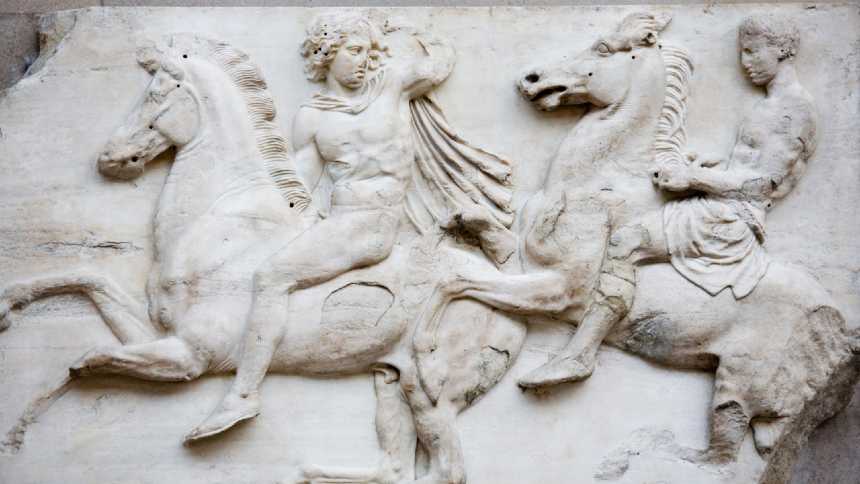
One of the most famous cases involves the Parthenon Marbles , a collection of sculptures taken to London by Thomas Bruce, Lord Elgin, in the early 19th century, when Greece was under British rule. The pieces remain in the British Museum to this day.
“Many of these museums claim that they are better able to preserve, protect, and properly display the objects they have acquired over time,” explains Fernanda Pitta, a professor at USP, to NeoFeed . But she points out that the British Museum itself was at the center of a recent scandal when an employee was accused of stealing pieces and selling them online. “This case dismantles the argument that these institutions are better prepared to care for this heritage,” she says.
Repatriation can also occur within the same country. Since the 1980s, Brazilian museums have been returning objects to indigenous peoples. Pitta cites, for example, the return of a small axe from the Krahô people, which was in the collection of the Museum of Archaeology and Ethnography at USP (University of São Paulo).
For her, this type of process needs to go beyond symbolic gestures: “Often, indigenous peoples don’t just want the object back, but continuous access to it. This requires museums to have lasting relationships that meet the real demands of the communities.”
More than an end, Pitta says, repatriation can be the beginning of connections. "There are many studies showing that the return of objects can open avenues for deeper dialogue—in the United States, in South America, in various places."
The debate is leading museums to rethink fundamental notions. "The responsibility for the collection, from the point of view of the original communities, goes far beyond — and sometimes even contradicts — the conventional criteria of what should be preserved, cared for, or kept intact," he states.
While institutions follow the logic of immobility—do not touch, do not alter—for many peoples, conservation means transforming, using, returning to nature. An example is the totem pole of the Haisla people of Canada, which was returned by the Stockholm Museum of Ethnography.
After more than 70 years in Sweden, the artifact returned to the community. A replica was carved by local artisans to remain in the Swedish museum. The original was left outdoors in the community's territory to decompose, according to Haisla tradition.
“For these people, preservation meant leaving the totem outdoors to decompose. That was the most authentic gesture of respect and remembrance,” Pitta explains.
In Brazil, cannons
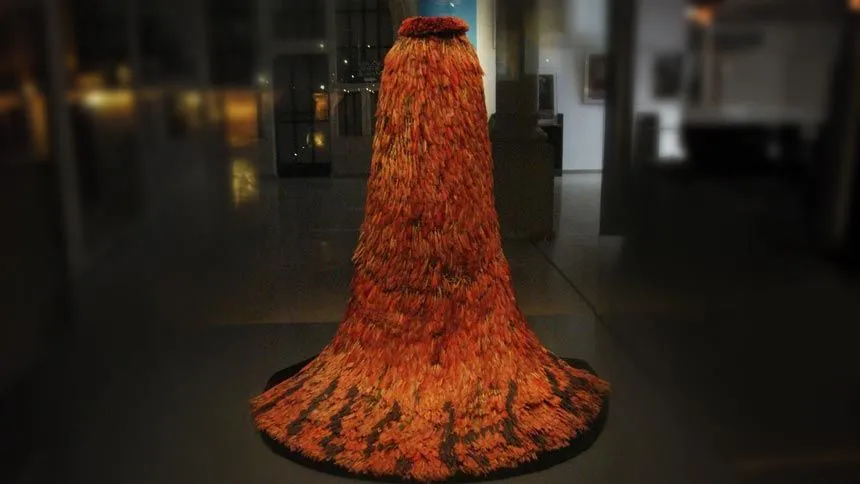
One of the most emblematic Brazilian cases of repatriation is that of one of the four Tupinambá cloaks, which had been under the care of the National Museum of Denmark, the Nationalmuseet, since the 17th century. For at least 20 years, the Tupinambá people had been demanding access to these cloaks.
This same piece, which was in Copenhagen, was part of the Rediscovery: Brazil +500 exhibition in São Paulo in 2000. It was the first time the Tupinambá had seen the piece up close.
“It was a mobilization for the mantle, but also for the recognition of our people and the demarcation of the territory,” Glicéria Tupinambá, artist and researcher, recalls to NeoFeed .
The struggle surrounding the artifact was essential in leading Funai to officially recognize the existence of the people in 2002, who were previously considered officially extinct.
While the repatriation was being negotiated, the Nationalmuseet invited Glicéria to visit the museum. Upon seeing the knot that tied the feathers together, the signature of those who make the cloaks, on the back of the pieces, she had no doubt: “I recognized those who still know how to weave that way: my aunts, my 95-year-old grandmother. I call this cosmotechnics.”
While observing the specimens, Glicéria “heard” which ones should return. “Some have to go back, others can stay — but all need care. They are ritualized pieces, with a spirit,” she explains. Those that return to Brazil should be displayed at the National Museum in Rio de Janeiro, which is scheduled to reopen in 2026.
Glicéria's research in Europe revealed that the cloaks were not looted, but taken as diplomatic gifts. “They mark the Tupinambá presence in Europe. There was dialogue with authorities. In Brazil, the cannons remained. And what was most precious went there: the cloaks made 400 years ago.”
For her, the debate about repatriation needs to go beyond physical return. “It is necessary to avoid erasing the Tupinambá presence in Europe. It’s not about erasing history, but about accessing it based on what we know. Much of the information in the archives about other peoples is wrong. Access to museums is essential to correct this as well.”
According to Glicéria, the true value of these pieces lies in the recognition of the knowledge and existence of the Tupinambá people. "Why would I take a historical piece, which requires so much technical care, if my community doesn't have the resources to maintain a proper museum? We don't even have demarcated land," she argues.
Through her interaction with the artifacts, the researcher was able to create new cloaks, reviving an ancient tradition of her people.