


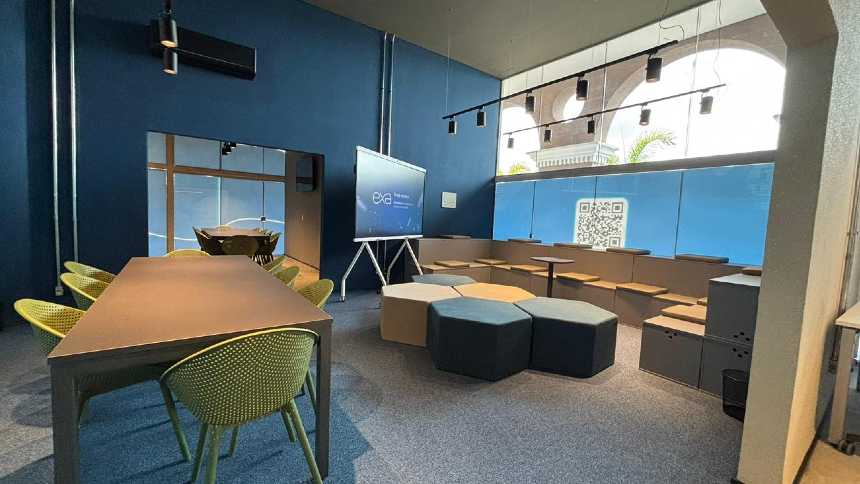
Born from a joint venture between FS Security , a cybersecurity holding company, and TIM , EXA was founded in 2022 and, in the same year, established one of its branches in Parnaíba, Piauí . Four years later, it is strengthening its ties with the city of just over 170,000 inhabitants.
The municipality was chosen to house EXA Labs, the company's new R&D center, which aims to be a kind of "Digital Port" in Piauí, in reference to one of the largest technology parks in Brazil, located mainly in the historic Recife neighborhood (Old Recife).
Inaugurated last week, the project will focus on fraud prevention and includes a projected investment of R$ 25 million over the next four years. Beyond the connection between research and professional training, the center operates against the backdrop of advancing threats, driven by artificial intelligence (AI). Similarly, it seeks to develop cutting-edge solutions to combat them, based on this same technology.
“Brazil was already the scene of many scams, but it has entered a more sophisticated wave, where it is often imperceptible what is fake and what is real life,” says Alberto Leite , founder and CEO of FS Security, which controls EXA, with a 75% stake in EXA's operations. The other 25% belongs to TIM.
“Today, you have everything from voice simulations to reverse social engineering,” Leite tells NeoFeed . “And thousands of formats, whether voice, video, text, in addition to multiple delivery channels, which has enhanced the capture of data and context from victims, as well as the cybercriminal's tools.”
Some data illustrates this progress. According to Serasa Experian, the country recorded more than 14 million attempted frauds in 2025, a 28.6% increase over 2024 – in the Northeast, the jump was 32%. AI is already used in 42.5% of these scams, and deepfakes grew by 830% in the span of one year.
In this context, the creation of EXA Labs aligns with a previous initiative by the company, also strongly linked to this technology. For three years, EXA has maintained a laboratory for AI studies in partnership with PUC-Rio.
This project has already borne fruit. The main result is EVA, a fraud prevention agent based on AI and machine learning, which was developed by the EXA team throughout 2025, with the participation of students from the Rio de Janeiro university.
Launched earlier this year, EVA allows users, among other things, to check via WhatsApp whether a QR code, link, or file is fake or not. It also allows users to verify if their passwords have been leaked before. The platform provides responses within ten seconds.
In addition to strengthening EXA's portfolio, the EVA project was one of the factors behind the decision to expand the company's R&D structure, as well as the partnership model established with PUC-Rio students. However, the company understood that it would be more valuable to broaden the horizons of the area.
“We understood that it was necessary to decentralize and seek a new culture, especially because the problems in the Northeast are not necessarily the same as those in Rio de Janeiro,” says Leite. “And Parnaíba has a very good range of universities and a great level of students.”
As part of this package and EXA's four years of experience in the municipality, he emphasizes that the region also has a good range of funding options for research and development, in the form of institutions and bodies such as the Banco do Nordeste (BNB), Sudene and BNDES.
The plan is to use these options to finance approximately R$ 8 million of the R$ 25 million investment planned for EXA Labs. The total figure also gives a good indication of the increased focus on R&D. In the last three years, EXA has invested R$ 9 million in this area.
In this expansion in Parnaíba, starting from EXA Labs, some of the resources already invested are going towards structures such as a real-time fraud monitoring center. The platform is fed by various sources, from incidents on social networks to data collected by the company on the dark web.
“The center is interactive and shows incidents in real time filtered by threat type and region, always through maps,” explains Leite. “We just cut the ribbon on EXA Labs. We are still at the beginning, but the idea is to reach a level of mapping 100% of frauds.”
The next phase of investments will include areas such as expanding the database that will feed the R&D center, as well as evolving EVA, with features such as identifying the origin of threats and providing a step-by-step guide for users to follow if they become victims of an attack.
Leading the way
At the same time, the project also includes the component of training specialized labor for EXA's staff, given the well-known historical gap of professionals in the sector in Brazil, a gap that has been widening with the advancement of technology in various fields, as well as AI.
In this regard, the launch of EXA Labs was accompanied by the signing of agreements with Uninassau and SENAI for internship programs. The number of vacancies is still being determined, and there are also ongoing discussions with other institutions in Piauí, such as UFPI, UESPI, IFPI, Unigrande, and Uninter.
“This process isn’t easy, but when implemented well, as in the case of PUC-Rio, it produces great results,” says Leite. “We’re trying to take this same model to Parnaíba, but we understand that the learning curve there will be steeper.”
As the largest employer in the sector in the state – today, there are more than 200 Exa professionals in the city – Leite says that, with this expansion, the plan is to encourage the arrival of other companies and consolidate the region as a new technology and innovation hub, similar to Porto Digital in Recife (PE).
“We’re still a sort of lone wolf in the region,” he says. “But we’re leading the way and we hope that, in time, others will follow.”
Meanwhile, EXA is counting figures such as the approximately 20 million users who already have one of its digital protection solutions. With this base, the company projects revenues of around R$ 500 million in 2026, a 32% increase over 2025.
Meanwhile, the company also has other plans to expand its R&D area. This time, abroad. The focus is on Israel, a global cybersecurity hub, where the company has been in advanced talks with a university – whose name has not been revealed.
“We started building what would be a collaborative laboratory there,” Leite says. “But this war has hampered those conversations. We'll wait for this peace agreement to improve the situation so we can resume this dialogue.”