



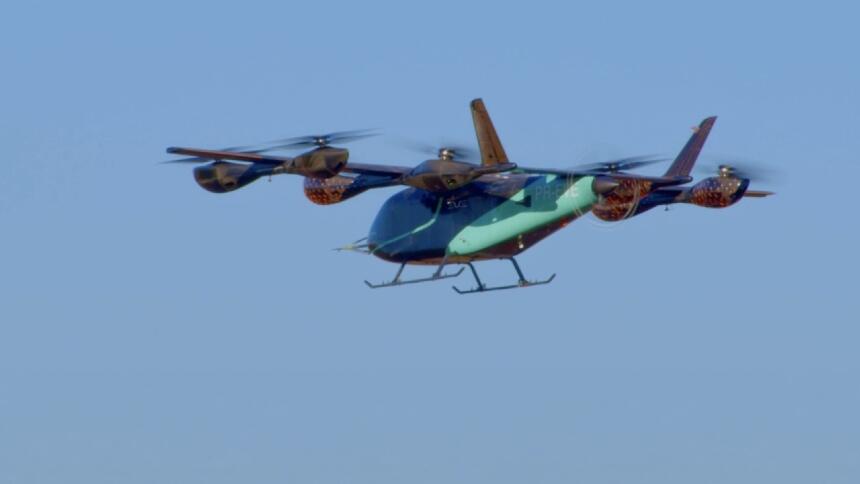
Born from a spin-off of the Brazilian company Embraer , Eve Air Mobility is advancing to another stage in consolidating its position in the still-maturing new space of electric vertical takeoff and landing (eVTOL) aircraft, the so-called "flying cars" .
The company announced on Monday, August 3rd, that its prototype had completed its first transition phase flight, which, in practice, marks the beginning of the transition from vertical to horizontal flight, a process the company considers one of the most critical stages of a project of this scale.
“This first partial transition flight is an important milestone in Eve’s development trajectory,” said Johann Bordais, CEO of Eve , in a statement about the flight, which lasted three minutes and nine seconds and covered approximately 1,500 meters, reaching a height of 27 meters.
“The successful activation of the rear propulsion system validates a fundamental aspect of our aircraft design and brings us ever closer to delivering safe, efficient, and scalable air mobility solutions,” the executive added.
The flight included the activation of the aircraft's rear pusher propeller, and during the journey, the aircraft reached a stabilized speed of 27 knots (50 kilometers per hour) and a maximum speed of 30 knots (55 kilometers per hour), with the propeller operating at up to 1,200 revolutions per minute.
“The data collected will support the continued expansion of the flight envelope as we move towards higher speeds and progressively more complex transition tests,” highlighted Marcelo Basile, engineering director at Eve, in the statement.
According to the company, its flight engineering team continues to conduct structural load analyses to support the future expansion of the flight envelope. Following this, the plan is to carry out tests to, among other things, support operations at speeds of up to 50 knots (92 kilometers per hour).
On the New York Stock Exchange (NYSE), where Eve has been listed since 2022 through a merger with Zanite, a Special Purpose Acquisition Company (SPAC), the shares appear to have gained momentum following the announcement made by the company on Monday.
The shares were up 3.23% around 10:40 AM on the NYSE, trading at $2.39, valuing the company at $834.1 million. However, year-to-date through 2026, the shares have accumulated a 40% depreciation.
The company's shares had already "piggybacked" on the inaugural flight of the prototype flying car in December 2025, in the city of Gavião Peixoto. At that time, the shares also registered an increase on the American stock exchange.
Created in October 2020 from EmbraerX, Embraer's innovation arm, Eve is the Brazilian manufacturer's bet to compete in the nascent eVTOL market with companies like the American companies Joby and Archer.
In this space, in addition to advancing prototype testing, the company has also been gaining traction in its order book, which already includes letters of intent for approximately 2,700 eVTOLs, many of them signed by helicopter operators eyeing this new market.
The most recent agreements in this direction were announced in July and involved 16 eVTOLs with Shearwater Global Capital, an aviation finance company from Bay Point, as well as 30 aircraft with Moov, for the European and Cape Verdean markets.
Meanwhile, Eve Air Mobility has been receiving support from resources financed by BNDES, which, since 2022, has already approved R$ 1.2 billion in credit for the company in different stages of its project's development.