


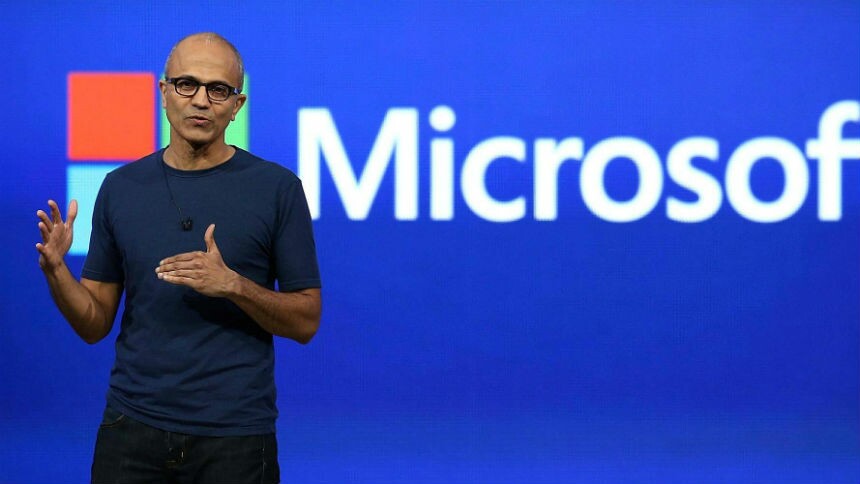
Microsoft was one of the major drivers of generative artificial intelligence in the world. Now, Satya Nadella, the company's CEO, is alarmed by the direction the technology is taking.
In an interview with The Wall Street Journal (WSJ) , the executive harshly criticized the way the race for AI dominance has been developing, commenting that he does not believe in the format where only a small group of companies captures all the value of this market.
Furthermore, Nadella believes that the path being taken carries significant security risks and job losses, as the technology demands almost unlimited resources to continue growing at the expected scale.
“You can’t say, ‘Hey, all white-collar jobs are going to disappear, and this could even become a weapon. So, let’s use all our power to build data centers,’” Nadella stated.
According to him, the next AI boom will be marked by cheaper models and greater user control, as well as political communication capable of winning public trust. "The public will not tolerate only a few models and a few companies doing all the world's learning," says Nadella.
Without mentioning giants like OpenAI , Anthropic , or even Google —companies that have been leading the trillion-dollar race for AI—Nadella stated that Microsoft wants to steer the technology race away from a future dictated by so-called "frontier models," as these market leaders are known.
According to Nadella, AI should be a knowledge-based mechanism that helps companies empower their employees and utilize their data, drawing on a range of models with different prices and capabilities.
In this regard, Microsoft has launched a series of low-cost models in recent weeks that aim to reduce customer spending on AI. Included in this package of new features is Copilot Cowork, an AI agent that allows users to choose between different models, including cheaper options, while performing their tasks.
According to the WSJ, Microsoft is also considering hosting a version of DeepSeek , a major Chinese competitor that offers low costs.
Despite his strong stance, Nadella stated that there is room for all companies to thrive, including new companies that haven't even launched yet. This doesn't mean, however, that Microsoft will stop cultivating its partnerships with OpenAI and Anthropic, which is somewhat controversial.
The executive's change of sides is, to say the least, curious. And it happens at an opportune moment. Numbers from the consulting firm Recon Analytics show that Microsoft has fallen behind in the development of its own AI systems. Since the second half of 2025, Copilot subscribers have increasingly preferred other options, such as Google's Gemini.
Nadella has a clear vision of the future. For him, organizations will be a "continuous learning system," combining human wisdom and AI-generated tokens. In this scenario, protecting intellectual property will be fundamental to preventing businesses from becoming commodities.
“No amount of speech or narrative, by itself, will be enough to resolve this situation, because, at the stage we are at now, we really need to turn words into actions,” Nadella added.