


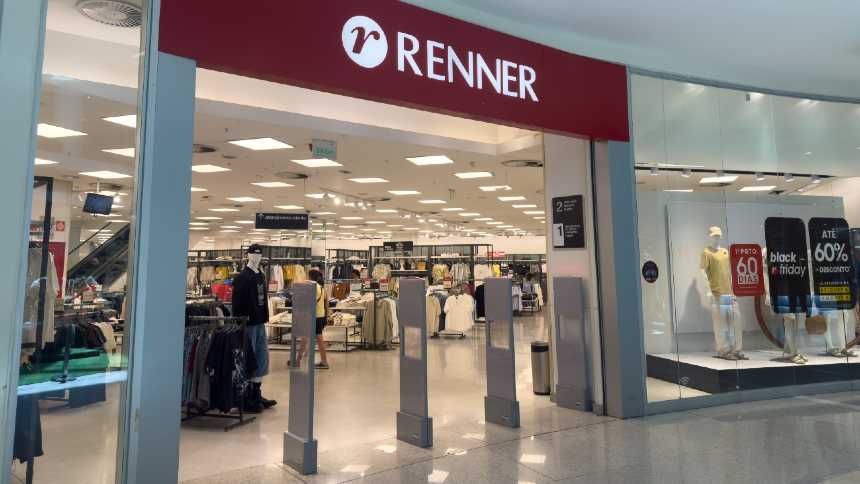
Lojas Renner started 2026 showing that the main lever of its strategy is not, for now, the rate of sales growth, but the profitability of each item sold. In the first quarter, the retailer delivered a record gross margin for the period, reaching 56.7%, 1.6 percentage points higher than the same period last year.
According to Fábio Faccio, CEO of Lojas Renner, a significant portion of this margin gain comes from increased production of items during collections. "When we produce more and more during the collection, with a shorter lead time , we can be much more assertive in what is being demanded at that moment and in the volume that is being demanded," Faccio tells NeoFeed .
The strategy, he says, has reduced surplus and old inventory and increased sales of new products at full price. According to the CEO, this is a gradual process that should continue to add value in the company's upcoming financial statements.
One of the ways Renner hopes to continue increasing its profitability is by diluting expenses. Daniel Santos, the company's CFO, cites the investments already made in logistics. "Our Cabreúva distribution center was built and designed in such a way that it allows the company to grow without the need to increase expenses," he says.
The margin gain was directly reflected in the operating result. Retail EBITDA grew 23.5% to R$487.5 million, with a margin of 17%, an increase of 2.7 percentage points. Net profit reached R$257.3 million, a 16.4% increase year-on-year and a record for a first quarter.
Record profitability, however, came in a quarter of more moderate sales growth. Net retail revenue grew 4.3% to R$2.9 billion, while same-store sales advanced 3.2%.
Although the pace is below the guidance of 9% to 13% annual growth in net retail revenue between 2026 and 2030, Faccio states that the quarter was impacted by the transfer of older e-commerce products between distribution centers, which reduced sales growth by about 1 percentage point.
According to the CEO, the expectation is that revenue will accelerate again to levels closer to guidance in the second half of the year. "Last year, we had a 9.2% increase in revenue, which came from 15% growth in the first half and 4% in the second half, rounding the numbers. This year, our expectation is the opposite," says Faccio.
This quarter, Renner also maintained a more cautious stance in granting credit through Realize, its finance company. The share of its own credit cards in sales fell from 27.7% to 26.7%, reflecting a more selective origination policy. This move limits portfolio growth but preserves credit quality in an environment that remains challenging for consumers.
As a result of greater prudence, the overdue portfolio fell from 21% to 20.8% of the total portfolio, while the share of delays of more than 90 days decreased from 15.2% to 14.9%. "Undoubtedly, when you operate in a more prudent way in the credit plan, it can indeed impact origination," says the CFO.
According to Santos, caution is appropriate for the moment, but it could open the door for the company to take on more risk in the future, should the scenario of default rates and household income compromise improve.
Another factor that could accelerate sales in the second half of the year is the planned store openings at the end of the year. So far, the company has opened eight of the 50 to 60 units promised for 2026. According to Faccio, the concentration of openings in the second half of the year is expected, as the retailer seeks to put the new stores into operation closer to the period of highest traffic.
The decision to accelerate store openings in 2026, after 34 inaugurations in 2025, is part of Renner's strategy to increase proximity to customers and boost conversion, even in a more challenging macroeconomic scenario. "We can't count on the macro improving; we work with what's within our control," says Faccio.