

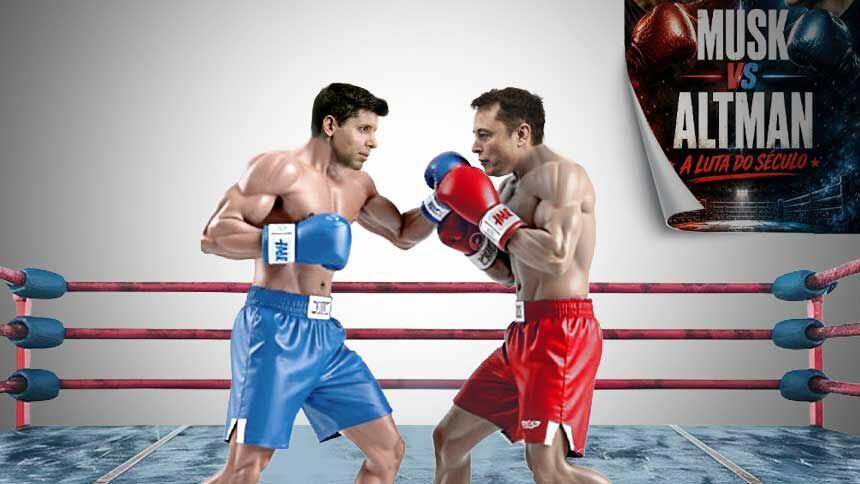
Known for a series of clashes between iconic entrepreneurs who helped shape the sector, the technology market is once again at the center of a major dispute. And this time, it has the potential to be the biggest confrontation in the history of bits, bytes, algorithms, and the like.
This battle began on Monday, April 27th, and promises to drag on for at least another three weeks. The stage is the Federal Court in Oakland, California. And it pits two heavyweights of this industry against each other: Elon Musk and OpenAI , personified in the figure of Sam Altman , its CEO.
One of the founders of OpenAI, alongside Altman, Musk went on the offensive by suing the company and his former partner, alleging a deviation from the original mission of creating an open-source, non-profit artificial intelligence (AI) laboratory focused on ensuring benefits for humanity.
In the lawsuit, he is seeking damages ranging from $134 billion to $180 billion – which would revert to the original foundation – the release of OpenAI's code, and Altman's removal. He is also targeting Microsoft , the company's main investor.
“Actually, I was a fool who gave them free funding to create a for-profit company,” Musk said in court testimony. “I think they’re going to try to complicate this process a lot, but it’s actually very simple. It’s not right to steal from a charity.”
In its defense, among other points, OpenAI refutes Musk's version, emphasizing that he did not oppose plans to create a for-profit arm and had even tried to take control of the operation in that process. Furthermore, it claims that the action was motivated by other, unphilanthropic intentions.
“We are here because Mr. Musk didn’t get what he wanted with OpenAI,” said William Savitt, OpenAI’s lawyer. “Because Mr. Musk is now competing with his own AI company, called xAI . And, being a competitor, he will do everything he can to attack OpenAI.”
The fact is that the cartel of opponents gives an idea of the scale of this imbroglio. The richest man in the world, Musk, owns a fortune of US$673 billion. OpenAI, owner of ChatGPT, one of the symbols of the AI frenzy, is valued at US$852 billion.
Aside from the speeches of both sides, fueled by supposed concerns about the future of AI, the plot behind this dispute is quite complex. And there have been numerous battles that have brought this war to the judicial sphere, as well as provocations exchanged before it even reached the ring.
Below are the eight rounds of this contest that is not yet over:
Round 1 – Musk's investment
"To promote artificial intelligence in the way that is most beneficial to humanity as a whole, without the restriction of the need to generate financial return." In December 2015, these were the words chosen to announce and summarize the objectives of OpenAI.
The operation was launched with the support of a $1 billion funding commitment. This sum would be spearheaded by the initiative's originators, such as Sam Altman, Greg Brockman, and Ilya Sutskever , as well as by figures like Peter Thiel and Reid Hoffman, who contributed substantial amounts to that sum.
Musk, to whom Altman had presented the project seven months earlier, also embraced the idea. Already famous – and with his bank account boosted – by Tesla , he says he was attracted by the proposal to create a counterpoint to Google , which, in his view, had been investing in AI without due precautions, aiming only for profit.
In the Oakland court, he recalled a conversation he allegedly had with Larry Page to illustrate this concern. According to Musk, when asked about the risk of AI wiping out humanity, the Google co-founder reportedly replied that this would be "acceptable," as long as the AI survived.
While Altman and his colleagues had a “hard job,” Musk would show up every two weeks to offer advice.
In an attempt to respond to what he called Page's insane vision, Musk, known for his bravado, has stated on several occasions that he was the largest donor to the OpenAI "cause." However, the imprecision regarding the amounts donated has been a recurring theme in these claims over time.
That hammer was struck, however, in court. In testimony that spanned three days during the first week of the trial, the billionaire admitted that he invested approximately US$38 million in the project. But he was keen to emphasize that his contribution went far beyond that amount.
“I had the idea, the name, I recruited the key people, I taught them everything I know, and I offered the initial funding,” he said. But he stressed that he was manipulated by Altman and his peers. And that, by trusting this team, he didn't read the “fine print” of this association.
This essential participation, in turn, was contested by William Savitt, OpenAI's lawyer. According to him, while Altman and his colleagues had "hard work," Musk would show up every two weeks to give advice and, occasionally, yell at people for not progressing at the right pace.
Round 2 – Musk pulls the car
The trigger for each party to go its own way came in 2017, stemming from discussions about creating a for-profit arm to accelerate the development of OpenAI and compete with Google. That's when the disagreements between Musk and Altman's group came to light.
Contrary to accusations of betrayal by Musk, OpenAI claims that the billionaire not only agreed with this direction but also pushed for it, even proposing a merger with Tesla and his own name to lead the operation.
In internal emails shown in court, the company's lawyers presented a proposal made by Musk in this context, in which he would hold 55% of the shares. Altman and the other partners reportedly refused to "hand over the keys to artificial intelligence to a single person."
In his testimony, Greg Brockman said that, at the height of this power struggle embodied in the duo, Musk even gifted each of the OpenAI co-founders with a Tesla Model 3, according to him, as a way to flatter them and convince them to embrace his proposal.
Musk even went so far as to gift each of the OpenAI co-founders a Tesla Model 3.
With the failure of that venture in 2018, Musk decided to pull the car. Before leaving the OpenAI board, he said that the company's probability of success was zero and that he planned to build a rival company within Tesla.
Round 3 –Musk accuses the hit?
A year later, Microsoft hitched a ride on OpenAI. First, with a check for US$1 billion. And, in subsequent rounds, with investments totaling US$13.8 billion, placing the Redmond giant as the company's largest investor. And in Musk's sights.
Among other jabs at both companies, the billionaire has already said that OpenAI had adopted a similar path to Microsoft, focusing solely on profit, and that it had become a subsidiary of the company led by Satya Nadella – another name that is expected to testify in the case – maximizing its results.
This partnership truly began to bear fruit at the end of 2022, when OpenAI launched ChatGPT and definitively kicked off the AI boom. In less than two months, the tool attracted over 100 million users. And, subsequently, other investors followed.
In total, OpenAI has already raised over US$200 billion from names like Softbank, Amazon, Nvidia, Coatue, and Thrive Capital. And this is another argument the company uses to justify Musk's anger, who allegedly felt cheated by not participating in this hype, thus missing out on further fattening his bank account.
In total, OpenAI has already raised over US$200 billion from names like Softbank, Amazon, Nvidia, Coatue, and Thrive Capital.
True or not, the businessman fulfilled the promise he made when he "missed the boat" and, in a counter-move, in 2023, founded xAI. For OpenAI, by seeking legal action, another of Musk's ideas is to bring Altman's company down and pave the way for his startup.
So far, xAI continues its pursuit of OpenAI, even in terms of the amount of capital raised. Since its inception, the company has attracted just over US$40 billion from investors such as Andreessen Horowitz and Nvidia. And, earlier this year, it was acquired by SpaceX, another name in Musk's portfolio.
Round 4 – Barbs, irony, and threats
While the Oakland court is now at the center of an intense exchange of accusations, the back-and-forth banter dates back much further, whether through statements in interviews or on social media, more precisely, X (formerly Twitter), another company created by Musk and, from the beginning, the entrepreneur's preferred arena.
In 2023, for example, in an interview with CNBC , Musk made an analogy about his relationship with OpenAI. "It would be like you funding an organization to save the Amazon rainforest, and instead it becomes a logging company, cuts down the forest, and sells it for money."
As early as 2025, he made an "unsolicited" offer of US$97.4 billion to buy OpenAI, formalized by his lawyer, Marc Toberoff. This was rejected, with a good dose of irony, by Altman, who resorted to the very same "X" to respond to the offer.
“No, thanks, but we can buy Twitter for $9.74 billion if you want,” Altman tweeted. The amount highlighted in his “proposal” was less than a quarter of the $44 billion Musk paid for the social network in 2022.
Musk took all the praise and accusations against Altman and OpenAI to his favorite arena: X (formerly Twitter).
The response was swift. "Swindler," Musk commented on the post. Then, on April 27th, the date the trial began, he also provoked his rival by calling him "Scam Altman." On more than one occasion, Altman, in turn, simply stated that his rival is not "a happy person."
Musk had adopted a different tone two days earlier, however. In a message sent to Greg Brockman, he proposed an out-of-court settlement to end the case. When his former partner suggested that both parties drop their complaints and raise the white flag, the billionaire retorted:
"By the end of this week, you and Sam will be the most hated men in America. If you insist, it will be so," he wrote.
Round 5 – Brockman's Diary
Co-founder and president of OpenAI, Brockman is, so far, the only representative of the company and "Team Altman" to speak in court – for two days. And, in that participation, one of the references was a personal diary of the entrepreneur, attached to the proceedings.
One of these memories involves the meeting that sealed Musk's split with his other partners. Brockman recounted that Ilya Sutskever, then head of research at OpenAI, had commissioned a painting of a Tesla as a gift to please the entrepreneur during the meeting.
However, when the other partners informed him that they would not accept his proposal to take control of the company, Musk sat silently for several minutes. And, after this pause, according to Brockman, he stood up and walked around the table, coming towards him.
“I thought he was going to hit me. He grabbed the painting and started to storm out of the room in a rage,” the president of OpenAI told the Tech Crunch website. “And then he turned around and said, ‘When are you going to leave OpenAI?’” Six months later, it was Musk who left the company.
"When are you going to leave OpenAI?", co-founder Greg Brockman asked Musk.
"There shouldn't be a single person with total and absolute control over OpenAI," Brockman told the nine-person jury that will help decide the course of this confrontation.
In this context, his diary provides ample material for the jurors. It shows, for example, that he and Altman discussed a plan to remove Musk from the OpenAI board.
“I can’t imagine turning this into a for-profit company without a very ugly fight,” he wrote at the time. “And his (Musk’s) version will be, correctly, that in the end we weren’t honest about still wanting to keep the company for profit, just without him.”
In another passage, during the tough negotiations between the partners, Brockman points out: “This is the only chance we have to get rid of Elon,” and adds, “Is he the leader I would choose? We really have a chance to make this happen. Financially, what would get me $1 billion?”
Brockman said he was reflecting on how satisfied he would be with his professional life. But the excerpt prompted Musk's lawyers to point out that he was more focused on his wealth than on OpenAI – according to the entrepreneur, his stake in the company is worth almost US$30 billion.
“What you really wanted was to be a billionaire, right?” questioned Steve Molo, Musk’s lead lawyer. He also highlighted the fact that Brockman maintains stakes in several companies with which OpenAI has close business ties, such as CoreWeave and Stripe.
Another focus for Molo and his team was Brockman's compensation, which included a stake in Altman's personal investments. An agreement that Musk was unaware of at the time, and which would reinforce Brockman's loyalty to the billionaire's rival.
Brockman countered that OpenAI's mission has always been his main motivation, and remains so to this day. He also took a jab at Musk. "He didn't understand and still doesn't understand AI," he stated. "And we didn't think he would dedicate the necessary time to actually become good at it."
Round 6 – Relationships and revelations
Shivon Zilis, the mother of four of Musk's children – the businessman has, as far as is known, a total of 14 "heirs" with four different women – also saw a significant portion of her private life exposed during the trial.
OpenAI was precisely the link between the two "lovebirds." The couple met at the company, where Zilis joined in 2016 as a volunteer consultant, and where they began their relationship. She also held a seat on the board of directors between 2020 and 2023.
It was at OpenAI that Musk met Shivon Zilis, the mother of four of his 14 children.
During her testimony on Wednesday, May 6, Zilis was questioned, among other things, about whether she passed information to Musk precisely during the period in which she served on the board. And she resorted to the company's mantra. "I had a commitment to the best outcome of AI for humanity," she said.
Other obscure points were explored. Starting with the fact that Zilis, who also worked at Tesla and Neuralink – other Musk companies – had hidden the relationship the two maintained. This only came to light after a series of reports.
In her testimony, she stated that the relationship between the two was platonic and that the children were the result of in vitro fertilization. She also claimed that she initially kept the father's identity secret to protect the children's safety.
Zilis didn't shy away from these attempts to corner her and brought up more details about Musk's marriage to OpenAI. She said, for example, that when he left the company, he was worried about competing with the company for AI talent.
In another passage, she also revealed that, before this animosity defined the relationship, Musk tried to bring Altman, Brockman, and Sutskever to Tesla, where the trio would lead the company's AI efforts. She further confirmed that he proposed making OpenAI a subsidiary of the automaker.
Round 7 – The Judge and the Jury
In other aspects of the case, there are those who aren't particularly fond of those involved. According to The Wall Street Journal , Molo, Musk's lawyer, tried to exclude two jurors who described his client as "trash" and a "first-class idiot."
“The reality is that people don’t like him,” responded Judge Yvonne Gonzales Rogers, who presided over the case and has also been involved in other high-profile disputes, such as Apple versus Epic Games.
“Many people don’t like him. But that doesn’t mean Americans can’t still have integrity in the judicial process,” the judge stated, highlighting the challenge of selecting a jury in high-profile cases.
“Many people don’t like him [Musk]. But that doesn’t mean Americans can’t still have integrity in the judicial process,” said Judge Yvonne Gonzales Rogers.
“I don’t know if I’ll ask (potential jurors) a question about billionaires, since they’re all billionaires and they’re all equally loved or hated,” Rogers said, adding that Musk and Altman’s fortunes, power, and fame won’t guarantee the pair “any special treatment.”
An example of this approach was given when, in a preliminary hearing, OpenAI's lawyers tried to convince it to reject the testimony of C. Paul Wazzan, whose analysis supports Musk's multi-billion dollar compensation claim.
“The jury will understand that (Musk’s expert) is making up these numbers. Do I find it convincing? Not very. Based on what I’ve seen, do I find it particularly persuasive? Not very,” Rogers stated, suggesting that the numbers were “made up.” She did not, however, grant OpenAI’s request.
During Musk's testimony, when he stated that if he lost the case, the country risked "losing all its charities," Rogers interrupted the speech—and the session—to tell the jurors that this was merely the billionaire's opinion, with "no legal value."
Round 8 – far beyond the verdict
In this specific case, in the view of experts, Musk is far from being the favorite to win. But the truth is that, whatever the decision, the verdict will certainly not close the case. And not only because of the appeals process.
On one hand, the result could reshape the balance of power in the artificial intelligence race. And, initially, OpenAI seems to have the most to lose, even if the most plausible outcome for Musk is a victory by points. Or rather, by just a few points.
The most critical scenario for the company would be having to revert to its original structure, which would go against much of the funding it has received, conditioned on its conversion to a for-profit model. And it would substantially reduce its momentum in the AI race, which increasingly demands billions in investments.
In this scenario, the company has already been suffering from increased competition, particularly from the American company Anthropic .
At the same time, the case poses risks for both Musk and Altman and company on another front: the capital markets. The IPOs of SpaceX and OpenAI are among the most anticipated offerings of the year. And any defeats would inevitably be a severe blow to these plans.