


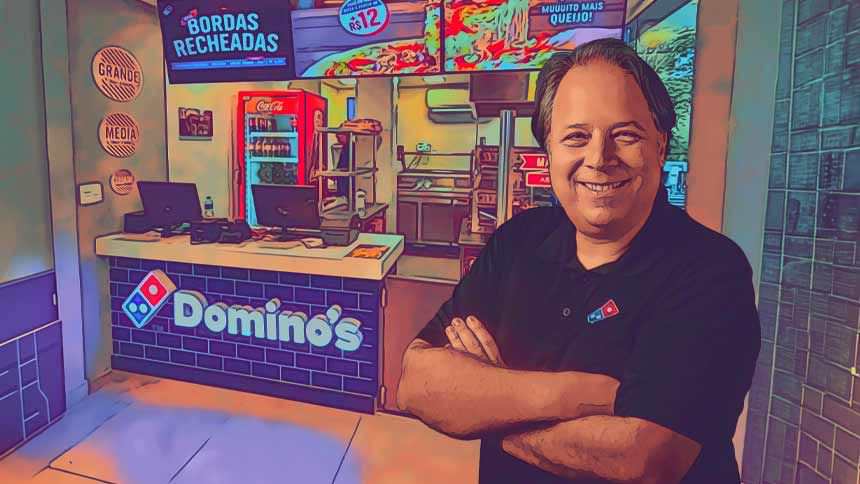

The Domino's pizza chain wants to expand its market share in Brazil. Currently with 220 stores (22 of which are company-owned), the company plans to open another 150 units in three years – reaching a total of 370 – focusing on smaller cities with up to 150,000 inhabitants. At least 35 contracts will be signed and 20 stores opened this year.
Controlled by Vinci Compass, the company achieved revenues of R$ 650 million in 2025. With the new strategy, the goal is to exceed R$ 750 million in revenue in Brazil by the end of the year, which will represent a 15% increase.
The expansion plan also includes reducing the size of physical units. Until 2023, the strategy was to open larger stores, but these represented a high volume of investment. Now, the focus is on ensuring greater profitability for franchisees, starting with units of up to 4.9 square meters (m²), in a kiosk format.
“In the past, opening a Domino's store required an investment of at least R$1 million. With the Selic rate at this level, I don't have the courage to sell a franchise for that amount. It was necessary to change this trend and reduce costs, precisely to be able to grow. Now, we sell franchises starting at R$300,000 in a smaller model,” says Orestes Miraglia, CEO of Domino's in Brazil, in an interview with NeoFeed .
Of the 150 new stores planned, at least 10% should be in the smaller format. The majority, around 60%, will be the "brotinho" model, ranging from 20 m² to 50 m², which can be installed in gas stations, for example. The remaining 30% will be larger restaurants, over 150 m².
The projected capital expenditure for installing the new store package by 2029 will be approximately R$ 70 million, considering an average cost of R$ 450,000. The investment volume comes from the franchisee, with support from the company.
In addition to reducing the size of the store, the master franchisor of the chain in Brazil also began to nationalize part of the costs, instead of importing equipment such as ovens from the United States. This reduced the expenses for opening the unit.
“We started buying this oven in Brazil, which previously had to come from an American supplier. This reduced the cost fourfold. The cost of acquiring the equipment, which is fundamental for Domino's, dropped by at least R$ 200,000, without sacrificing quality,” says Miraglia.
In the case of the kiosk, if the oven were to be brought from abroad, the investment would be R$ 400,000, more than the entire cost of installing the mini-store. With the option from the national market, the franchisee spends R$ 50,000 to install two small ovens.
The first Domino's kiosk opened last year at the Novo Rio bus station. By the end of this year, three more kiosks will be opened: at the Tietê bus station in São Paulo; at the Campinas bus station; and at Galeão airport in Rio de Janeiro.
According to the CEO, who was previously a Domino's franchisee in Minas Gerais, the compact format initiative, created by him precisely because of the demand for a cheaper and more scalable model, should be replicated in other countries where the pizza chain operates.
“I had to prove to the Americans that this model would work and that it was possible to make pizza to be served immediately, in a space of five square meters. And it was possible to show them. This kiosk in Rio de Janeiro generates a 25% profit,” says the CEO.
Miraglia says the chain won't open more kiosks because, despite being cheaper, the location needs to be very strategic, with high foot traffic, such as airports and bus stations.
In terms of geographic expansion, the strategic plan is to reach municipalities further away from capital cities that do not yet have any Domino's stores. At least one-third of the new stores, out of a planned opening of 150 units, should be in smaller cities.
“We want to go to the interior of Brazil. We are signing agreements to open stores in these municipalities, with a maximum capital expenditure of R$ 400,000. In Divinópolis (MG), for example, we are arriving with a 50 m² restaurant,” he says.
In smaller formats, the payback on investment, according to Miraglia, is between 12 and 36 months. “I prefer that the franchisee invests less and earns more. I analyze the points and help the entrepreneur understand the best opportunity for them,” he explains.
In his assessment, the capital cities already have a significant number of Domino's stores, and it would not be healthy to open stores in regions already explored by the chain. Of the current 220 stores in Brazil, almost half are located in the cities of São Paulo (47) and Rio de Janeiro (49). There are stores in all capital cities.
800 pizzas per hour
“It doesn’t make sense to divide the ‘prime cuts’ and increase the competitiveness of those retailers who are already making money in these locations. Now, if we open up a city, the impact will be huge. In João Pessoa, for example, we have one. The ideal now is to go to the interior of Paraíba,” he explains.
Lajeado, in Rio Grande do Sul, and Pouso Alegre, in Minas Gerais, are examples of cities that have recently received Domino's restaurants. The chain will now arrive in Lagarto, in Sergipe, and Jequié, in Bahia.
"In the interior of São Paulo, we are already strong. There's no need to open more. We want to move beyond this area," says the CEO.
With this expansion, the company will quickly surpass the current volume of seven million pizzas produced annually in its Brazilian stores. This means that Domino's sells 20,000 pizzas per day, or 800 pizzas per hour.
To achieve this volume of pizzas sold, the delivery radius of each store cannot exceed one mile (1.6 kilometers). And the maximum time for the product to arrive at the customer's home cannot exceed 25 minutes.
According to Miraglia, the secret to meeting the deadline is having your own network of delivery drivers, even if the stores are also registered on delivery platforms like iFood.
With a digital artificial intelligence system, the master franchisor can show the store owner that a higher cost would be required to deliver beyond a one-mile radius.
"We proved to the franchisee that if they expand too much, they won't be able to serve customers well. Today, 70% of orders are within a 500-meter radius of the store," says the CEO.
According to Miraglia, Domino's in Brazil has been growing, considering the same stores, for 11 consecutive quarters. The national level is higher than the global scenario, which is 10 consecutive quarters. Of the chain's revenue in Brazil, at least 30% comes from the distributor, which sells the products to the retailers.
Globally, Domino's is present in 95 countries, with approximately 23,000 stores, and is considered the largest pizza chain in the world. Its competitor in the sector, the also American Pizza Hut, has 16,000 restaurants.
The chain's headquarters, located in the United States, is listed on Nasdaq. Domino's market capitalization is US$12.4 billion.