

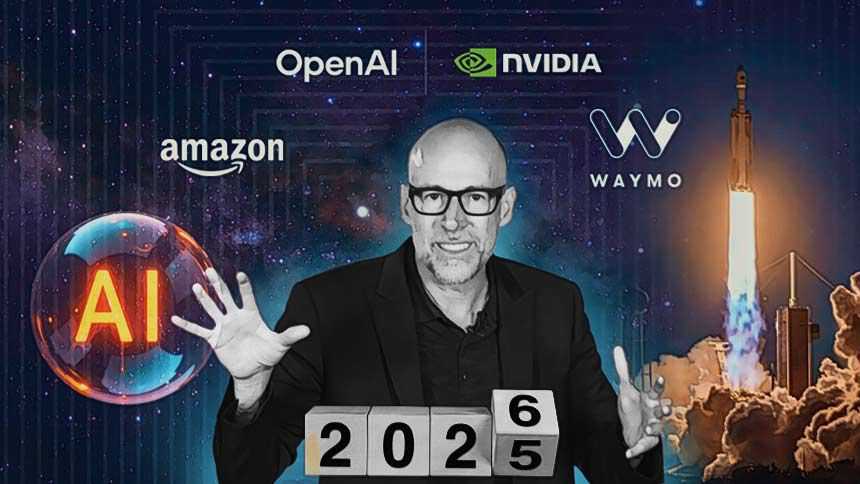
At 61, Scott Galloway boasts an impressive resume as a writer, entrepreneur, and marketing professor at New York University's Stern School of Business. All this experience positions him as one of the leading gurus of Silicon Valley.
The American often shares this experience in ironic and acerbic posts through "No Mercy, No Malice," a blog where he comments on the business world and, in particular, the technology market. And, at the end of each year, he makes room for his predictions for the following 12 months.
In line with this calendar, Galloway published his "prophecies" for 2026 on Friday, December 19th, at the very end of 2025. The new selection, as usual, is extensive and full of phrases that combine precise analysis with his sharp wit.
This time, the package includes issues ranging from corrections in the stock prices of artificial intelligence (AI) companies and the bursting of the data center bubble to the growing threat to the Nvidia and OpenAI duopoly in the AI field and the impact of this technology on Hollywood .
Galloway's crystal ball also reserves room for topics such as the space race, Waymo 's dominance in the autonomous car market, and the favorable prospects for Amazon . As well as the traditional jab at Elon Musk , one of his favorite targets.
As usual, Galloway took the opportunity to review his predictions for 2025. And this time, the guru was quite sharp. Of the 11 prophecies he made, only one did not come true: Shein 's IPO.
Below are the main themes addressed by Galloway for 2026:
1 – Correcting the actions of artificial intelligence
For Galloway, the question isn't when the artificial intelligence (AI) bubble will burst, but what the catalyst will be. He has the answer ready: China. And he adds some data to support this prediction.
The guru points out that Donald Trump changed tariffs on the country of the Great Wall 17 times in 2025 and that Xi Jinping's government is tired of having a major trading partner with slow decision-making processes and the behavior of a "raccoon on methamphetamine."
In classifying Trump's tariff policy as the definition of stupidity, Galloway also points out that, since 2019, China's share of exports to the US has fallen from 17% to 10%. Meanwhile, Chinese global exports have grown by 40% and imports have remained stable.
“If I were an advisor to Xi, I would advise him to get straight to the point, promoting AI dumping, repeating the steel dumping strategy of the 2000s. This is already underway – and working,” he writes.
Galloway notes, for example, that 80% of the startups in Andreessen Horowitz's portfolio already use open-source Chinese AI models. Just like Airbnb. And that these models already perform as well as or better than American ones, but with a fraction of the capital investment.
"Flooding the market with competitive and cheaper AI models will squeeze the margins and pricing power of the seven largest companies in the sector, bringing down a frighteningly concentrated S&P index and likely driving the US, possibly the entire world, into recession," he states.
2 – The bursting of the data center bubble
There is no shortage of figures to justify this "prophecy." Galloway cites that OpenAI is promising $300 billion – money it doesn't have – to Oracle for an infrastructure that Oracle didn't build.
“We can’t see the contract itself, but that’s a big lie,” he says, stressing that the biggest AI illusion so far is the assumption that, in the coming years, the US will have the necessary infrastructure to support this wave.
“OpenAI needs 20% of the current electrical capacity of the US – the equivalent of 250 nuclear power plants – at a cost of US$10 trillion,” says Galloway.
He further states that there is a five- to eight-year wait to connect a new data center to the grid. And that, in the meantime, China has more than double the energy capacity of the US, at half the cost. He adds:
"The second biggest illusion of AI? Job creation. The average number of full-time employees in a data center is equivalent to the number of people working in two Applebee's restaurants."
3 – Nvidia and OpenAI Duopoly Under Threat
Galloway notes that, based on its valuation, Nvidia is telling the market that it will add $800 billion in revenue over the next five years – the equivalent of the combined revenue of Apple, IBM, Meta, and Tesla.
OpenAI, which has annual revenues of US$20 billion, projects adding US$180 billion in the same period, equivalent to the combined revenue of Disney, Fox, The New York Times, Paramount, and Warner. "Furthermore, OpenAI's investment commitments of US$1.4 trillion exceed Argentina's debt," he points out.
Conversely, he emphasizes that the competition is fierce. Whether it's China launching comparable AI models with less investment, Anthropic taking the lead among corporate users, or Alphabet fighting back.
“Gemini updates are improving, and arguably the greatest concentration of AI talent resides at Alphabet. OpenAI could be the Netscape of our era, that is, the disruptor enjoying a moment of prominence before being eclipsed by an already established company,” he says.
4 – The “top pick” among big techs: Amazon
Galloway says he is optimistic about Amazon, even though the company is underperforming the seven largest technology companies.
"The convergence of AI and robotics is the champagne and cocaine cocktail driving Amazon's profit margin expansion in retail, catalyzing a 2x increase in the gross merchandise value of its largest business by 2033, without hiring new employees," he states.
He notes that, just as Ford's assembly line reduced automotive production time by 88%, Amazon's investments in robotics have reduced the time between click and delivery by 78%.
The professor also points out that, while other companies base their business on valuing information (bits) rather than objects (atoms), Amazon uses bits to move atoms faster and cheaper. He concludes:
“Notably, the market hasn’t priced this in yet; in 2025, Amazon’s stock was trading at a P/E ratio of 33, compared to its historical average of 58. The greatest increase in shareholder value from AI will occur in companies that use third-party AI. Specifically, Amazon.”
5 – Space – “The Next Big Thing”
Citing examples such as the personal computer, the internet, and AI, the guru states that when a technology becomes cheaper, startups emerge and the ecosystem attracts increasingly cheaper capital, which drives innovation, and so on. And that this is the current scenario in the space sector.
“Over the past 15 years, the cost to put a kilogram of payload into orbit has fallen by 89%, while private space investment in the U.S. has increased sixfold,” he notes, adding that SpaceX dominates the sector, accounting for 84% of U.S. space launches in 2024, up 18% from 2008.
“If I were in charge of Investor Relations, I would position SpaceX as follows: Google holds 93% of the information through its searches, Meta controls two-thirds of social connections, Amazon holds half of e-commerce. SpaceX controls 90% of everything else in the universe. Everything is a subset of the addressable market that is space,” writes Galloway.
6 – The best investment (that you don't have access to): TikTok USA
Galloway says the math of the forced sale of TikTok is simple, unless "you're one of Trump's cronies." In this context, he cites that the company's advertising revenue in the US in 2024 was $12 billion.
“Applying a price-to-sales ratio of 10x, its US business has an implied value of $120 billion. Taking into account the revenue share from China, Trump's deal values TikTok in the US at $28 billion. But I'm a Democrat, so I can't invest,” he states.
7 – Short-form videos and AI impact Hollywood
He points out that, for the creative industry, the return on human capital is inversely proportional to screen size, and cites some data to support this view. Among them, the fact that 78% of Americans between the ages of 10 and 24 watch movies and TV shows on YouTube and TikTok.
In other data, he cites the example of the children's program "The Kids Diana Show" on YouTube, which has episodes with an average duration of 2 to 10 minutes, "perfectly calibrated for the increasingly shorter attention span of young people." And it has 137 million subscribers.
“The other meteor heading for Hollywood is AI. What AI will do to Hollywood is what podcasts are doing to TV,” he points out.
8 - Waymo dominates the market
Galloway uses the statistic that car accidents kill 40,000 American women annually to argue that autonomous driving could be the equivalent of a cure for prostate cancer, Parkinson's disease, and breast cancer combined. And that Waymo stands out in this arena.
He mentions that the company went from 38,000 paid trips per month in 2023 to 1 million in just two years. And that the company is far surpassing rivals like Tesla. He adds that the second player that stands out in this space is Uber.
"She is technology-agnostic, choosing to invest capital in the customer experience. As former CEO Travis Kalanick said, the most expensive part of the business is the person in the driver's seat," he writes.
9 – Humanoid robots = Self-driving cars of 2015
He claims that, just like self-driving cars in 2025, humanoid robots are another weapon Elon Musk uses to distract attention from the fact that Tesla is a car manufacturer. He cites the billionaire's statement that the company's Optimus robot will be a "glitch in the system that generates infinite money."
“It’s as if he were under the influence of ketamine,” he observes. “The current/future opportunities are not robots that imitate humans, but rather robots that augment/replace humans on an industrial scale.”