


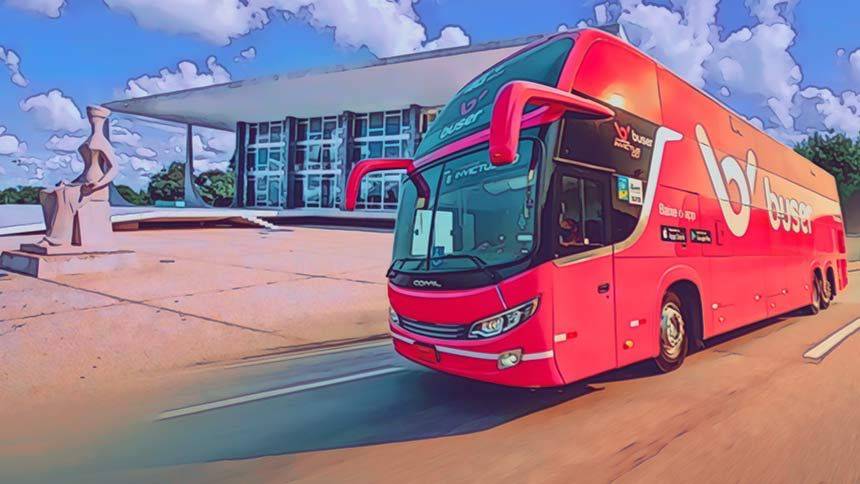
Brasilia – As if the growing avalanche of lawsuits from new companies seeking injunctions in court to operate in the regular market (bus stations) wasn't enough, the road passenger transport sector is now facing yet another legal battleground. This time in the Supreme Federal Court (STF), where Buser recently emerged victorious against traditional bus companies, and the regulatory agency (ANTT) is also facing challenges.
The backdrop to the dispute lies in the fight for space in a market that moves R$ 6.15 billion per year in interstate and international road transport, according to ANTT (National Agency for Land Transport). Regular bus companies claim that app platforms operate outside the law by violating Brazilian legislation and failing to meet safety requirements and inspection rules demanded by ANTT.
Buser, the target of several lawsuits filed by bus companies, advocates for greater competition and accuses the market of being closed (the so-called "closed circuit" has existed in Brazil since 1998). The digital platform sector, aligned with Buser, also demands efficient regulation from the ANTT (National Agency for Land Transport).
In the latest chapter of this dispute, Supreme Court Justice Kassio Nunes Marques decided to allow Buser to operate in Paraná, arguing that the lack of regulation for platforms in the transportation service "should not have the power to prevent Buser's activity."
“Conversely, in a system founded on free enterprise, the lack of regulation, in principle, preserves the freedom of action of private entities,” says the minister in the decision, the first in the highest court of the Brazilian Justice system.
According to Nunes Marques, the company acts as an intermediary in this business, uses charter companies registered with the ANTT (National Agency for Land Transport), and its prohibition could inhibit investors from entering the market.
Before that, however, the company was suspended in the state after two consecutive defeats in lower courts. Both the Federal Court in the Southern region (TRF-4) and the Superior Court of Justice (STJ) ruled that the "collaborative chartering" service, practiced by Buser, was irregular.
Through this business model, Buser offers travel services based on demand on specific routes. In contrast, the regular market of traditional companies requires round-trip journeys with the same passengers. Platforms like Buser already consider this traditional system incompatible with technological advancements.
“What we see is that whenever there’s a new model on the market, like Spotify, Uber, iFood, it clearly causes discomfort, because traditional companies, in order to keep up with innovation, need to change the way they operated before,” said Patrícia Secher, executive manager of Legal at Buser, to NeoFeed .
“Users need a cheaper option, and we seek to serve markets that others don't operate in. Buser operates largely based on supply and demand,” she adds, also pointing out that 63% of Brazilian cities are not currently served by regular interstate transportation.
The executive understands that after the platform entered the market in 2019, there was a "wave" of regular bus companies using the Judiciary as a "form of predatory litigation" against Buser. But currently, she believes there is a trend of favorable court decisions considering the legality of the company's service.
Secher lists victories for Buser in lawsuits in the state courts of São Paulo, Rio de Janeiro, Santa Catarina, Maranhão, and Espírito Santo. “But we don’t want the incumbent [traditional] companies to cease to exist. We want the market to grow more and more, to have competition, and for the user to be able to choose to travel with company A, B, or C.”
Buser also defends itself against accusations that it operates outside the law, stating that it hires charter companies that comply with all requirements and licenses demanded by the sector's regulatory agency (ANTT). Furthermore, it emphasizes safety standards: the buses are equipped with a "fatigue camera" that detects potential driver drowsiness and fatigue, alerting a communication center.
Currently, 14 million active customers are registered on the platform, according to Buser, which has already raised more than R$ 700 million from venture capital funds. Investors include Softbank, LGT Lightrock, Monashees, Canary, Globo Ventures, Iporanga, and Valor Capital.
“According to what Minister Nunes Marques said, there is no need for regulation for Buser. And that is already sufficient for us to operate. So, if the law doesn't prohibit it, nothing prevents us from operating,” adds Secher, who says, however, that he doesn't look negatively on future regulation of road transport services by digital platforms.
Regular market
Companies in the so-called regular market don't see it that way. According to the general director of the Brazilian Association of Passenger Land Transport Companies (Abrati), Letícia Pineschi, the competition today with digital platforms is "unfair." And companies like Buser don't follow the rules of Brazilian legislation, just like the regular companies that operate in bus stations.
She admits that there is currently an "excess of litigation" in the sector, which she explains by the interest of new market players in "disrupting" the system and operating outside the rules.
The industry executive warns that Buser and other platforms do not comply with constitutional duties and legal standards regarding service continuity and regularity, safety, support for large cities, do not serve less profitable routes, nor do they submit to rigorous oversight.
“The competition that Buser engages in is completely asymmetrical, unfair, and ruinous. And it loses most of its lawsuits because of this. Buser already practices a prohibited business model that is inconsistent with legal security and the social function of public transportation,” Pineschi tells NeoFeed . “Collaborative chartering does not exist in the Brazilian legal system today.”
According to data from ANTT (National Agency for Land Transport), the regular sector transports more than 39 million passengers per year and currently connects five thousand municipalities, with 93,700 drivers qualified to operate more than 32,000 buses.
Regarding Buser's operations, Abrati highlights that a recent decision by the STF (Supreme Federal Court), from April of this year, reaffirmed that interstate chartering must operate in a "closed circuit" (as stipulated by the new regulatory framework for the sector), without individual ticket sales.
According to the organization, this understanding by the Supreme Court prevents charter services from functioning as "disguised regular routes" and ensures equality among operators in the road passenger transport system.
Regarding Minister Nunes Marques' decision, the organization, as part of the process, is already working to have its effect suspended. "We see it as an isolated decision, somewhat contrary to everything the Supreme Court has already said. So I don't see it as a major concern," states Pineschi.
"The Court itself [STF], not specifically in this case, but has already ruled in a way that defends the constitutionality of the authorization model, within the regulatory framework, for passenger transport services, which is totally contrary to what Buser proposes, which is the deregulation and total dismantling of the system."
Injunction industry
In addition to the most recent case of conflict between traditional bus companies and Buser, the sector is also experiencing a deepening crisis due to countless lawsuits filed by new companies seeking to operate in the interstate bus ticket market.
According to Abrati, there are currently 325 lawsuits in the Federal Court in Brasília (TRF-1), headquarters of ANTT, the sector's regulatory agency. The lawsuits and requests for injunctions challenge ANTT regulations. One of these rules, resolution 6.033 of the agency, from 2023, established the new regulatory framework for the sector in the country, replacing the old model (of permits) in effect for over 20 years with the current authorization model.
The new model does not allow for bidding processes or auctions, for example. In light of this change, lawsuits questioning the constitutionality of the resolution or alleging supposed favoritism towards certain operators have exploded.
The very entity that represents Buser and other digital platforms (iFood, Amazon, Uber, 99, etc.), the Brazilian Association of Mobility and Technology (Amobitec), filed a lawsuit against this resolution, which was denied by the TRF1 (Regional Federal Court of the 1st Region). The association, however, appealed to the full court.
Speaking to NeoFeed , André Porto, the organization's executive director, said that ANTT has failed to regulate the current authorization system. And to this day, the regulatory agency has still not established a "stable" legal framework for the Brazilian road passenger transport service. ANTT was contacted but did not respond by the time of publication.
“It [the ANTT resolution] is full of illegalities, according to the Public Prosecutor's Office itself. And it was made to favor companies that are already in the market,” he emphasizes. “Instead of regulating the authorization regime, it revives the permit regime, creates auctions, and even called for a window to authorize companies, which was suspended by the Supreme Court.”
Porto refers to the first extraordinary window (qualification process for new companies to enter the road transport sector), launched by ANTT. The idea was to open up competition to markets that are still underserved or dominated by "monopolies," he analyzes.
The agency received 47,000 applications from the market, but on July 10, Minister André Mendonça (STF) suspended the attempted selection process, citing vulnerabilities in the electronic system of the competition.
“Companies continue to operate with monopolies or oligopolies, and many others are unable to enter this market. Those who cannot, resort to legal action, claiming that the ANTT regulation is wrong,” says Porto.
"There is a very high degree of litigation in the sector today due to the ANTT's inaction in opening the market. And since the agency is not fulfilling its role of opening the market, companies are trying in various ways."
One of these forms is collaborative chartering, advocated by Buser, but which regular bus companies say is not provided for by law. However, the executive of the platforms argues that the ANTT (National Agency for Land Transport) should regulate this type of chartering.
Another strategy Buser employs, he explains, is to buy smaller companies already operating in the regular market – the same market that is challenging the company in court. “The supply of this service [interstate bus tickets] is very deficient in Brazil. We need more competition, but not from established players. They just want to protect their market.”
Contacted for comment, ANTT did not respond to NeoFeed 's request for an interview.