

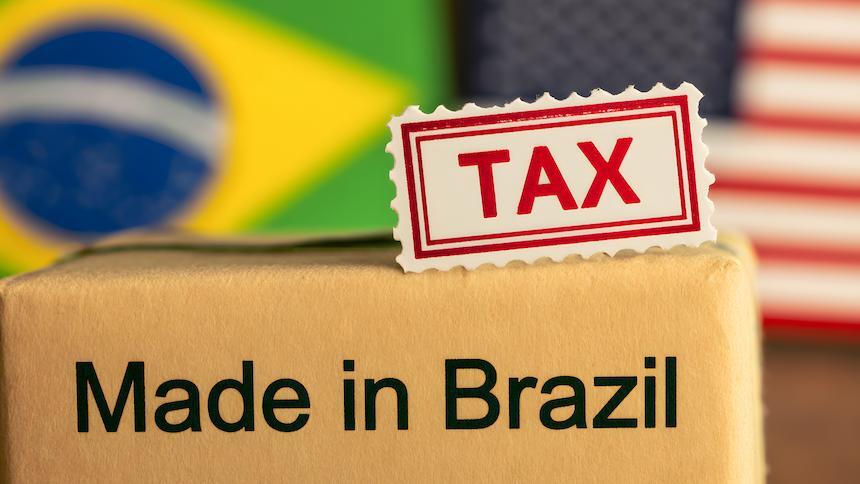
Brasilia - Brazil will have an initial window to try to reverse the new tariff increase imposed by the United States last week, but there will only be room, in fact, to negotiate reductions or even the annulment of the new impact on national products after the presidential elections in Brazil in October.
A source involved in negotiations with U.S. government officials told NeoFeed that representatives from the U.S. State Department have privately signaled that Washington does not intend to negotiate until the results of the Brazilian elections are in.
Above all, the more political wing of President Donald Trump's government, linked to the so-called MAGA ("Make America Great Again"), is already making political calculations about the electoral chances of the pre-candidate for President in Brazil, Flávio Bolsonaro (PL), winning the race against President Luiz Inácio Lula da Silva (PT). In theory, Flávio would have the support of Trump's group.
Therefore, the political chess game should once again influence the issue, at least until Brazilians decide who will be their president starting in 2027 – even if Lula is re-elected for a second time.
On Thursday, July 30th, the Minister of Development, Industry, Trade and Services (MDIC), Márcio Elias Rosa, stated that the Brazilian government intends to resume talks with the White House in August. "If they don't contact us, we will contact them," he said during an event hosted by Apex Brasil.
However, no bilateral agenda has yet been scheduled. NeoFeed has learned that a first meeting between technicians from the MDIC (Ministry of Development, Industry and Foreign Trade) and the Office of the United States Trade Representative (USTR) is planned for September. However, it will not include the presence of high-ranking officials from either government, such as Elias Rosa himself.
The trend, privately demonstrated so far by Trump administration officials, according to the same source, is that the matter is likely to "drag on" a little longer.
Meanwhile, the Planalto Palace insists on confrontation – the Lula government even questioned today at the World Trade Organization (WTO) that the US tariff increase violates international trade rules. And it is expected to exhaust all attempts at formal negotiation with Washington.
To date, Brasília has not considered invoking the Reciprocity Law which, ultimately, allows Brazil to retaliate against trade wars imposed by other countries, according to certain technical procedures. Vice-President Geraldo Alckmin (PSB) himself recently made a statement to that effect: “The idea is not retaliation. An eye for an eye can lead to both of us going blind.”
Pre-election context
Politically, however, the narrative that the American government is "pushing its luck" without technical justification to extend tariffs to Brazil is favorable in a pre-election context, according to what they have reported to interlocutors.
The strategy of linking the tariff hike to the political camp of the family of former president Jair Bolsonaro (PL), who is imprisoned, would also favor and reinforce Lula's discourse of national sovereignty in the campaign, according to members of the PT campaign.
Ultimately, the U.S. government would have preferred Brazil to sign an agreement similar to the one Argentina signed. But according to negotiators who attended the meetings, the Brazilian government objected because it implied restrictions on the global market – for example, negotiating trade in critical minerals with the United States in a way that excluded China.
The government of Argentine President Javier Milei already faces difficulties in fulfilling its own agreement with Washington, as it depends in part on Congress approving measures promised to Trump.
However, Argentinians will also have a presidential election coming up in 2027. Such constraints were rejected by the Brazilian Foreign Ministry, which remains firm in its conviction to reverse Trump's series of tariff increases in the future.
Reaction
According to Constanza Negri, trade and international integration manager at the National Confederation of Industry (CNI), there is currently a great deal of "uncertainty" and "tension" regarding the future of the tariff increase. Approximately 29.4% of Brazilian exports to the United States (US$ 12.4 billion) were subject to the most recent 12.5% tariff.
Most of these shipments, however, equivalent to 80.4% of this volume, will also be subject to accumulated tariffs and will start paying an additional tariff of 37.5%.
She argues that Brazil, along with the industrial sector, should follow the path of "dialogue" and be careful about adopting measures that could potentially worsen the trade crisis.
"Given this complex scenario, the industry has expressed concern regarding measures that can be adopted. We need to carefully consider how we can untangle these knots," Negri tells NeoFeed .
"We have to avoid situations that lead to a worsening of the situation. We have a very complementary relationship with the United States, and you don't replace a trading partner like them overnight."
The CNI executive also emphasized that the industrial sector has been advocating to the Brazilian government that it continue prioritizing its "pragmatic" participation at the negotiating table with Washington and strive to implement an agenda to mitigate impacts in the very short term, such as financial support measures, for example.