


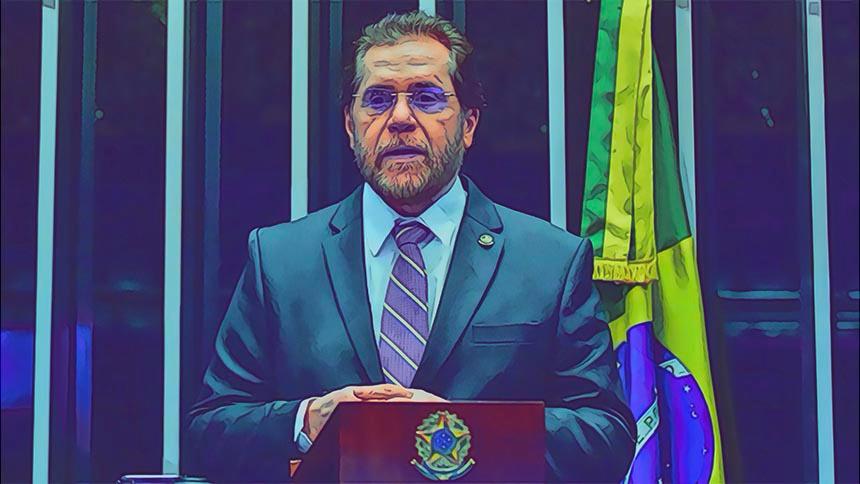

Brasilia - After the proposed amendment to the Constitution (PEC) on the financial autonomy of the Central Bank spent almost three years in the Senate, the rapporteur, Senator Plínio Valério (PSDB-AM), said he was tired of the various back-and-forths throughout the negotiations and will now present his new opinion - the second version - on Thursday, April 16, in the late afternoon, "come rain or shine".
He revealed that representatives of the Central Bank president, Gabriel Galípolo, had even approached him in the last two days to suggest adding more points to the report, but he declined. Even so, he acknowledges Galípolo's support, who was at the National Congress last week asking senators for help in approving the constitutional amendment.
"This time I don't want to hear 'no' anymore, I'm fed up. It's going to the amendment. I won't accept any more [suggestions]. I ended this yesterday [Tuesday, April 14th]. I've reached the point of rudeness where I refuse to meet with anyone else. I'm not going to give in," the senator said in an interview with NeoFeed . "Now is no longer the time to negotiate."
According to him, the pressure will now be on the pro-government senator Otto Alencar (PSD-BA), president of the Senate's Constitution and Justice Committee (CCJ), where the PEC is being processed. He believes that if the vote were held today, his report would be approved. Even so, he is still not sure when the proposal will be scheduled or voted on. Next week, there will be a holiday (Tiradentes, Tuesday, April 21).
Furthermore, the government continues to exhibit "political resistance," Valério assesses. The opposing stance, which originated with the former Finance Minister, Fernando Haddad, now continues under the current Minister, Dario Durigan, he says. The senator also believes there is an ideological bias on the part of the Workers' Party wing of the government, which manifested itself, for example, in the figure of former Minister of Institutional Relations, Gleisi Hoffmann.
According to the preliminary text, the rapporteur will propose, in addition to the financial, operational, and budgetary autonomy of the Central Bank, that the body cease to be an autonomous agency and become a public entity of a special nature. Furthermore, it will require the president and all directors to appear before the Senate and the Chamber of Deputies to give an account of their actions.
In recent days, both Plínio Valério and the author of the PEC (Proposed Constitutional Amendment), Senator Vanderlan Cardoso (PSD-GO), have been working to garner the support of senators to approve the text in the CCJ (Committee on Constitution, Justice and Citizenship). NeoFeed has learned that even some opposition senators are signaling support. And within the Central Bank, the proposal, which was initially rejected in an internal survey by Sinal (the union of civil servants), now has great acceptance.
New research conducted by the National Association of Auditors of the Central Bank of Brazil (ANBCB) reveals that 96% of active employees are in favor of the proposed constitutional amendment: 1,724 active employees, compared to 73 against, out of a total of 2,241 employees, with a 20% abstention rate.
Check out the main excerpts from the interview:
You have been trying for years to present a report on the amendment to the Constitution regarding the autonomy of the Central Bank, without success. When will the new report be presented?
Come rain or shine, I will definitely present my new report this Thursday [April 16th] at 5 PM.
But the Finance Ministry has been putting up resistance. Does the new minister, Dario Durigan, also remain opposed or has he already expressed some support?
Haddad was against it, and the one who came in now is also against it, but he doesn't say why. He didn't tell me directly, but through intermediaries. What is he against now? If the government tells me what the problem is that's preventing the vote, I'll fix it, as long as it doesn't break the backbone [of the PEC].
Has the government been unclear about what it opposes?
No. Back then they said: no, but the autonomous entity has to be public, it can't have private law. Okay, the Attorney General's Office came up with the solution [proposed the public law legal regime]. And now? What's the excuse for not wanting it? So, they'll come up with another excuse that has nothing to do with it. What do I do? I pass the buck and the weight goes to Otto [Alencar, senator], who is the president of the CCJ. Because if I hand it over on Thursday, he has a deadline to schedule it on Wednesday [April 22nd] and then all the pressure will be on him.
Have you spoken to him about deadlines? When will it be possible to vote?
I spoke with him. We had a meeting. My conversation with him went like this: he said that so-and-so is against it, and I said that I was going to present it, and he told me to go ahead and present it.
In the CCJ (Committee on Constitution, Justice and Citizenship), do you see any resistance to your report?
No, you don't see a senator arguing, you don't see that. The prevailing sentiment is that the Central Bank needs autonomy so that it can have its own budget and evolve, or at least maintain its current level. I've spoken a lot about the difficulties the Central Bank faces. The Central Bank has vehicles, trucks, that are 42 years old. The Central Bank has a directorate that oversees the financial market, which ten years ago consisted of 300 companies. Today, they have half the department's staff to oversee more than 3,000 companies. How can something like that work? Pix, which is a national institution—nobody lives without Pix in Brazil—is managed by 32 employees. When Pix has problems at night, and an employee comes to fix them, they don't get night shift pay because there's no money to compensate them. When they need someone, they need help, they leave home and go there.
"The prevailing sentiment is that the Central Bank needs to be given autonomy so that it can have its own budget and evolve, or at least maintain its current level."
But will your report guarantee payment of this additional amount?
The project provides funding for the Central Bank to strengthen its financial, budgetary, and operational structure. Today, any institution of this size needs its own artificial intelligence. The Central Bank doesn't have it. Imagine what it's like to monitor 85 million users a day, moving trillions [of reais] without sufficient personnel? Currently, they perform this task with great difficulty, but with the new budget, things will improve.
With the PEC (Proposed Constitutional Amendment), the budget cannot be subject to contingency measures, right?
It won't be possible. They've already said, "Oh, that money is just more expense for the government." That's a lie! The money in the Central Bank's budget will come from what they handle, from the fees they charge.
And these fees and fines charged by the Central Bank no longer go to the Treasury?
Part of it no longer goes to the Treasury. So there's no such thing as a primary deficit. And there's a lot of cash there [the collection of these fees and fines]. Imagine a bank moving this absurd amount of money and not having the budget to buy a truck, a modern computer, to set up an AI [Artificial Intelligence], to maintain a server that has a proposal from the private sector.
Are there any other new points that will be included in your report?
I'm putting more rules in place for Pix because Pix has a very large national and popular appeal. Everyone knows what Pix is, even the guy who begs for money. So, I'm also trying to raise public awareness so that people understand. I put in place two restrictions that the bank wanted: one of them is the budget. They also won't get all the money [budget] they need. It's not how they want it. What the Central Bank spent in the previous year will be adjusted by the INPC (National Consumer Price Index). There was someone advocating for a 2.5% adjustment for inflation [IPCA], but you end up with a problem. Then, if that money isn't enough with the adjustment, and it probably won't be, they can have it, provided they ask the Senate. If Congress approves the Union Budget, how can that not go to the budget of a bank [the Central Bank], which is public?
Has the report already been circulated among the senators to gauge public acceptance? Are there more senators in favor?
Yes. Back then it was neck and neck [regarding the number of votes needed to approve the PEC], because the government was working against it. Would we win by one vote or lose by one vote? That's when Jaques Wagner [government leader in the Senate] asked to withdraw it, and I said: "If you're going to withdraw it, then it won't be back anytime soon." And it [the report] is coming back two years later.
Will there be more support now?
The only one who complained was Haddad, and today it's become a civil matter because Gleisi Hoffmann [former Minister of Institutional Relations] is from that radical wing of the PT, which even has a bill in the Chamber of Deputies to end the autonomy of the Central Bank. That's madness. When will that pass in the Senate? Never. A law [on the independence of the Central Bank] that worked, helped control inflation, and helped uncover the Master case. All they [that wing of the PT in the government] want is a bank [Central Bank] like it used to be. That's over. So much so that when Lula found out he couldn't fire Roberto Campos [Neto, former president of the Central Bank], he went crazy. That's how the fight went on for two years straight.
"The resistance today is more political than technical."
In other words, resistance within the government still continues?
It continues, but the resistance today is more political than technical. When they had the support of Sinal [national union of C employees], they said, "It can't be a private entity, it has to be public." Now there's no more argument, because the employees are shielded, both active and retired. We tried to shield them in every way. I asked for protection, so as not to harm anyone. So the employees have nothing to complain about. If you do a survey within the bank today, I think 90% agree and 10% disagree. You'll never have 100% anywhere. So we sought to protect the employees, their rights. Nobody will lose their health plan. There's nothing more to discuss. Now it's time to put it on the agenda and pressure Otto.
Do you believe the PEC (Proposed Constitutional Amendment) will pass in the Senate today?
Today I believe it will pass. The support is greater than two years ago, when I was going to read [the report] and they asked for a review, and it never got to be read.
But Senator Otto has indicated that he will schedule the vote for next week, even though it's a holiday?
He didn't signal that he's going to schedule it. He's signaling that he's in favor, yes. He doesn't see any more obstacles. However, he's part of the government's base, he has total access to the government. So he hears a lot of requests not to schedule [the PEC]. And I told him: "Otto, you're the one who's going to suffer the pressure from now on, not me anymore!"
Are you convinced that the Senate president will immediately schedule it for a plenary vote if it passes the CCJ (Committee on Constitution, Justice and Citizenship)?
I have his word that it will be put to a vote in the plenary session. The moment it passed the CCJ [Committee on Constitution and Justice], he [Davi Alcolumbre] put it to a vote and we requested urgent consideration. Now it's a vote. We can't hold this up any longer. Everyone is saying the Bank needs it. Did you see Galípolo's appeal? He asked for help. Because he projects that, I don't know how long from now, 30% of the civil servants will be retired. And what if none of them have been hired? Just imagine Pix: that's 32 civil servants for millions of users.
And should you include in the report that Pix will be exclusively managed by the Central Bank?
I put it in. Today it's not law. You see that Trump complained. Pix will now have legal backing; Brazilian law says it belongs to the Central Bank, that it cannot rent, sell, outsource, lend, and that it cannot charge individuals. And I have to give this guarantee in the report because later on, if it depends on the PT (Workers' Party), they will charge individuals. That's the end!
"Pix will now have legal backing; Brazilian law states that it belongs to the Central Bank, that it cannot rent, sell, outsource, lend, and that it cannot charge individuals."
NeoFeed has learned that the Central Bank intends to make further final adjustments to the text. Will you still accept them?
He always wanted to. There comes a point when they always make some kind of comment, and we either listen or we don't. But this time I don't want to hear "no" anymore, I'm fed up. Go to the amendment, get the senator and present the amendment. I'm not accepting any more [suggestions]. I ended this yesterday [Tuesday, April 14th]. I've reached the point of rudeness where I'm not receiving anyone anymore. I receive everyone, but to talk about the same thing? I'm not going to give in.
Did the president of the Central Bank, Gabriel Galípolo, contact you to include more points in the text?
They contacted me yesterday, today. Not the president. It was directors, intermediaries. I've been telling them to make amendments. Send them even to me personally. Now is no longer the time to negotiate. The government is against it, they don't know why. The Central Bank wants more and more. They always work on the government's budget constraints. Now I'm going to take it off my shoulders. And whoever contacts me now, present an amendment. Imagine if back when Senator Ciro [Nogueira, PP-PI] presented the pro-Master amendment I had been like I am today, running around, anxious, fed up, and had accepted it, right? So I think that's enough: two and a half years, three years. Enough!
Doesn't the holiday next week and the fact that it's an election year make things even more difficult?
If it depends on the government, it won't happen. If it depends on us, it will happen next week. And through voting? I think we'll win through voting. And if we lose, so be it. That's how parliament works. They want to push it until after the election, which means never. I think the PT believes it will remain in power and will want a Central Bank that isn't autonomous.
So, sir, you're not going to change anything else you've proposed so far?
Nothing. There was no news. According to my new report, based on the AGU's suggestion, we now state that, according to Article 50 of the Federal Constitution, the directors and president of the Central Bank, whenever summoned or called upon, will be obliged to appear both here and in the Chamber of Deputies. This was going unnoticed, it was brought to our attention, and I corrected it. The rest is all the same: we will propose that the Central Bank have a special public law regime [no longer an autonomous entity]. The Bank didn't want to be private. And the government agreed with that. But it's just a matter of stating the problem. I'm not saying this resistance comes from the Presidential Palace, because it's not the government as a whole. I will submit it to the system tomorrow (today). I'm just waiting for the final drafting now, which we had to correct some articles and clauses on; our specialists are working on it. There were some minor errors, but it doesn't change anything. But at 5 PM tomorrow (today) we will put the report on the system. By then I will already be in the interior of Amazonas. And now it's up to Otto. What I want is a strong Central Bank.