

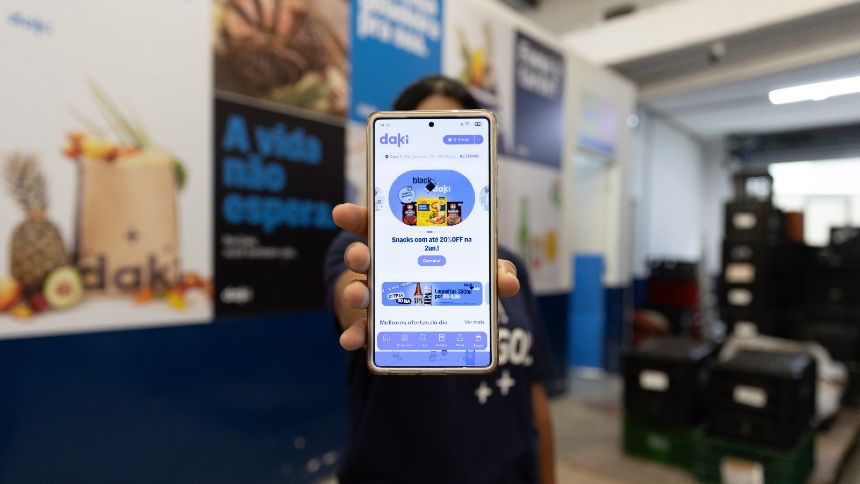
Few names illustrate the boom and bust of startups like Daki . Created in 2021, the newcomer online supermarket joined forces with the American company Jokr , attracted investments, and became a unicorn in ten months. But in 2023, it left that shelf when its valuation fell from US$1.2 billion to US$800 million.
The adjustment came with the reduction in consumer appetite for online shopping in this space, which had been boosted during the pandemic, and which, at the time, also attracted players like iFood . At the same time, investors "froze" their investments.
Daki, however, survived this unfavorable climate. And it's once again filling its cart with a package that combines, among other things, the expansion of operations and the use of artificial intelligence. And it comes packaged with some impressive numbers.
“The sector moves around US$200 billion in Brazil, and 90% of it is still offline,” says Ralf Wenzel, co-founder and chairman of Daki/Jokr. “And we are growing 50% per year and reaching R$1 billion in revenue.”
The battle for a slice of this billion-dollar online pie includes specialized names like Daki and Shopper , delivery companies like iFood and Rappi , and groups like Mercado Livre and Magazine Luiza .
The latest giant to fully enter this arena is Amazon . Last week, the American company launched Amazon Now in Brazil, a grocery delivery service with delivery times as low as 15 minutes, available in cities such as São Paulo, Rio de Janeiro, and Porto Alegre.
To defend its territory, one of Daki's plans is to resume its expansion. Slowing down this strategy was one of the adjustments made by the startup over the last three years – it now has a presence in São Paulo, Santos, and Belo Horizonte. In parallel, the company also reduced its dark stores – from 70 to 50 units.
“We want to launch in one or two more cities this year,” says Wenzel. “We’re going to expand again because we’ve built a model where each of our stores is profitable. So, this can be implemented in places like Brasília, Porto Alegre, and Salvador.”
Although he doesn't definitively state that these will be some of the next destinations, he readily recalls some indicators that Daki has gathered since 2023. "We have a gross profit margin of 45%," he says. "And our stores contribute, on average, with an EBITDA margin of 20%."
He emphasizes that the model built during this period is behind these numbers. The thesis is to control the entire business chain, starting with the purchase of products – 40% of them fresh, such as fruits, vegetables, meats and fish – directly from the producers.
This vertically integrated format also includes three distribution centers in São Paulo and Belo Horizonte, and last-mile deliveries – either express or scheduled – originating from its dark stores.
“The crucial point was realizing that it wasn’t just about being a marketplace and managing the purchase and delivery experience,” he says. “We became the retailer ourselves, controlling every step and capturing the full margin potential.”
From artificial intelligence to private labels
One of the ingredients that fueled this model and that will be reinforced this year is artificial intelligence (AI). Today, the startup has more than 50 AI agents in operation and about 90% of its purchase orders are already automated.
Among other things, agents determine the products and quantities to be purchased for each store. Based on volumes, they also suggest prices or discounts in negotiations with suppliers and producers.
With the help of AI and a significant volume of data, Daki has a product waste rate of 1.5% and 98% of orders are delivered on time and with all requested items. This combination will also be the basis for the expansion of its retail media area, launched about a year ago.
“The fact that we understand the neighborhoods, customers, and their preferences in detail gives us the opportunity to do highly targeted advertising,” says Wenzel. “The expectation is that in one or two years, 10% of the revenue will come from this arm.”
Looking towards healthier margins, private label brands will also gain strength. With products like mineral water and toilet paper, which represent about 5% of the total assortment of 4,000 SKUs, the idea is to expand into lines such as other beverages and convenience items.
Similarly, considering its overall product mix and suppliers, the company sees room to enter categories beyond food and convenience items. Segments on its radar include cosmetics, pharmacy items, and pet supplies.
Launched in 2025, its loyalty program is another focus. This one, however, is more of a medium-term goal. Wenzel understands that the platform can be the bridge for the integration of, for example, financial services.
Market movements
The development of this model coincided with another movement. Between 2022 and 2023, the startup decided to close its operations in the United States, Mexico, Colombia, Chile, and Peru to focus 100% on Brazil. Other "pure players," however, followed the opposite direction.
This was the case with the Mexican company Justo. The company decided to leave Brazil and focus on its domestic market at the end of 2024. Notably, the exit from the country came a month after a Series C funding round of US$70 million, led by General Atlantic.
The Colombian company Frubana followed the same path, raising US$271 million from names like Softbank and Tiger Global. Owner of a marketplace for purchasing and delivering supermarket items to restaurants and neighborhood markets, the company left the country in July 2025.
In another example, this location, James Delivery, acquired by GPA in 2018, was internalized and discontinued starting in 2023. A similar path was followed by the Chilean company Cornershop, which was absorbed and subsequently deactivated by Uber.
The sector has also been the stage for partnerships. Daki itself is one of the names behind iFood's grocery deliveries, which opted to migrate to this model, a journey that also included the purchase of a minority stake in Shopper at the end of 2024.
It is precisely in new partnerships of this kind that Daki sees another avenue for expansion, and at the same time, for defense against competition from larger, more generalist players.
“It’s not enough to invest millions to conquer this market. You need to build a physical infrastructure, integrated with technology. And that takes time. We have that, and we’ve made it profitable,” he says. “So, we’re in a unique position and we can be the missing piece in the puzzle for many of these rivals.”