

The year 2026 should consolidate the closing of a cycle of federal concessions in the infrastructure sector, initiated in 2023 by the current government of Luís Inácio Lula da Silva, which should encompass at least 40 auctions in ports and airports – double the number in 2025 – and another 13 auctions for federal highways , in addition to seven state highways.
Experts consulted by NeoFeed highlight that, despite the different auction schedule in the last three years conducted by the Ministry of Transport for highway concessions and the assets of the Ministry of Ports and Airports (MPor), the market sentiment is that the federal logistics sectors are exhausting the bidding processes for so-called common concessions, that is, those that are sustained only by charging tolls to users.
The exception would come from unprecedented assets, such as the Paraguay River Waterway , or "crown jewels," such as the mega-terminal at the Port of Santos.
The fact that 2026 is an election year explains the predictable attempt to formalize the auctions in the first half of the year, both for federal and state assets. In the case of the MPor auction calendar, announced this week by Minister Silvio Costa Filho, the excessive number of auctions in 2026 is due to the final consolidation of a portfolio that has been prepared over the past few years.
Therefore, the Ministry of Ports and Waterways (MPor) concentrates the most attractive assets. The package includes 21 airports, 18 ports, and a waterway, with construction schedules already underway and some projects considered crucial for the national economy. The government's expectation is to attract capital, increase operational efficiency, and unlock historical bottlenecks in Brazilian logistics.
There is a groundbreaking project on the list: the concession of the Paraguay Waterway, planned for the second half of 2026. If confirmed, it will be the first waterway concession in Brazilian history, with estimated investments of over R$ 60 million.
Waterways are considered strategic for transporting grains and minerals in South America, as well as reducing logistical costs and pressure on highways. The government indicates that this model could pave the way for new river concessions in the coming years.
Among the ports, the first block should go to auction as early as February and includes four projects located in Macapá, Natal, Porto Alegre, and Recife. The official forecast is for R$ 230 million in investments, focusing on modernization, capacity expansion, and increased regional competitiveness.
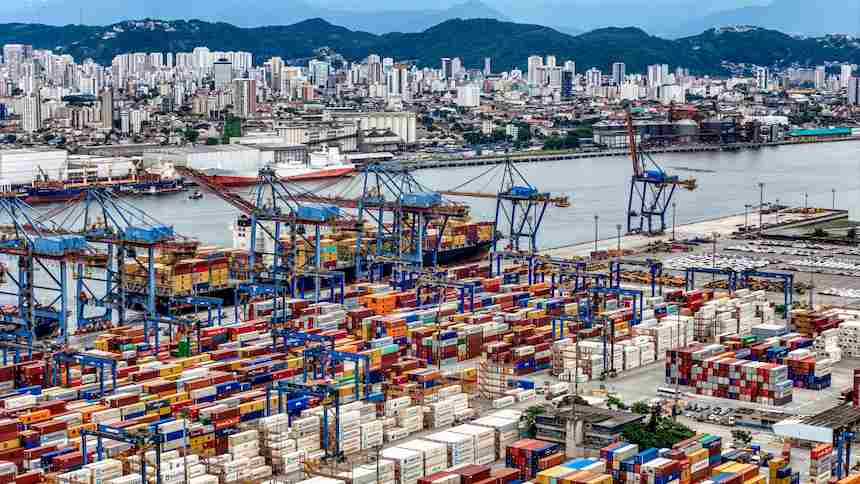
The biggest expectation is for the auction of the mega container terminal at the Port of Santos, Tecon 10. The project foresees a minimum grant of R$ 500 million and R$ 6.4 billion in investments to increase cargo handling by 50% at the largest port in Latin America, in addition to the construction of a passenger terminal and an internal railway line.
The bidding process should begin between the end of February and the beginning of March, with the auction scheduled for April. The planned area for the terminal is 621,000 square meters, which, according to Minister Costa Filho himself, makes the project the largest infrastructure auction ever held in the country.
Other important ports will go to tender in 2026, such as São Sebastião, Rio de Janeiro, and the Vila do Conde Port in Pará, which is part of the Northern Arc. The tender for the concession of the Port of Itajaí, in Santa Catarina, originally scheduled for this year, is expected to take place in 2027 or 2028.
The aviation sector will be the one that concentrates the largest number of tenders, with 21 auctions scheduled for the second half of the year – 20 of them for regional airports, especially in regions with low connectivity, such as the Legal Amazon and the Northeast, within the 2nd Round of the AmpliAR Program. The program allows private concessionaires to take over loss-making regional airports in exchange for contractual rebalancing.
The most anticipated auction, however, will be for Galeão International Airport in Rio de Janeiro, which is expected to take place in the first quarter, with a minimum bid of R$ 932 million and a forecast of R$ 1.1 billion in investments for maintenance and improvements.
Among the highway auctions, whose schedule had already been advanced in previous years, 20 tenders are still planned, 13 of them federal and the rest from state governments (3 in Minas Gerais, 2 in São Paulo and 1 in Rio Grande do Sul).
Among the most anticipated projects are the auction of the Rota Mogiana, from the São Paulo state government, which should take place in February, with projected investments of R$ 8.9 billion, and the renegotiation of the Rota Arco Norte BR 163 -MT/PA, a federal highway with R$ 10.4 billion in investments, with an auction scheduled for April. Another federal highway to be auctioned is the Rota 2 de Julho (formerly Via Bahia), with R$ 14 billion in investments, scheduled for November.
New phase
According to Fernando Galacci, a partner in the infrastructure, regulatory, and government business area at the law firm Souza Okawa Advogados, the perception that the auction scenario is entering a new phase, with the end of bidding for common concessions that are sustained solely by charging users fees, even applies to the MPor schedule, which took a long time to get off the ground.
“The next airport auction already reflects this, since the major assets have already been auctioned off during the previous phases of the federal concessions program,” he says. “Now it’s necessary to change concessions or think about re-bidding, organizing blocks (airport clusters), perhaps starting to think about PPPs,” he adds.
According to him, other sectors, such as ports and highways, will also begin to undergo greater scrutiny regarding their exclusively tariff-based viability in future rounds, raising doubts about the interest and feasibility of establishing PPPs to launch projects that are sustained not only by tariffs, but also through state payments.
“The challenge, then, will soon involve structuring guarantees for these public payments, something with a complicated history on the federal government's side,” he warns, adding that this final stretch of auctions organized by the current federal government may still reveal some new entrants, given the high interest of different investors and companies in setting up platforms and undertaking projects with a long-term profile.
Another infrastructure sector expert, Daniela Poli Vlavianos, a partner at the law firm Poli Advogados e Associados, observes that the auctions announced by MPor do not indicate continuous structural expansion, but rather the final consolidation of a portfolio that has been prepared over the past few years, such as the Santos terminal and Galeão Airport.
She emphasizes that the inclusion of the first waterway concession, that of the Paraguay River, has important institutional significance, as it inaugurates a new regulatory frontier in the country.
“At the same time, it reveals that truly 'new' projects in the federal pipeline are already scarcer and require greater technical sophistication, federal coordination, and regulatory stability to become viable,” says Vlavianos. “This reinforces the interpretation that the government is showcasing what was already ready, rather than opening up a broad new wave of unprecedented assets.”
In the highway sector, Vlavianos states that the dynamics are different. "The sector is clearly entering a phase of maturation, marked by the re-bidding of existing sections, contract revisions, requests for economic and financial rebalancing, and greater attention to the governance of contracts in force," she affirms.
According to Mariana Avelar, a lawyer at the firm Manesco Advogados, perhaps the biggest news for 2026 will be the substantial resumption of railway concession projects and the prospect of consolidating the AmpliAR program, in the case of airports.
"It is possible that future models, after the pipeline planned for 2026, will require innovative constructions for economic and financial viability, which may involve reductions in capital expenditures with a greater focus on maintenance obligations, an increase in the tariff design, with higher values for specific users, or alternatively, government contributions, with emphasis on the use of PPPs," he says.
According to her, however, there is room for new entrants and continued investor interest in the infrastructure sector.
“It is natural for business groups operating in various logistics platforms to alternate strategies, which can range from divestment decisions in certain modes to focus more on others, to expanding diversification strategies – a point that may be opportune, given the projected expansion of the portfolio of ports and airports,” says Avelar.