

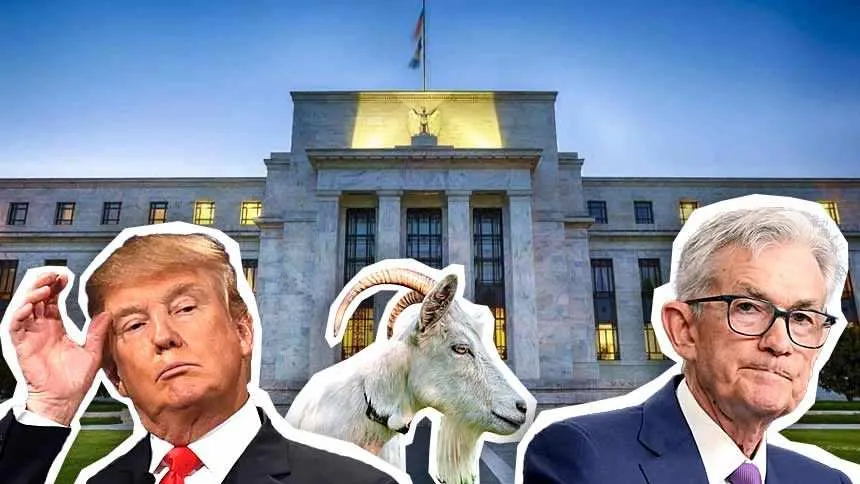
Jerome Powell, chairman of the Federal Reserve (Fed), has always been seen as a defender of institutional stability. For years, he avoided direct confrontations with Donald Trump, even under intense pressure to lower interest rates in the world's largest economy.
This stance changed last Sunday when a criminal investigation against Powell, revealed by The New York Times , led the central bank chief to react publicly – and firmly.
The Justice Department investigation is looking into whether Powell lied to Congress in testimony about reforms at the Fed headquarters in Washington.
The project, which began in 2022, has an estimated cost of US$2.5 billion, about US$700 million over the original budget. Trump has used this increase to accuse Powell of mismanagement, even going so far as to personally visit the construction site, an unusual gesture for a president.
More than a dispute over projects, the episode exposes an attempt by Trump to expand his influence over monetary policy. According to legal experts, this move could be a step towards removing Powell for "just cause," something unprecedented in the history of the Fed.
In a rare video message (see the full version below), Powell described the action as a threat to the central bank's independence. "The criminal charge is a consequence of the Federal Reserve setting interest rates based on our best assessment of what serves the public, not the president's preferences," he stated.
Since September, the Fed has cut interest rates by only 0.75 percentage points, to a range of 3.5% to 3.75%. Trump, on the other hand, is demanding more aggressive cuts – as low as 1% – and has even called Powell an “imbecile” and “stubborn.”
The offensive against Powell provoked an immediate reaction. All living former Fed presidents and several former Treasury secretaries released a joint statement denouncing "procedural attacks to undermine this independence."
Janet Yellen, who led the Fed between 2014 and 2018, described the investigation as "the most significant attack the institution has ever suffered."
“If you can bring baseless charges against your enemies, we are no longer living in a society governed by the rule of law,” Yellen warned. For her, the episode signals “the end of the Fed’s independence” should Trump proceed.
The independence of the Fed is a pillar of the American economy. Created by Congress, the safeguards prevent a president from directly interfering in interest rate decisions—which have a profound impact on inflation, employment, and the trajectory of the economy. The seven members of the Board of Governors, for example, serve 14-year terms and cannot be dismissed at will.
This protection, however, is being tested. Trump has already begun the selection process to replace Powell as chairman of the board. Kevin Hassett, former director of the National Economic Council, is one of the names being considered.
In an interview with CNBC , Hassett denied involvement in the investigation, but left a revealing phrase hanging in the air: "In time, we'll find out if this seems like a pretext."
For analysts, the episode marks an unprecedented escalation in the relationship between politics and monetary policy in the US. If Trump manages to shape the leadership of the Fed, the impact could go beyond interest rates: it opens the door to decisions guided by political interests, with lasting effects on credibility, inflation, and global stability.
In the end, many believe that the next chairman of the Fed will be Donald Trump himself — a possibility that, until recently, seemed unthinkable.
Here is the full text of Powell's statement:
"Goodnight,
On Friday, the Department of Justice served the Federal Reserve with grand jury subpoenas, threatening criminal charges related to my testimony before the Senate Banking Committee last June. That testimony concerned, in part, a multi-year project to renovate the Federal Reserve's historic buildings.
I have deep respect for the rule of law and accountability in our democracy. No one—certainly not the chairman of the Federal Reserve—is above the law. But this unprecedented action must be seen in the broader context of ongoing government threats and pressure.
This new threat does not refer to my testimony last June or to the Federal Reserve building reforms. It does not refer to the oversight role of Congress. The Fed, through testimonies and other public disclosures, has done everything possible to keep Congress informed about the reform project. These are pretexts. The threat of criminal charges is a consequence of the Federal Reserve setting interest rates based on our best assessment of what will serve the public, rather than following the President's preferences.
The question is whether the Fed will be able to continue setting interest rates based on evidence and economic conditions — or whether, instead, monetary policy will be driven by political pressure or intimidation.
I served on the Federal Reserve under four administrations, both Republican and Democratic. In every instance, I performed my duties without fear or political favor, focusing exclusively on our mandate of price stability and full employment. Public service sometimes demands firmness in the face of threats. I will continue to do the work for which the Senate confirmed me, with integrity and a commitment to serving the American people.
Thanks."