

BEIJING AND SHANGHAI —Along the 1,318-kilometer route, the landscapes quickly transform as seen through the window. Newly erected skyscrapers and bustling urban centers mingle with humble dwellings and plantations, interspersed with fields dotted with enormous wind turbines.
Inside the train car, the contrast also sets the tone for the journey. The stability and almost absolute silence create a stark contrast with the speed displayed on the digital panel: 350 kilometers per hour.
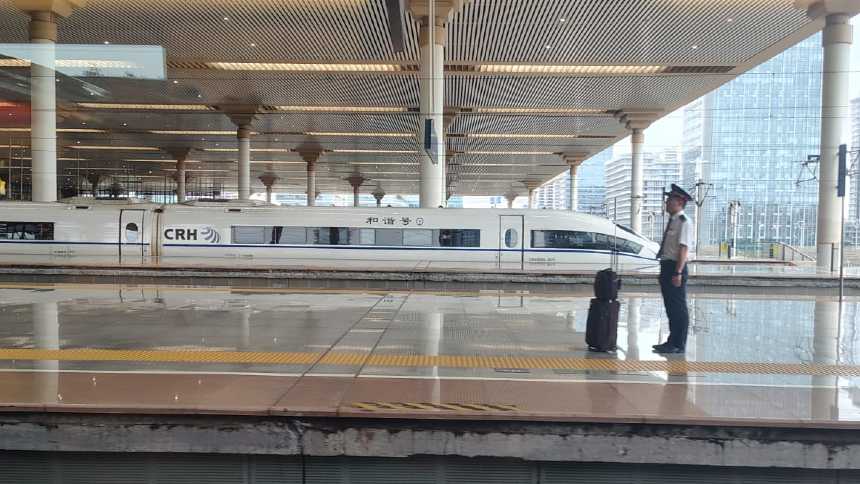
Traveling the line connecting Beijing to Shanghai in just over four hours is a good example of how quickly Chinahas advanced in high-speed rail. NeoFeedboarded the bullet trainconnecting the two metropolises and was able to see firsthand how the country has become a major player in this mode of transport.
Operated by the state-owned China State Railway Group, the Chinese high-speed rail system began planning in 2004, and four years later, the first line, linking Beijing to Tianjin, was officially inaugurated.
Since then, the country has strongly accelerated the expansion of this network. Currently, the system is over 50,000 kilometers long, which puts China far ahead in the sector. In second place, far behind, is Spain, with 3,900 kilometers, followed by Japan, with 3,100.
Other figures show how the project's reach extends beyond the railway tracks and aligns with China's development and integration plan. High-speed trains already connect approximately 97% of the country's cities with more than 500,000 inhabitants and transport around 4 billion passengers annually.
The project to reach these affected numbers is a model adopted in other areas by the Chinese government. Initially, technology partnerships were established with companies from countries such as France, Japan, and Germany. After acquiring this know-how, China began developing its own trains and tracks.
Among other features adapted to the country's specific characteristics, high-speed trains have intelligent suspension, safety sensors, and automated control. At the same time, they are less polluting than road and air transport, which has helped to boost the growth of this mode of transport.
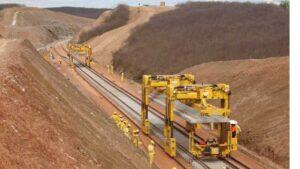
The Chinese rail network is approximately 50,000 kilometers long.
Technology is embedded in other parts of this journey. 5G antennas installed throughout the route ensure that, in the carriages, often occupied by passengers on their way to work, the internet connection is also high-speed.
This menu also includes the option to access a delivery system and choose a meal from an establishment at nearby stations. The order is placed via an app or a QR code on the seats, and delivered directly to the passenger at the designated stop.
Payment for meals — as well as items not included in the complimentary "menu" offered to travelers — follows the Chinese standard. Transactions do not involve cash and are mostly conducted through the Alipay and WeChat apps.
Ticket options include three categories, separated by carriages: economy, business, and first class. Prices range from R$120 to R$1,800. The onboard service is similar to that of airplanes, offering juices, coffee, biscuits, and snacks, depending on the chosen class.
There are some differences, however, in this comparison between the two types of transport. Unlike commercial aircraft, the seats are wider and there is more room to stretch your legs.
On another note, although the stations are very similar to airports, traveling on a bullet train does not require passengers to arrive at least an hour in advance. However, it is important to be aware of the need for punctuality in departures. This is another factor that attracts those who choose Chinese bullet trains.
And the plane?
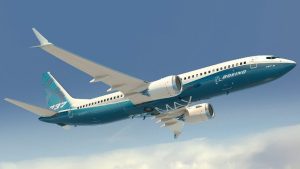
The fact is that this is increasingly becoming a preferred option for travelers, at least for short and medium distances. This has already led to significant changes in the Chinese transportation market, particularly impacting local airlines.
A study by Cirium Ascend illustrates this context. According to the consultancy, high-speed trains are behind the drop in demand for domestic flights over distances of up to 800 kilometers, which represented 26.4% of total trips in 2011 and fell to 15.9% in the first quarter of 2025.
According to the survey, the fact that the stations are, on average, 10 or 15 kilometers from urban centers, compared to 25 to 40 kilometers from airports, is one of the factors that attract passengers. Another is the more efficient security screening, with shorter queues and less stringent protocols.
The study shows, for example, that the average total travel time—from the doorstep to security clearance—on a trip from Beijing to Shanghai is 120 minutes by plane, and 75 minutes by high-speed train.
The consultancy highlights that, in this direction, airlines have been encouraged to prioritize longer trips. Between 2011 and 2025, the average flight distance increased from 1,477 kilometers to 1,610 kilometers.
In this scenario, the expectation is that high-speed trains will gain even more relevance. In tests, the new generation of CR450 trains is already reaching speeds of just over 450 kilometers per hour. In parallel, the country's plan is for the network in this mode of transport to reach a length of 70,000 kilometers by 2035.