

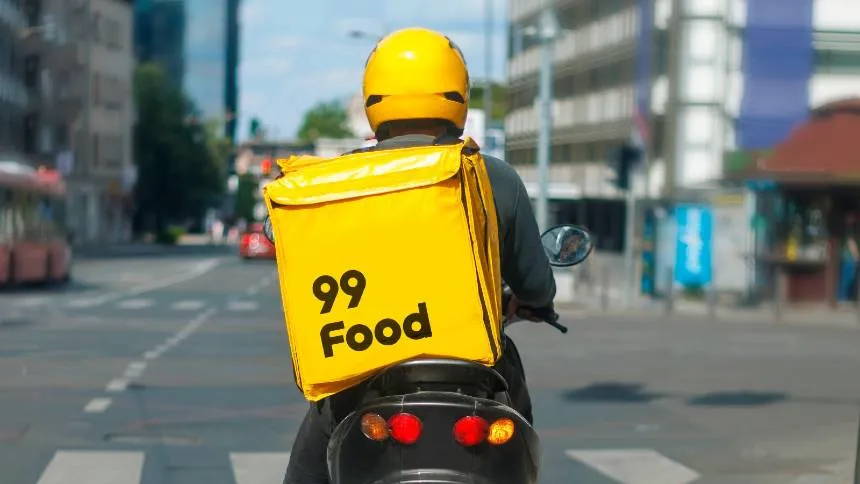

Three weeks after the Administrative Council for Economic Defense (Cade) reopened the process investigating anti-competitive practices in the delivery market, 99Food began its operations in Santos on Tuesday, July 21st. Santos is the second city in Brazil with the presence of the three main players in the sector, as anticipated by NeoFeed . Keeta and iFood already operate in the municipality.
The launch of the new city coincides with the antitrust agency reopening the case filed by Keeta , which accuses 99Food of entering into exclusivity contracts that prevent the restaurant from working with more apps.
The argument justifying the reopening of the case by the CADE (Administrative Council for Economic Defense) is that the restaurants holding these exclusivity contracts had not been heard by the agency. The Brazilian Association of Bars and Restaurants (Abrasel) also complained that it had not been consulted.
99Food denies and refutes its competitor's claims. The platform, controlled by the Chinese company DiDi, says that no market practice differs from what its main competitors do. According to the company, it is Keeta itself that fosters an exclusivity policy with commercial establishments.
“They are the ones who do this. We felt this practice of exclusivity in the market when we decided to enter Santos and looked for restaurants. It's not what they say, but the opposite. What we do is legitimate and is not a ban clause,” says Bruno Rossini, director of 99, to NeoFeed .
This is the first time the company has spoken about the matter since the decision by CADE (Brazil's antitrust authority) to reopen the case. According to the executive, the fact that the company is a "newcomer" to the market shows that it would not have the power to impact the sector through exclusive service contracts.
“We still have fewer than 100 cities. And our oldest operation is less than a year old, which is Goiânia. We protect our investment within the limits allowed by CADE (Brazil's antitrust authority). Our option is valid because it doesn't impact the market. And most companies don't want exclusivity,” he states.
According to the executive, the environment in Santos was a bit more closed off than the company had anticipated. And, among the restaurants, most contracts were signed without any exclusivity clause, allowing establishments to operate on multiple platforms.
However, the company offers the option, depending on commercial conditions, to allow the restaurant to have a contract with another platform, preferably iFood. But, according to Rossini, this is not a ban clause for Keeta.
“Our strategy is to facilitate the opening of this market. What we've been hearing from restaurants is that they don't have the scope to work with many platforms at the same time. The average profile of a Brazilian restaurant is that of a small establishment,” says Rossini.
According to the director of 99Food, reopening the case is legitimate and the restaurants should indeed be heard. “We received the decision calmly. 99 innovated, within what is permitted, and CADE (Brazil's antitrust authority) will decide on that. Competitors do exactly the same thing.”
Even with the new Santos location, two practices adopted by Keeta, which have been the target of criticism from the sector, will not be adopted by 99Food.
One of them is "intermediate purchase," in which the platform makes the direct purchase, on behalf of the customer, at the restaurant, and then handles the delivery. In practice, the end consumer does not appear to the app, which can lead to problems in case of delivery failures.
Keeta's other practice is to pay iFood's exclusivity fees to attract restaurants to the platform – 99 says it will not do the same. In the case of the company controlled by Meituan, the amounts per establishment reach R$ 1 million.
“We are not going to do that. What we have been discussing with the restaurants is the risk they take when breaking exclusivity contracts. Our role is to provide support and help them understand that the model may no longer make sense,” Rossini added.
In a recent interview with NeoFeed , the president of Abrasel, Paulo Solmucci , says that in the city of São Paulo, where the three operate, competition has increased. According to him, iFood now has 60% market share; 99Food, 30%; and Keeta, 10%.
“The company already had a significant user base in Santos, which facilitates communication with restaurants. Every business wants to offer the best service to the customer, and we entered the launch with a solid number of establishments,” says Pedro Pecly, business development leader at 99.
Since 2022, the company has been operating a motorcycle passenger transport service on the coast of São Paulo, unlike in the capital, where this type of vehicle is prohibited.
The entry into Santos concludes 99's initial R$2 billion investment plan in the Brazilian market. From now on, the company will follow a new cycle, with an undisclosed investment amount.
In any case, the company has already defined a package of R$ 50 million in investments in the cities where all 99 operations are already functioning, to set up support bases for delivery drivers.
“We will prepare the environments to guarantee a safe place for him to rest, with coffee and water. We will seek out these spaces, some in partnership with city halls, and ensure this support. Santos should have one of these bases,” says Rossini.
Next week, the company will launch the 99 Compras platform in São Paulo, another delivery model that, in addition to food, will serve 20 categories, such as supermarkets, pharmacies, stationery stores, and florists.