

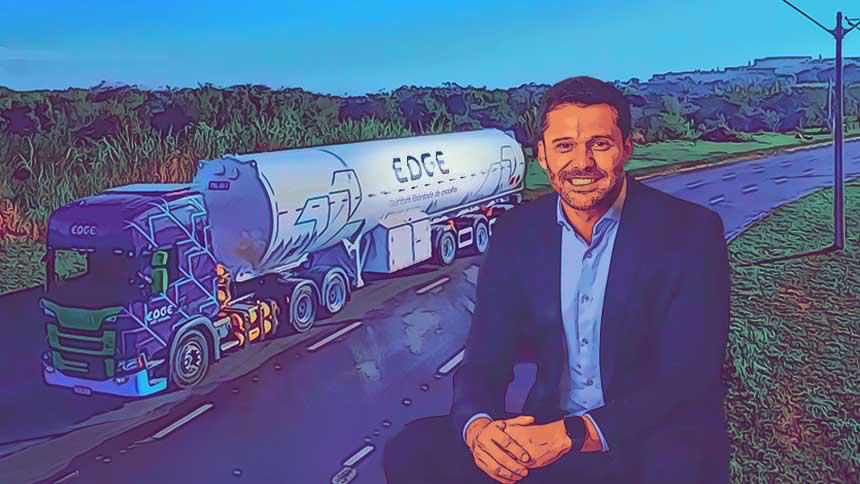
Considered by the market as the "crown jewel" of Compass, part of the Cosan group , Edge, a pioneer in the free market for liquefied natural gas (LNG), has a plan to capture supply opportunities for industries through distribution far beyond the existing gas pipelines in Brazil, which still have low coverage.
To achieve this, the company decided to invest approximately R$ 2 billion in its own infrastructure to guarantee the supply of LNG through truck deliveries and expand its offering to the industrial sector. Today, the company has 70 clients in 11 states, across eight industrial sectors – serving, for example, Vale and Saint-Gobain.
The largest portion of this investment – approximately R$ 1 billion – was allocated to the construction of the São Paulo LNG regasification terminal (TRSP), a 294-meter-long vessel anchored in the port of Santos , which transports the product via barges, which is then transferred to trucks for final delivery to the customer.
The gas is stored at a temperature of -163 degrees Celsius to reduce its volume by approximately 600 times. Authorization to carry out this method was granted by the National Agency of Petroleum, Natural Gas and Biofuels ( ANP ) in January of this year.
Edge is a subsidiary of Compass, a company that also owns Comgas and Commit Gás and which held its IPO on the B3 stock exchange on May 11 of this year.
Financial analysts are betting on the LNG company precisely because of the growth path it has developed from a new market for the sector, which was only implemented two years ago – Edge was the first to operate in the segment, with its first contract signed in July 2024.
“This investment cycle has already yielded results for the company. We are expanding the off-grid market [outside the gas pipeline network]. The company has great ambitions based on the opportunities that will still arise,” says Demétrio Magalhães, CEO of Edge, in an interview with NeoFeed .
The expansion of road transport is strategic precisely because of the bottleneck currently faced by the sector, even though it is experiencing strong growth. There are not many pipeline routes in Brazil, which hinders the direct expansion of LNG.
According to data from the Brazilian Association of Piped Gas Distribution Companies (Abegás), the distribution network in the country today is only 47,000 kilometers long, with 76% (36,100 kilometers) of these pipelines located in the Southeast Region. Currently, the industrial volume in the free natural gas market is 15 million m³ per day.
But the biggest problem lies in the volume of transport pipelines, which is the final stage that actually gets the gas to the companies. This branch is only 9,400 kilometers long in Brazil. To give you an idea, the United States has 480,000 kilometers of pipelines, 51 times more than the Brazilian infrastructure.
In practice, only 5% of the Brazilian market has access to gas pipelines. In São Paulo, for example, penetration doesn't reach 30%. That's why the off-grid model, with trucks, has become an alternative for Edge to achieve geographic growth and revenue generation. But there are also operational limitations, mainly regarding truck range and fuel costs.
Road transport using LNG can cover a radius of 1,200 kilometers from Santos. This means it's possible to deliver the product to cities in southern Bahia, parts of Paraná and Santa Catarina, the Midwest, and throughout the Southeast.
In any case, in the view of Edge's CEO, this road layout should serve as a benchmark for high demand so that distributors can expand structural investments in the sector.
“That’s why there’s plenty of room to continue building transportation and distribution networks. When I bring LNG to customers who aren’t served by pipelines, I start to justify investments in pipelines. It’s a way to expand the culture of the natural gas market, which is very competitive,” says Magalhães.
In July of this year, the company reached the milestone of 500 trucks sent to LD Celulose, in the Triângulo Mineiro region, in six months. During that period, 16 million m³ of LNG were transported.
In addition to the Santos terminal, the company recently started operating its biomethane purification plant in Paulínia, in the interior of São Paulo. Currently in the ramp-up phase, the unit has received investments of R$ 450 million, mostly through the Climate Fund of the National Bank for Economic and Social Development (BNDES).
The biomethane unit, called Onebio, was built through a joint venture (JV) between Edge (with 51%) and Orizon (49%).
The fact is that the expansion of the company's operations in the free LNG market, with Ometto as chairman of the board, is occurring precisely at a time when Cosan is facing a debt crisis.
In recent months, Ometto's holding company has undertaken a series of actions, such as making changes to the boards of its companies, selling its stake in Vale, seeking resources in the market to reduce its debt, and filing for extrajudicial reorganization of Raízen , the largest in history, which has R$ 65 billion in debt.
In this sense, Compass's own IPO, which raised R$ 3.2 billion from the main tranche (R$ 2.8 billion) and extras, managed to secure a significant amount for Cosan's cash flow – the group's consolidated stake is equivalent to 76.18% of the shares. The IPO was the first on the B3 stock exchange in five years .
“An IPO opens up new sources of funding. And, for a growing group, it’s always interesting. Edge will always seek the best forms of financing for our expansion plan,” says the CEO.
The pricing error
While the operation is already showing traction on paved roads, the company's potential on Faria Lima Avenue is yet to be fully discovered. Recently, five major investment banks – BTG Pactual, Citi, Itaú BBA, Bradesco BBI, and JP Morgan – initiated coverage of Compass's shares with a buy recommendation, projecting an appreciation of up to 49% in the stock price.
In its report, Citi classified the pricing of Edge as a "market mistake," ignoring its role as a growth catalyst for the holding company, with the potential to multiply its traded volume from 6 million to 22 million m³/day by 2030.
"An important source of potential appreciation lies in the Edge segment of the Compass subsidiary, since, in our opinion, the market is currently assigning little value to this segment," says a Citi report.
In the bank's view, the stock market has priced Compass focusing excessively on its traditional pipeline distribution concessions (such as Comgás) - which BTG defines as a "boring but excellent" business due to its predictable cash generation.
Operational figures help support the banks' thesis. In the first quarter, Edge recorded EBITDA of R$187 million, a 36% increase compared to the same period of the previous year, driven by a sales volume of 416 million m³ of gas.
The revaluation of Edge in the financial market has a direct effect on the flight plan of Cosan, the holding company led by Rubens Ometto. At a time when the conglomerate is seeking alternatives to reduce its debt and accelerate its deleveraging, unlocking the value of the subsidiary becomes key.
Market recognition generates two immediate effects for the parent company: first, it reduces the historical discount applied to Cosan's shares by revaluing the book value of its main asset.
Secondly, the combination of stable distribution and the accelerated expansion of Edge's off-grid model supports dividend yield projections close to 9% per year for Compass - proceeds that will directly boost Cosan's cash flow.
For BTG Pactual, the key point of the IPO of the company that owns Edge was contributing to the reduction of Cosan's net debt. The company ended the first quarter with gross debt of R$ 15.2 billion and cash of R$ 7.7 billion, resulting in net debt of R$ 7.5 billion.
"Although the valuation fell short of initial market expectations, the transaction brought important benefits. It assigned a market value to the holding company's largest asset, helping investors to better assess the discount on Cosan's stake," says the BTG report.
Magalhães points to the resilience of the new market, precisely during the period in which expansion had to face the challenges caused by two wars since 2024: the war between Ukraine and Russia, and the war between the United States and Iran.
With higher oil prices and the opportunity to diversify its raw materials, the company managed to grow even with the volatility of the international market. Today, the company receives natural gas from various sources, such as Argentina, Bolivia, and the pre-salt basin in Brazil.
The investments made, coupled with opportunities arising from a stressed market, led to a 27% increase in sales volume in the first quarter. During this period, the company sold 416 million m³, compared to 317 million m³ sold in the same period of the previous year.
Since going public, Compass has fallen 7.9% on the B3 stock exchange. The market capitalization of the company that owns Edge and Comgas is R$ 18 billion.