


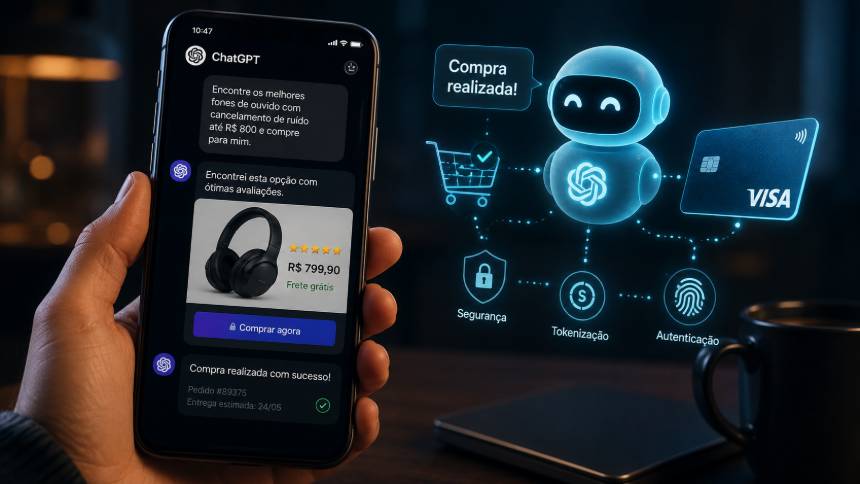
Visa announced on Wednesday, June 10th, a partnership with OpenAI to transform ChatGPT and all of the company's platforms into buyer services. The idea behind the partnership is to accelerate the number of transactions that are completely executed by agents, without human intervention.
"The consumer still participates in the process by approving the purchase. Our vision is that this human intervention will decrease and that the purchase will be increasingly delegated to the agent," says Catarina Tobar, senior director of products and partnerships at Visa, in an interview with NeoFeed.
Under the agreement, Visa will provide the payment network, tokenization systems, authentication, and risk monitoring that will allow OpenAI agents to conduct transactions securely. Purchases will occur within user-defined parameters, such as spending limits, authorized categories, and the requirement for additional approvals.
For now, the solution is only available in the United States, but the idea is to expand it to other countries soon. Brazil is one of Visa's priority markets, but implementation will require adaptations due to local particularities.
"In Brazil, we need to consider issues such as installment payments, integration with digital wallets, and different forms of payment. We are working to ensure that the entire ecosystem is prepared for this new wave of commerce," says Catalina.
The executive highlighted that Visa has already begun this process through the Visa Agent Ready Program, a recently announced program to prepare issuing banks and other market participants for payments made by artificial intelligence agents.
In May of this year, Visa announced a pilot project with Banco do Brasil to test purchases made by artificial intelligence agents. The project served as a preview of the technology that the company now intends to scale through its partnership with OpenAI. "We have invested heavily to ensure that issuers are already ready in a production environment," says Catalina.
Visa also announced new tools for the industry, including a directory of certified agents, rating systems to assess their reliability, and artificial intelligence models trained on billions of transactions to detect fraud and improve approval rates.
The company is also strengthening its infrastructure for stablecoins, cryptocurrencies pegged to traditional currencies like the dollar. The company reported that it already handles approximately US$7 billion annually in this type of transaction and intends to expand the use of these assets in everyday payments.
The expectation is that AI agents can change the way people shop, while stablecoins have the potential to change how money circulates behind those transactions.