

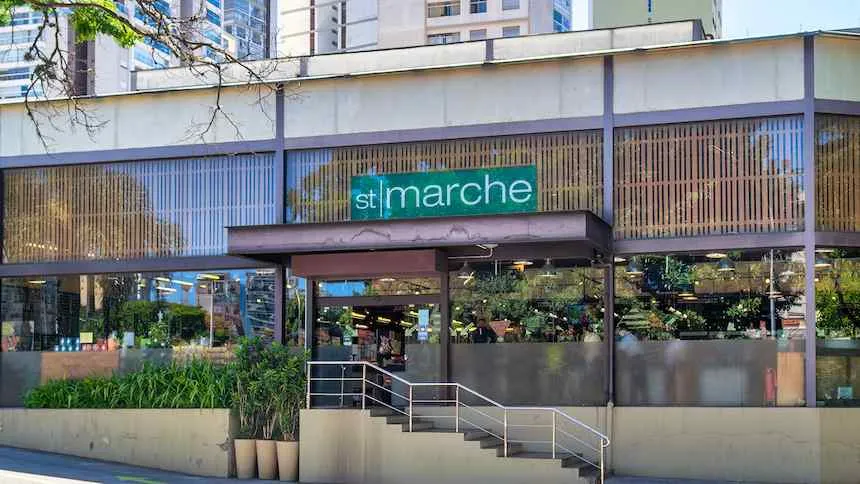
Owner of brands such as Prezunic, GBarbosa and Giga in the Brazilian market, the Chilean group Cencosud shook up the M&A scene in the country's food retail sector by announcing the acquisition of the St Marche chain this Wednesday, June 24th.
In a statement, the company announced that it has reached an agreement to acquire 100% of the operations of the Brazilian premium supermarket chain, debt-free and without cash outlay. The transaction is subject to approval by the Administrative Council for Economic Defense (Cade), among other terms.
The additional conditions include the approval of the judicial reorganization plan ratified by St Marche also this Wednesday, eight months after the retailer concluded an out-of-court restructuring involving a debt of R$ 528 million.
According to Cencosud, with the green light from Cade and the approval of the RJ plan ratified today, the purchase of St Marche will be financed through the reallocation of capital generated by resources from another recent M&A made by the group – this time, on the other side of the negotiating table.
In February 2025, the company sold all 54 stores under the Bretas banner in Minas Gerais to the Supermercados BH group, in a deal valued at approximately R$ 716 million.
The amounts to be invested in the St Marche operation, in turn, were not disclosed by Cencosud. Contacted by NeoFeed , the Chilean group stated that it would adhere to the information released in the press release about the acquisition.
Aside from the figures involved, the fact is that, with the agreement, Cencosud reinforces its presence in São Paulo, where the group previously operated only with Giga, a wholesale retail chain acquired in May 2022 in a transaction worth R$ 500 million.
By incorporating St Marche, the group extends its operations in the region to the high-income supermarket segment, bringing to its portfolio an operation with 32 stores, in a package that also includes Empório Santa Maria and a 7,500 square meter distribution center.
“It’s a difficult asset to replicate organically,” says Ana Paula Tozzi, CEO of AGR Consultores. “And it’s a unique opportunity to enter a higher value-added segment, which has higher-income clients, high purchase frequency, and lower price sensitivity.”
Tozzi emphasizes that, even amidst financial difficulties, St Marche operates with a loyal clientele and has managed to build a proposition associated with the shopping experience, a differentiated assortment, imported products, quality perishables, and convenience.
“The chain has a strong connection with high-income consumers,” says Tozzi, who highlights the potential gains for St Marche, especially in the context of its judicial reorganization. “Cencosud’s entry adds financial muscle, negotiating scale, and investment capacity.”
Upon entering this high-end food retail space in São Paulo, the most obvious competitor Cencosud will face is GPA , which has historically always been at the forefront of premium supermarkets in the city of São Paulo and its metropolitan area.
However, just like St Marche, GPA is also going through a more challenging period and facing financial difficulties, which in March of this year resulted in a request for extrajudicial reorganization to restructure R$ 4.5 billion in debt .
According to Alberto Serrentino, founder of the consulting firm Varese Retail, Cencosud's entry into the segment should not have an impact, at least in the short term, on GPA, both because of St Marche's own situation and because of the leadership transition and asset integration process.
“St Marche is a company run, from the beginning, by its founders, and it is now migrating to a corporation,” says Serrentino. “It’s necessary to understand who will be running this operation, what the culture will be. So, in the short term, I don’t think they will be aggressive enough to bother GPA.”
According to Serrentino, in the outcome of the two debt restructuring processes, everything will depend on the quality of execution by each of the companies. "GPA also has several issues to resolve. It still has a large contingency stock, high leverage, and several complex agendas to overcome."
Similarly, Tozzi also doesn't foresee any potential impacts for GPA at this early stage. However, he does make a reservation: "The acquisition doesn't mean an immediate loss of market share, but it certainly increases the pressure for competitiveness at a time when GPA is seeking to regain market confidence and stabilize its operations after years of restructuring."
Regarding Cencosud, Serrentino points out that the group has experience operating premium stores in Chile. However, in Brazil, its previous foray into this segment, starting with the acquisition of Perini in Bahia in 2010, did not yield good results.
“Another question is what the group’s strategy is for St Marche. Do they see, for example, room to take this brand to other markets?” he says. “This is not an easy business to operate and scale.”
Inside the house
The fact is that Cencosud itself has issues to face in its own operation, separate from St Marche. In its most recent balance sheet, referring to the first quarter of 2026, the group reported revenue of 3.9 billion Chilean pesos, a decrease of 4.4% compared to the same period a year earlier.
In Brazil, the drop in revenue was even more pronounced, at 12.4%, to 321.2 million Chilean pesos (R$ 1.8 billion). However, as part of the recent strategy focused on profitability in operations, adjusted EBITDA increased by 41.9% during this period, to 12 million Chilean pesos.
In its earnings report, BTG provided some insight into this scenario, highlighting weak results hampered by operations in Argentina, Chile, and the United States. Simultaneously, it noted improved margins in countries like Brazil and Colombia.
"Although Peru and Colombia are showing stronger growth and Brazil is improving, it is unlikely that these markets will fully offset weaker trends in other regions in the short term," the bank highlighted, with a neutral recommendation and a target price of 2,900 Chilean pesos for the stock.
On the Santiago stock exchange, Cencosud shares were down 1.41% around 2:25 PM (local time), valuing the company at 5.8 trillion Chilean pesos (approximately R$ 33.2 billion). Year-to-date, the shares have risen more than 26%.