

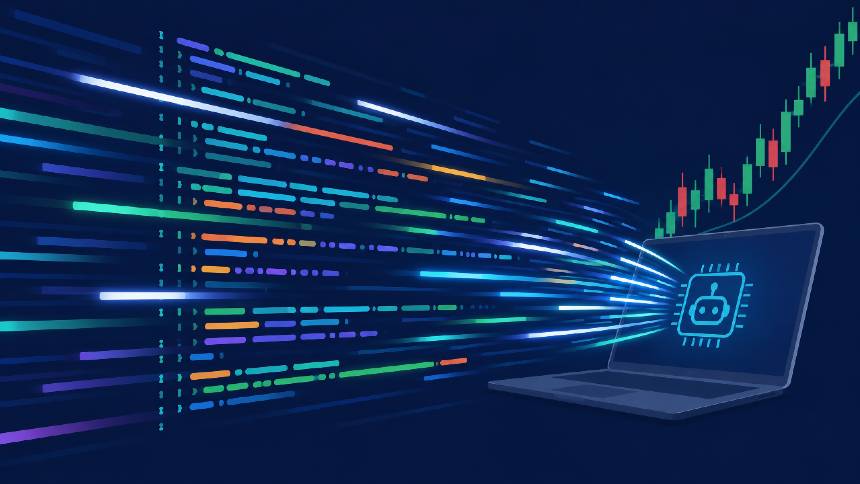

Still in bed, before turning on the light, Jorge Dib already has his cell phone in hand. The first thing the macro fund manager at Galapagos Capital asset management accesses is Bloomberg — a habit he developed over decades in the market and which remains intact. But the second step has changed. Instead of opening a newspaper, he reads a personalized briefing prepared overnight by a robot.
The system, developed by himself, combines Claude, Grok, and Gemini — each model with a specific function. Together, the three track what has been released about the markets, and the result arrives organized, with the information that the manager has configured as relevant to their management style.
It's only after that that Dib considers opening one of the newspapers he still subscribes to. "The newspaper is old, isn't it? A lot of things have already come out the day before. But I still take a quick look," says Joca, as he is known in the financial market.
Artificial intelligence is reshaping the day-to-day operations of the Brazilian fund industry. NeoFeed spoke with eight independent asset managers with over R$100 billion in investments to understand how the local market is adopting the technology — and what they found is a sector undergoing accelerated transformation, but still uneven.
Among them, the use of AI to automate and streamline previously manual processes is almost unanimous, as is the preference of managers for the Anthropic language model, which has become an efficiency tool in back offices .
“Claude has a more complete and integrated toolkit , and its more advanced tools are easier to use. You can build agentic flows directly on the platform, without depending on a third-party intermediary,” says Thomaz Pougy, technology director at RBR Asset .
At RBR, Pougy orchestrated the introduction of technology into the asset manager's processes. The company created a corporate account, associated all employees with their own logins, and, before granting access, put together an internal training program. "If you don't know what you're doing, you'll run out of data in two prompts," he says.
With approximately 40 employees, RBR selected one professional per area to receive more in-depth technical training and disseminate its use to colleagues, enabling them to develop ways to make their tasks more efficient.
The second phase involved developing AI agents and integrating them into proprietary systems, facilitating tasks ranging from legal matters to managing household funds.
In the fund-of-funds area, which requires information on external operations, the system scrapes hundreds of public documents and performs a preliminary analysis, extracting the data that will feed the manager's internal system. The registration of an operation, which used to take more than a day, has already been cut in half, says Pougy. "And we're going to improve."
With AI agents taking over tasks previously delegated to less experienced analysts, asset managers have been able to increase their coverage area without needing to expand their teams.
“We didn’t fire anyone. But an analyst who used to cover X amount of stocks can now cover 2X, 3X. We are managing to expand this analytical capacity,” says Danilo Ribeiro, CEO of Paramis Capital .
Davi Costa, a fund analyst at CVPar responsible for monitoring the FIDC market, uses AI to build Python and R code that automates operational tasks. "The gap has shifted from programming knowledge to understanding the operational problem. Those who know the product well can, together with AI, build the tools they need," he states.
The analyst says he is frequently asked if he is afraid of being replaced by machines. He states that he is not, and that technology is here to help.
“From my experience in my sector, I think it’s difficult for AI to steal jobs. You need human intellect. The ideal for workers is to try to adopt these technologies as quickly as possible, much more than to fear being replaced,” says Costa.
On the other hand, Henrique Lara, partner and equity manager at Reach Capital , believes that management teams tend to become increasingly lean. "Artificial intelligence already does the work of the junior analyst. But the judgment of the manager or a senior analyst remains necessary."
Responsible for buying and selling global stocks at Reach, Iara has always been closer to the technology sector and it was he who introduced artificial intelligence into the asset manager's processes.
Like Joca from Galapagos, Iara also developed an agent that reads the news from her management area and sends a daily summary. For the team, she also developed an idea repository fed by AI agents with everything the team reads, receives, and discusses, such as reports and transcripts of analyst calls and internal meetings.
For Iara, this ability to orchestrate agents is a new skill for being a good manager in the age of artificial intelligence. "A programmer who knows how to use AI very well is 100 times more productive. I think that, in a way, this will also be a dynamic in the world of investment management."
Management company with almost no analysts.
Luis Felipe Amaral, CEO and founding partner of Drýs Capital (formerly Equitas), took this to the extreme, revolutionizing the entire business model of the asset manager. Coming from a tough redemption period in equity funds after the pandemic, the manager decided, back in 2022, to redesign the entire structure of the firm based on artificial intelligence , training employees in the new technology.
“Some people didn’t adapt and ended up leaving. The analyst who wanted to do exactly what I used to do ended up leaving, while the senior analysts were reassigned to other business areas,” says Amaral.
The equity management team, which once had 10 people, including nine analysts, has shrunk to just two managers, one of whom is Amaral himself. Each manages a fund: Amaral, Drýs High Convictions, and Ricardo França, Drýs Selection. Although they manage alone, each has their own orchestra of AI agents, developed by themselves, with distinct styles.
"I feed this agent system with everything I've learned in 30 years in the market, with what I believe makes sense or not." His system, he says, periodically scans 20,000 actions based on his predefined criteria and delivers the results on demand.
“The calls, all the interviews, everything that comes out about the company, it's the agents who gather the information,” he says. “He brings me what he saw, the analysts' reaction, how that should impact our projections. There's an interaction with me. I give my opinion.”
Besides having a team at his fingertips 24 hours a day, Amaral says that one of the biggest benefits of the change was being able to use the time he used to spend managing people to dedicate more time to managing the funds. “When I had a team of 10 people, a portion of my time was spent managing people, egos, feedback. You lose time, attention, and focus—and I guarantee that all managers experience this.”
Today, he says, the exchange of ideas focuses on interactions with artificial intelligence and with the manager of the High Convictions fund. “It’s a very different conversation. The analyst is covering only one or two sectors. The manager is seeing everything, with the responsibility of making decisions.”
The results have been reflected in the fund quotas. Year-to-date, Equitas Selection and High Convictions have accumulated gains of 25.41% and 78.98%, respectively, compared to 9.24% for the Ibovespa. High Convictions, created in mid-2022—the same period as the start of the asset manager's transformation process—has accumulated a return of 320.20% since its inception, 241 percentage points above the benchmark.
Amaral states that the new model has also resulted in significant cost savings, reducing the payroll for the analyst team to between US$2,000 and US$3,000 per month—the amount he pays to run his agent system on Claude Code. According to him, the system is updated daily to adapt to new demands or more recent models released by Anthropic.
From a team of twenty-two people focused exclusively on equity management, the team has shrunk to twenty-one, with only four people now managing funds, including credit, in addition to three people in support and sales.
Although the management team has been reduced, the CEO says that the Drýs team has remained almost the same size, with the emergence of other divisions — the biomethane company Renu Energia, with five people, and Credit Guide, a private credit data platform. Developed with AI by a Drýs analyst who became responsible for the business, the tool has become the company's main area in terms of personnel, with 9 people.
For quants, a "revolution"
Daemon Investments took a different path, opting to keep its management team intact and primarily using AI to gain efficiency in testing quantitative models, the basis for managing its funds, which total US$7 billion.
"This is the greatest revolution in human history since the control of fire," says Sérgio Schirato, CEO and founding partner of Daemon.
At Daemon, AI has become central to the research and development process for quantitative strategies. What previously took months—simulating a strategy, training parameters, applying it to different markets, evaluating variations—is now done in days.
“We are managing to do more than we could by quintupling the team. It’s as if we gained superpowers,” he says.
In addition to speed, the management company integrated AI directly into its codebase via Anthropic's corporate solutions, allowing the model to access the work of the entire team simultaneously. "It's almost a collective consciousness," he defines it.
The idea of a shared knowledge base has also been used by Legacy Capital . André Dias, quantitative manager at the firm, explains that the database, previously restricted to the quantitative area, is being opened to the entire company, with agents cross-referencing time series with internal analyst comments, allowing them to even assess each analyst's track record of accuracy.
In the quantitative area, AI has also filled a gap left by the departure of junior programmers. "We managed to cover that by using AI. We greatly increased our development productivity," he says.
Both Dias and Schirato have also sought to use AI in their quantitative models to assess market sentiment regarding specific assets.
At Legacy, the quantitative area runs transcripts of earnings calls through language models to classify whether the company's tone was optimistic or pessimistic—an analysis that previously required more rudimentary proprietary models. At Daemon, Schirato mentions an interest in analyzing alternative data, such as social networks, as the next step in the process.
Similar functions have existed for years and have become a business in the United States. One of the companies operating in this area is Context Analytics, acquired in February by the Israeli company Bridgewise , which also operates in Brazil and seeks to adapt the technology developed for the local market.
Context Analytics, based in Chicago and with over 13 years of operation, is used by S&P Global, Millennium, and BlackRock, primarily in quantitative strategies. The product monitors market sentiment minute by minute on social media and news to anticipate sharp swings in stock prices.
Daniella Italiano, Bridgewise's sales director for Latin America, states that the greatest interest in Context Analytics' product comes from quantitative funds. According to her, however, the technology still needs some adjustments to adapt to the Brazilian market—among them, a better understanding of irony and sarcasm on social media.
According to her, asset managers' interest in using AI for decision-making is still limited to a few local players. "We see artificial intelligence being applied in back-end and middle-end processes to generate process efficiency—this has already been more than proven. But when we talk about a technology for generating alpha as an ally in the asset manager's strategy, it's not such a trivial conversation."