


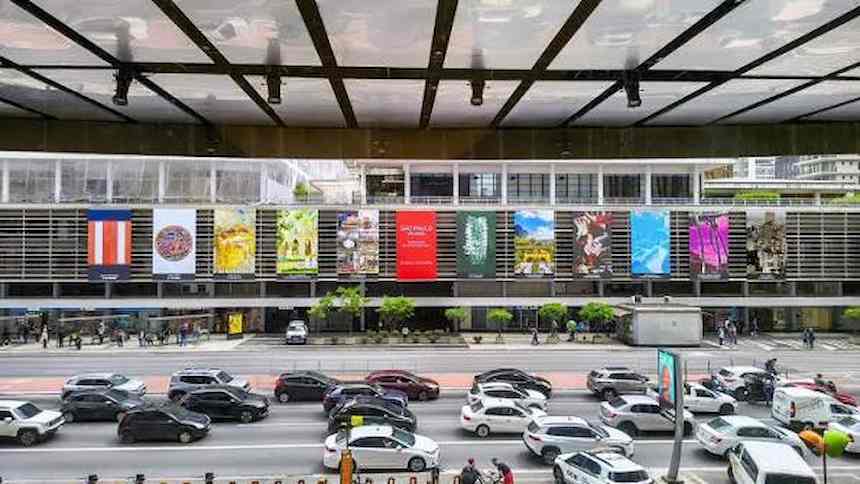
Anyone passing through the Vila Mariana and Ibirapuera neighborhoods of São Paulo, or around Avenida Rebouças, will find a scene that contrasts sharply with the promises of the 2014 Master Plan, encountering shops on the ground floors of buildings closed and without any activity. In some parts of the city, eight out of ten active storefronts are empty.
A study commissioned by the São Paulo Commercial Association (ACSP) to the Campagner Architecture and Urbanism office shows that between 60% and 80% of the active facades in the Urban Structuring Axes — blocks located within 150 meters on each side of bus corridors — are unoccupied.
In Vila Mariana, the rate reaches 80%. In Ibirapuera, it's 70%. In Rebouças, it has the lowest rate among the three areas surveyed: 63%. Most of these properties don't even display a "for rent" sign.
The response from the real estate market confirms the magnitude of the problem. One Innovation, a mid- to high-end real estate developer with projects in Perdizes, Pinheiros, Itaim, and Jardins, decided to halve the size of active facades in its new developments – other companies simply gave up on including them altogether.
According to Alessandro Azzoni, coordinator of the urban policy and environment council at ACSP, the diagnosis is that the problem lies not in the demand for street retail – which is actually growing – but in the way these spaces were designed.
"Many construction companies saw the active facade as a way to gain area, but they didn't consider the commercial suitability of the space," says Azzoni.
"There are stores on streets unsuitable for commerce, in low-traffic areas, and many spaces were delivered as generic halls, without specifications specific to retail," he adds.
In practice, many developers included these stores in the Gross Sales Value (GSV) calculation and tried to sell them as a natural part of the residential project. But retail has a different dynamic in terms of price, return, operation, and maturation.
A shopkeeper rarely buys property for their own use. An investor, on the other hand, only pays if they see a viable income. The result: the asset "burns in the hands" of the buyer.
For Julia Arruda Botelho, founder of the consulting firm Matchpoint Real Estate, a company with R$ 2.7 billion under management and over 1 million square meters administered, giving up the active facade could mean forgoing real potential revenue.
"Giving up is easy, but you're losing the potential profit you would have made there. In the vast majority of cases, the incentive provided by the law is well worth it," she says.
The founder of Matchpoint argues that the active facade can cease to be a poorly resolved urban planning obligation and become a business vertical, provided that retail is integrated into the project design from the beginning.
"Just as you have a residential specialist when you're developing a residential project, if you're developing a retail project, you need a retail specialist there to determine the profile, the technical specifications, and how much you're going to sell," says Botelho.
Active storefronts as a business
Some developers have already taken this path and are reaping results that buck the trend. Porte Engenharia e Urbanismo and HBR Realty have created their own structures to plan the commercial ground floor before, during, and after the delivery of their projects – and are registering occupancy rates of around 80% to 90% in these areas.
At Porte, the active facade strategy began to be considered even before the legislation. The company operates in the East Zone of São Paulo and its main showcase is the Platina Axis, a 3.6-kilometer project in Tatuapé parallel to Radial Leste.
The logic is different from most of the market. Instead of looking at each project in isolation, Porte tries to build a new urban center, combining residential, corporate, services, street commerce, wider sidewalks, landscaping, and pedestrian circulation.
"The Platina Axis is a new central hub proposed by a private initiative," says Paulo Pinheiro, head of asset management at the company.
The eastern region has 4.4 million inhabitants, of whom 2.6 million commute to work in other parts of the city. The project aims to create a center connected to the neighborhood and reduce this dependence. In this model, the active facades are not treated as standalone shops on the ground floor, but as part of the region's occupancy strategy.
Porte also changed the way it captured value from these spaces. In its early projects, it sold the store leases to investors. Over time, it realized that by selling everything, it lost control over the mix of products, pricing, and occupancy.
"Along the way, we learned how to mature and increase our control over these spaces," says Pierro. "For assets that are no longer ours because they were sold, we acted as consultants. From the moment we realized that doing so meant losing control, we stopped selling the facades."
In the Métria development, scheduled for delivery in July, Porte decided not to sell the shops as independent units. Instead, it brought in partners who buy a percentage stake in the asset, while the developer retains management of the mix of stores, sales, and occupancy. The strategy is to transform the active storefront into recurring income.
For Igor Melro, commercial director of Porte, the impact goes beyond the store's direct revenue. A well-utilized storefront enhances the value of the development, improves investor perception, and strengthens the long-term relationship with the customer.
"From a return perspective, this area makes a lot of sense for us, because a happy customer, who sees a good return on their invested capital, invests again," he says.
The experience also provided lessons about what doesn't work. Melro cites cases where investors accepted tenants without the real capacity to sustain the rent—which increases the risk of vacancy. Another lesson lies in urban design: in a new project near Radial Leste and the Carrão metro station, Porte decided to create an internal walkway instead of concentrating the active facade only facing the avenue.
"Who wants to walk on the sidewalk of an avenue with that volume, that noise, that pollution, and that speed?" says Melro. "These are design issues that often go unprioritized, but they are essential."
Platform logic
HBR Realty follows a different path, but starts from a similar premise: active facades only work when treated as a retail product. Through ComVem, a proximity and convenience commerce platform, the company operates commercial ground floors in residential, corporate, and mixed-use developments.
ComVem has 40 units in operation and 22 under development, totaling approximately 110,000 square meters of gross leasable area — equivalent to three or four large shopping malls, but distributed across more than 60 locations. The occupancy rate is approximately 90%, contrary to the average reported by ACSP. Sales for retailers on the platform grew by more than 37% in the first quarter of 2026 compared to the same period of the previous year.
According to Alexandre Nakano, CEO of HBR Realty, these numbers show that the active storefront works when it ceases to be an isolated store and starts to be operated as a proximity retail platform.
"More than isolated units, we see ComVem as a scalable platform of urban assets, structured under a portfolio logic," says Nakano. "The difference lies in the combination of centralized management, continuous monitoring of local demand, and the ability to integrate convenience, services, and gastronomy into people's daily lives."
The platform brings together chains such as McDonald's, Starbucks, Oxxo, Drogasil, Kopenhagen and Bacio di Latte, as well as regional operations and gastronomic concepts.
HBR works with developers such as Helbor, Cyrela, and Cury, and says it is being approached to outsource the management of stores in developments with occupancy difficulties—which, according to ACSP's figures, are plentiful in the city.