

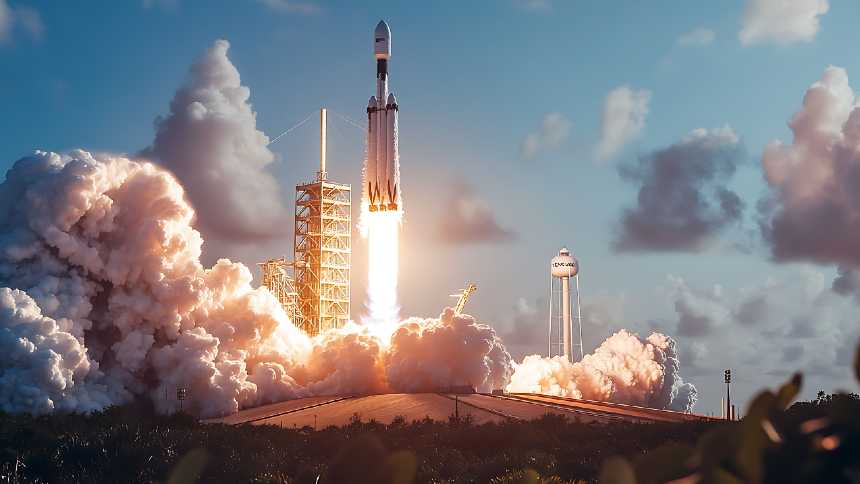
SpaceX went public with a bang worthy of its interplanetary ambition. Elon Musk's company raised $75 billion in its initial public offering, selling all 555,555,555 shares available at $135 each.
The move secured a valuation of $1.77 trillion, making it the largest IPO in history—far exceeding the $26 billion raised by Saudi Aramco in 2019. The shares will now be traded under the ticker symbol SPCX.
According to the Financial Times , demand for the IPO was overwhelming. Purchase orders exceeded supply many times over, with global investors vying for space in a company that has become, in practice, the critical infrastructure of the space economy.
But SpaceX did not succumb to the temptation to increase its free float . On the contrary: it kept its capital dispersed to the minimum necessary, reinforcing the protection around Musk and ensuring that no external pressure interferes with its plans — which range from expanding Starlink to colonizing Mars.
This achievement, however, is not just a financial milestone. It reinforces a paradox that NeoFeed had already highlighted: Elon Musk is simultaneously SpaceX's greatest asset and its greatest risk . His ability to attract capital, talent, and global attention is unparalleled. But the extreme centralization of power—preserved even after the IPO—keeps the company dependent on a single leader, with all the volatility that this implies.
The stock market debut also solidifies SpaceX as a systemic player in the market. The size of the offering, as analysts had already warned, forces large investors to reallocate resources. With institutional liquidity levels near record lows, funds may be forced to reduce positions in giants like Amazon, Microsoft, and Nvidia to make room for SpaceX.
The company's prospectus, in turn, deviated from the corporate norm. Instead of limiting itself to metrics and projections, it spoke of colonizing Mars, building a city of one million inhabitants, and ensuring that humanity does not suffer "the same fate as the dinosaurs." It's typical Musk rhetoric: grandiose, visionary, and, for some, excessively speculative.
Behind the rhetoric lie robust—and challenging—numbers. SpaceX reported $18.7 billion in revenue last year, but closed with an operating loss of $2.6 billion, driven by heavy investments in the Starship rocket, the global expansion of Starlink, and AI infrastructure. The company is growing fast, but burning cash at an equal rate.
Still, the market's appetite was voracious. Only 5% of the total shares were made available to the public, leaving Musk with over 80% of the voting power. It's a structure that reinforces the central thesis: SpaceX is, essentially, an extension of its founder's vision—and unpredictability.
Now that it's publicly traded, the company enters a new phase. The valuation of $1.77 trillion may be just the starting point, should demand for SPCX remain explosive. But scrutiny is also increasing. Musk, who has always operated with almost absolute freedom, will have to deal with pressure from public investors, stricter regulations, and quarterly expectations.