


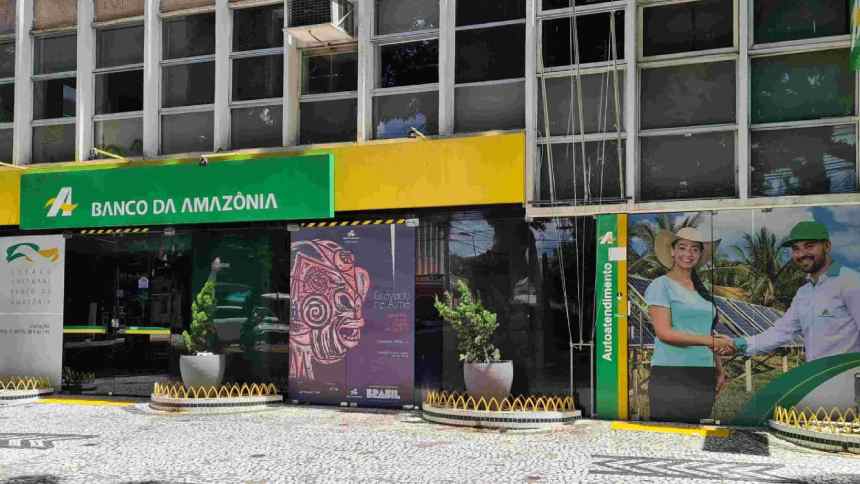
Banco da Amazônia, a financial institution controlled by the federal government, has a well-defined plan for 2026: to diversify its revenue streams, no longer depending almost entirely on its loan portfolio.
The goal is that, within two years, the segment will decrease from the current 85% to around 55%. The remaining 45% should be occupied by insurance, capitalization, merchant acquiring, and credit cards. All this without reducing the volume of the core sector, but rather expanding the overall revenue pie.
To that end, the company decided to look to its own customer base of approximately 1.2 million to begin offering other services, especially insurance. In this case, the goal is not to venture into the "open market," so as not to compete directly with the country's major banks.
“We have been restructuring over the last two years so that the bank can operate in all possible business areas. During this period, we have also been growing in our development policy, in commercial banking, and in advancing our digital presence,” says Luiz Lessa, CEO of Banco da Amazônia, in an interview with NeoFeed .
“In 2023, 95% of the bank's revenue came from credit. This is not good and carries a very high level of risk into the bottom line. What we did was precisely to create, since last year, these new avenues for growth with more products,” he adds.
According to Lessa's assessment, only the insurance sector has significant growth potential, capable of representing at least 20% of the result, precisely because of the opportunities it offers to its existing clients. In the case of Bradesco, for example, the insurance segment represents 41% of the group's total net profit. In the case of Banco Amazônia, it currently represents 5%.
The options, which have recently begun to be offered to account holders, are life insurance, business insurance (to protect assets), employee insurance, lender's insurance, and loan repayment guarantee insurance.
“We only had this option, and even then it wasn't well explored. Our plan, then, starts from our base. We will grow from our clients. We want to win over entrepreneurs, their employees, their suppliers, and their customers,” says Lessa.
In this sense, the CEO of Banco da Amazônia is aware that competing with the market-leading banks is not the best option, since there is still a long way to go within a universe that, in his view, has not yet been explored.
“I’m not going to go out into the open to compete with the big retail banks, because we’re not that size. We’re a medium-sized institution. That’s why we want a customer acquisition cost that’s appropriate to our characteristics,” says the executive.
"Today I finance equipment, with my line of credit, for example, but I don't offer insurance to the client who came seeking this resource. That's what we're going to change from now on," he adds.
In line with diversifying its services, Banco da Amazônia also wants to grow geographically through technology. Today, the company has 124 branches in the nine states that make up the Legal Amazon (Acre, Amapá, Amazonas, Mato Grosso, Pará, Rondônia, Roraima, Tocantins and part of Maranhão).
Digital arm in progress
At the end of the first semester, the bank will launch its digital arm, with a superapp responsible, among other things, for opening accounts, something that was previously only possible at a physical branch. The estimate is to gain one million new customers in the first 12 months from the start of operations. In practice, it aims to almost double the volume of new account holders and users of financial services.
“This new channel will complement our efforts to expand our product and service offerings, thereby attracting more customers. We want to integrate various platforms into this app and establish ourselves as a more national bank,” explains Lessa.
And, unlike the implementation of the insurance portfolio, where the bank does not intend to compete with the largest in Brazil, in the case of the app it acknowledges that the intention, in this case, is to enter the market that already has established digital banks.
“The market is too big. In this case, it's open water, and I want to carve out a space for myself. There are opportunities in this digital area for many institutions. Technology is important for our growth,” says Lessa.
According to the CEO, the company invested approximately R$ 800 million in the last year to implement this digital transformation.
"Those who are from São Paulo or Chuí can't open an account without coming to a state where we operate. Now, we'll be able to sell credit cards or open checking accounts for anyone anywhere in Brazil," he explains.
Even with the established plan to expand products and services, Banco da Amazônia ended 2025 with a 2.4% drop in net profit compared to the previous year, totaling R$ 1.1 billion. According to the CEO, this slight reduction is directly linked to the increase in default rates, which reached 4.7%.
“This is directly related to the change in legislation dealing with credit and loss provisioning. We needed to change the limit and increase this account. And that affected our profit,” says Lessa.
According to him, the bank recorded an increase in expenses, but it was related to more investments specifically in digital transformation. "It's an expense that, down the line, will generate revenue and reduce costs," he explains.
In any case, even with the new avenues underway, the bank's trend is for the credit division to continue growing. In 2025, the bank reached a credit volume of R$ 66.8 billion, an increase of 20.4% over the previous year's result. The largest increase was in the commercial portfolio, which grew by more than 37%, reaching R$ 3.5 billion.
Most of this volume comes from legal entities (companies) and companies originating from the Northern Region, the area in which the bank operates. And, in this vein, the focus is on expanding services to small and medium-sized enterprises.
“The idea now is to improve the way we focus on credit approval, monitoring the client's journey before they can become delinquent. We're going to look at whether a client who took out loans for their crops with a one-year grace period, for example, is progressing through their production phase,” he explains.
The bank's net worth grew by 9.7%, closing 2025 at R$7.2 billion. The return on average equity (ROAE) reached 16.2%.
In terms of development policy, Banco da Amazônia also registered growth. The National Program for Strengthening Family Farming (Pronaf) registered 100% growth in 2025, with 2.7 billion in contracts. Microcredit output advanced 142%.
In 2026, Banco da Amazônia's shares on the B3 stock exchange will have appreciated by 9.65%. The bank has a market value of R$ 4.8 billion.