

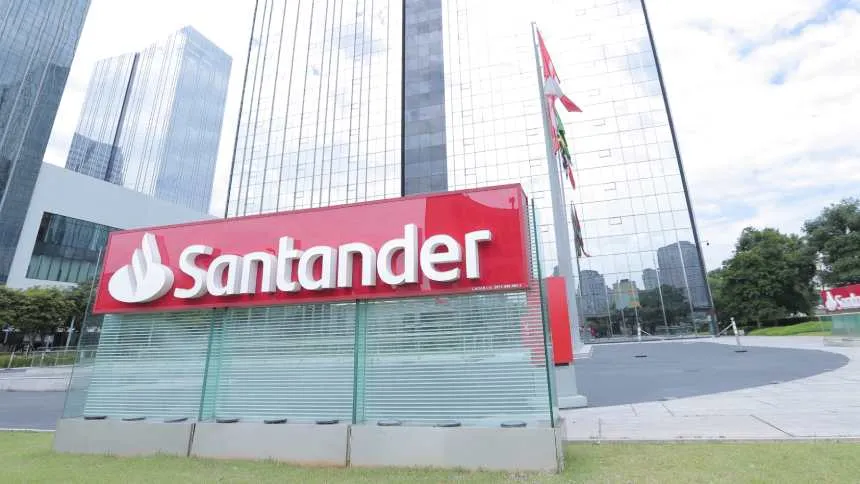
The Spanish bank Santander announced on the evening of Thursday, July 30, that it intends to launch a voluntary public takeover bid (OPA) to acquire the approximately 10% stake and units it does not yet own in Santander Brasil, in a transaction worth up to €1.9 billion.
In a relevant fact, the Spanish parent company informed that the move will also include a simultaneous exchange offer in the United States, involving the acquisition of the American Depositary Shares (ADSs) of the Brazilian operation traded on the New York Stock Exchange (NYSE).
In this context, Santander Spain would issue approximately 156 million new shares, equivalent to about 1.1% of its current share capital.
According to the statement, holders of shares, units, and ADSs of Santander Brasil who accept the offer will receive in return Brazilian Depositary Receipts (BDRs) or ADSs of the Santander group, which will represent a new ordinary share of the Spanish parent company.
The exchange ratio will be 0.4056 BDRs or ADSs of Santander for each unit or ADS of Santander Brasil, and 0.2028 BDRs or ADSs of the Spanish bank for each ordinary or preferred share of the Brazilian subsidiary.
These terms represent a 15% premium over the closing price on July 30, when Santander Brasil's units ended the day quoted at R$ 25.25, a decline of 1.48%. Year-to-date, the units have accumulated a 25.8% drop, valuing the Brazilian operation at R$ 135.6 billion.
Santander emphasized that the Brazilian operation will remain listed on the B3 after the process is completed and that the offer is not contingent on a minimum percentage of participation. It also stated that, depending on the outcome of the stock swap in the United States, the ADSs may be delisted from the NYSE.
Despite this statement, the fact is that, regardless of the level of participation by minority shareholders, the process is likely to further reduce the liquidity of Santander Brasil's units, whose free float is currently 10.2%, precisely the target of the offering. This opens the door, over time, to the possibility of a delisting.
Should this be the outcome of the offer, in the medium term, Santander Brasil would follow the same path as the bank's operation in Mexico, whose delisting from the local stock exchange was completed in April 2023. In that case, however, the chosen path was a traditional takeover bid, without voluntary participation.
In other markets, chosen as priorities by the Spanish bank, the strategy has translated into inorganic moves to expand its operations, with recent acquisitions such as the purchase of TSB bank in the United Kingdom for £2.65 billion (approximately €3.1 billion) and Webster Financial in a transaction worth US$12.2 billion.
In a press release accompanying the announcement, the Spanish parent company noted that the transaction reflects Santander's confidence in Brazil and the growth potential of its business in the country.
“Brazil is one of Santander’s main markets, with very favorable long-term prospects, a broad and growing customer base, and significant opportunities for profitable growth,” said Ana Botín , CEO of Santander, in the statement.
The executive also highlighted that the transaction is part of the group's disciplined capital allocation strategy, as well as its simplification orientation, with the expectation of a "positive effect on earnings per share and tangible equity value per share, with a neutral impact on capital."
“Furthermore, it offers minority shareholders an attractive premium and the opportunity to become shareholders in one of the world’s leading financial groups, benefiting from the value creation of a global and diversified group,” Botín added.
The fact is that the offer comes at a very unfavorable time for Santander Brasil, which has been under new management since July 1st. On that date, Gilson Finkelsztain , former CEO of B3, took over as president of the operation, replacing Mario Leão , who had held the position since January 2022.
Finkelsztain, however, did not participate in the release of Santander Brasil's second-quarter earnings report on Wednesday, July 29th. The call with analysts regarding the results was led by Spaniard Carlos Muñiz, CFO of the operation. And the indicators for the period only reinforced the challenges ahead for the new CEO.
The bank reported recurring net income of R$3 billion, representing a 17.6% decrease compared to the same period a year earlier, and a 20.4% decrease compared to the first quarter of 2026. This figure fell short of market projections, which had indicated a range of R$3.5 billion.
Among other indicators that disappointed investors, Santander Brasil reported a return on average equity (ROAE) of 12.5%, 3.4 percentage points below the rate reported in the first three months of 2026 and 3.8 percentage points below what was recorded in the same period of 2025.
In a call with analysts, Carlos Muñiz emphasized that the indicators reflected balance sheet management decisions, with a rebalancing of the product and client portfolio, in search of a better risk-return ratio. He also said he was not concerned about market share at this time.
“We are much more concerned with the macroeconomic environment and ensuring that all business generation and all credit origination are profitable and compatible with the level of risk we are willing to take. I prefer to play it a little safer, even if it is costing us in the short term,” said the CFO.
The executive also highlighted that the operation's revenue is not expected to recover anytime soon and that the goal is not to maximize growth in this line of business, but to ensure that the bank is not taking excessive risks or making investments that could create problems later on.
He further stated that he is not optimistic about an improvement in the scenario in 2026. And he added: "If I had to point to a timeframe for a more consistent improvement, I would say it is closer to the beginning of 2027."