


Allos, the largest shopping center company in Brazil with 51 shopping centers (45 owned and six under management), has decided to help retailers increase their revenue through digital channels. To this end, it created a sales model, unprecedented in the country, operating from its own company studio, for sales via the TikTok Shop platform.
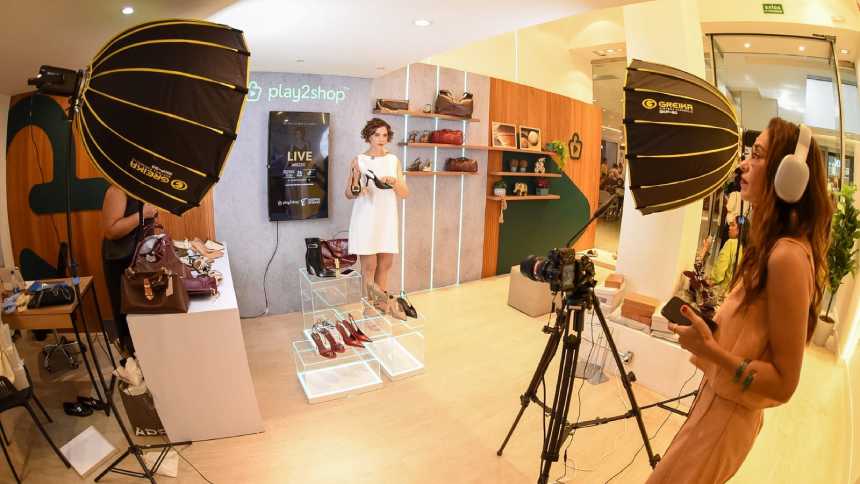
The first model of Allos' Live Shopping project was installed at Shopping da Bahia, in Salvador, with the implementation of a 50-square-meter studio in a store space. The initial broadcast was on March 26th, made by the Arezzo unit in the Bahia shopping mall.
The space can be used by retailers free of charge for approximately one hour to conduct online sales. Allos provides all the necessary infrastructure for the live event, including high-tech equipment, internet access, and teams to assist with the transmission.
By the end of the year, the company plans to install two more studio models for live sales broadcasts in two shopping malls: one in Norte Shopping, in Rio de Janeiro, which should be around 80 m², and another in a shopping center in the city of São Paulo, yet to be defined.
“We are taking an important step in the phygital model, further connecting the in-person experience of shopping malls with the reach and conversion of the digital channel,” says Ana Paula Niemeyer, CMO of Allos, in an interview with NeoFeed . “There is no competition between the channels, but rather a complementarity.”
But the model isn't just about providing studio time. The company has also started offering consulting services to retailers, so they can better understand how the world of content creation associated with product sales works.
One of the requirements for setting up a studio in a shopping mall has been proximity to a post office, usually located inside the mall, to facilitate logistics for new sellers regarding the delivery of products sold.
According to her, there is a concern that the mall retailer should cover all stages of the sale, since, in this way, they cease to be a local seller and start speaking to any customer in Brazil. No entrepreneur will be able to do the live stream without completing the training provided by the company.
“In practice, Allos follows consumer behavior, which today is not only in the traditional model but also in a multifunctional platform that integrates consumption, service, entertainment, gastronomy, and experience,” says Niemeyer. “We are moving from a transactional relationship to an emotional relationship.”
The executive states that, in addition to market perception, the company has begun receiving requests from retailers to implement this measure. Allos also helps retailers themselves to register on the social network. The project was developed in partnership with Play2Shop.
According to her, the trend is that the space will be used more by small entrepreneurs, especially local ones, and those unfamiliar with e-commerce. During seasonal sales periods, such as Easter and Children's Day, priority in the days leading up to these dates will be given to retailers who have more appeal during these periods, such as a chocolate chain or a toy store, for example.

"A small shopkeeper probably wouldn't be able to do this live stream, because they would need to rent a studio, buy equipment, understand how it works, and also hire an influencer to help," he explains.
This volume of smaller retailers represents the majority of stores in Allos shopping malls, a trend followed in virtually all units across Brazil. Data from the Brazilian Association of Shopping Malls (Abrasce) shows that 65% of the units are small businesses.
With over 68,000 m² of gross leasable area (GLA) and approximately 420 stores, the Salvador shopping mall was chosen as the pilot location for the project due to the large volume of customers circulating in its corridors, currently around 3.6 million per month.
“We’ve already noticed, even though we started recently, that there’s great visibility from the live stream, even for people walking through the mall who watch the live broadcast. This already brings the customer to the store,” explains the CMO.
“That’s why we’re going to Rio de Janeiro and São Paulo to have diverse locations with this format that includes both physical and digital elements,” he says. Allos promotes the TikTok Shop broadcasts through its advertising channels in shopping malls and on its social media networks.
According to the CMO, Allos's goal is to offer at least eight hours of live streaming per day, five days a week. This should mean 40 live streams per week in each of the company's shopping malls that already have the digital studio.
Although it is still in its early stages, the company believes it will be possible to create metrics to measure the success of the live streams, such as the volume of access, sales conversions, and to understand the flow of this format in each aisle of the shopping mall.
“We want to look at these indicators, which are very important. It’s important that there’s a return for the retailer and for Allos,” he says. Besides Arezzo, representatives from stores like Live!, Acium, Casa 10, and others have also broadcast from the shopping mall studios.
Although the service is free, Allos charges a small percentage of sales made through digital channels as a way to offset some of the costs and revenue loss from using a physical store to create the studio. The company does not disclose the percentage or the investment in the project.
In addition to the three that will be implemented in 2026, Allos is working to gradually offer the model in all of its shopping malls. "We will also conduct a pilot in a smaller city to understand the performance of this project," explains the CMO.
Over the past 12 months, Allos' shares on the B3 stock exchange have appreciated by 65.8%. The company has a market capitalization of R$ 16.9 billion.