


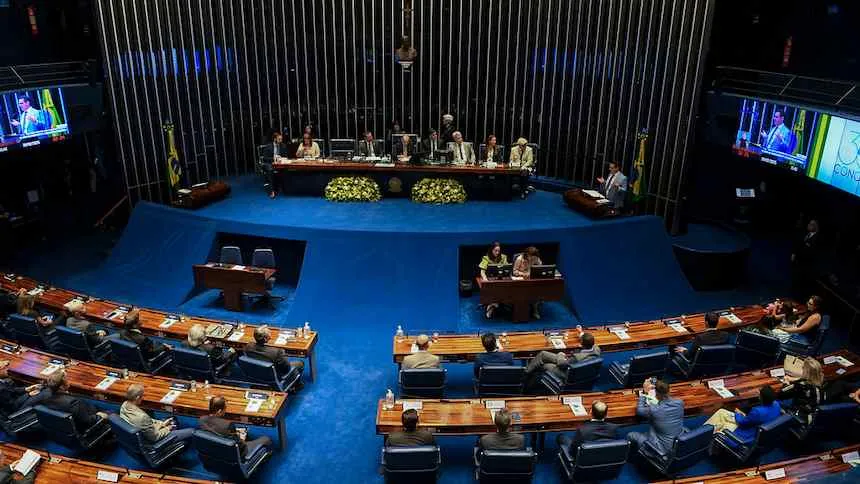
Brasilia - After a multi-pronged push in the National Congress, the Senate moved forward on Tuesday, June 16, with a bill that fully protects the budget of the 11 federal regulatory agencies. This deepened the tension with the government on this issue.
First, the Senate Infrastructure Committee (CI) approved a bill by Senator Laércio Oliveira (PP-SE), submitted last year, which prohibits budget cuts for agencies - such as ANS (supplementary health), ANTT (road and rail transport), ANA (water and sanitation), ANP (petroleum), Anatel (telecommunications), among others - and guarantees them financial autonomy.
Throughout the day, after coordination between senators and the president of the House, Davi Alcolumbre (União-AP), the proposal was approved in plenary. NeoFeed learned that the government leader in the Senate, Jaques Wagner (PT-BA), approached parliamentarians during the plenary vote to emphasize the Executive's opposition to the bill because it concerned a budgetary matter. Randolfe Rodrigues (PT-AP), the government leader in Congress, even tried to postpone the vote, but in vain.
The original bill stipulated that only the agencies' own revenues, fines, fees, or oversight funds would be subject to protection. However, the rapporteur, Senator Marcos Rogério (PL-RO), amended the text to extend the protection to all expenses of these agencies.
The rapporteur further explained that his opinion does not deplete the Union Budget to allocate additional resources to the agencies. The text merely preserves the revenues collected by regulatory bodies from their core activities, such as audits, as a "budgetary relief mechanism."
"It would be unfair to approve a project that will only solve the problems of those agencies with surpluses, leaving the other agencies empty-handed," says Marcos Rogério.
"When you cut an agency's budget, you are sending a signal to the market that the Brazilian regulatory environment is unstable and unreliable, and this signal leads to costs in the form of investments that don't materialize, auctions that become less competitive, and risk premiums that increase the cost of financing entire projects," the rapporteur added.
This year, the government has already issued two decrees containing budget cuts to federal regulatory agencies. One more recent one, for R$ 300 million, on May 29th, and another in March for R$ 84.6 million.
To reinforce this argument, several presidents of regulatory agencies were present in the Senate today. They demonstrated that various activities have been suspended or reduced due to repeated budget cuts by the government.
In May, NeoFeed had already shown the movement of agencies and congressmen to push through measures in Congress in an attempt to protect their budgets.
“Cutting the budget of regulatory agencies is hurting the country. Our budget has been falling significantly,” says Tiago Chagas, CEO of the National Civil Aviation Agency (Anac).
The director of the National Electric Energy Agency (Aneel), Agnes Maria de Aragão, pointed out that the agencies are even losing professionals to the private market, given the deficient structure of the bodies.
According to her, Aneel collects around R$ 1.5 billion per year, but its budget exceeds just over R$ 100 million. "And it's no use releasing the budget in November, at the end of the year," she emphasizes.
Artur Watt Neto, director-general of the National Agency of Petroleum, Natural Gas and Biofuels (ANP), states that the agency had to halt programs, such as one in partnership with the Navy, and drastically reduced the hiring of outsourced workers. But it has been trying to deliver results. "We are trying to keep the agency functioning."
LDO device
In addition to this and other proposed laws, lawmakers are also moving to overturn, in a future session of Congress, a veto by President Luiz Inácio Lula da Silva (PT) on a provision of the 2025 Budget Guidelines Law (LDO), which prevented the government from blocking the budget of these agencies.
The Senate president has just scheduled a joint session of Congress for next Thursday, June 18, to consider this and dozens of other vetoes.
In recent days, 47 business entities such as Abdib, CBIC, and Moveinfra released a manifesto calling for the veto to be overturned, entitled "Suffocating regulatory agencies is compromising Brazil's development."
"The justification for the veto under the pretext of complying with fiscal rules disregards the fact that agencies without budgetary predictability lose their ability to operate," the document says.
"Without adequate resources, inspections are hampered, licenses accumulate delays, and efficiency in vital sectors of the economy is compromised," he adds.