

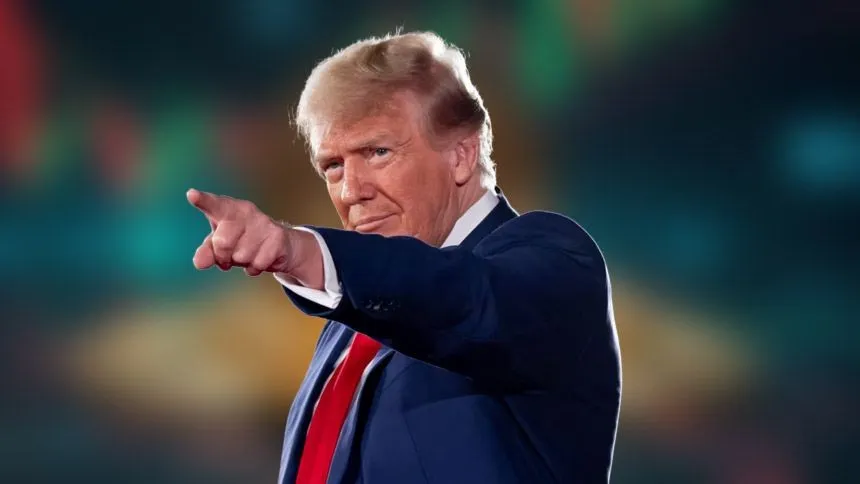
President Donald Trump has activated, at full volume, the economic intervention mode that has marked his second term in recent days.
The attacks against the Federal Reserve (Fed, the central bank of the United States), against Exxon Mobil , and against credit card companies have led many to question whether the country remains safe for investment.
The sentiment was reflected in the American indexes, which traded lower on Monday, January 12th. Around 12:18 PM, the Dow Jones was down 0.52%, at 49,245.22 points; the S&P 500 was down 0.14%, at 6,956.55; and the Nasdaq was down 0.08%, at 23,652.48 points.
The offensive against the monetary authority has been the most painful so far. On Friday, January 9th, the Department of Justice announced that it had opened a criminal investigation against Jerome Powell to examine his testimony before the Senate in June regarding the reform of the central bank's headquarters in Washington.
The Fed and Powell have long been in Trump's crosshairs , who is dissatisfied with their handling of monetary policy. Powell is a recurring target of the president, who has called him an "idiot" and "stubborn" for not accelerating interest rate cuts. The assessment is that Trump and his allies are seeking every possible pretext to undermine the Fed's independence.
The renovation of the headquarters is the most recent case. The government accuses the Fed of providing incorrect information to Congress regarding the increased cost estimate for the project, which rose from $1.9 billion to $2.5 billion. The monetary authority claims that the difference stems from actual costs of materials, equipment, labor, and unforeseen problems.
In August, Trump announced the dismissal of Lisa Cook, a director at the Federal Reserve, on charges of mortgage fraud, in an attempt to appoint someone aligned with him. The following month, the courts reversed the decision.
The opening of the inquiry led Powell to take a stand against the White House , something rare in the Fed's nearly 113-year history. In a video posted on Sunday, January 11, he said the investigation is part of Trump's campaign to push for decisions favorable to his policies.
"This is about whether the Fed will be able to continue setting interest rates based on evidence and economic conditions. Or whether, instead, monetary policy will be driven by political pressure or intimidation," he stated.
The investigation against Powell adds to two other interventionist measures taken by Trump in recent days.
On Sunday night, speaking to reporters on Air Force One, Trump said he could block Exxon Mobil from operating in Venezuela , after CEO Darren Woods stated at a White House event that the country is "unsuitable for investment."
“I’m probably inclined to leave Exxon out of it,” Trump said, according to The Wall Street Journal (WSJ) . “I didn’t like their response. They’re playing dumb too much.”
Another recent case of interference was in the credit card market. In a post on Truth Social on Friday, Trump called for interest rates to be capped at 10%.
Amid pressures over the cost of living in the US, he argued that the limit should take effect on January 20, the anniversary of his inauguration, and remain in place for one year.
The three incidents fueled the "sell America" trade rally in markets on Monday. Along with the decline in indices, gold futures rose more than 2%, while the dollar fell 0.30% against major currencies.
The VIX, an index that measures expected stock market volatility based on S&P 500 options, was up 6.5%.