


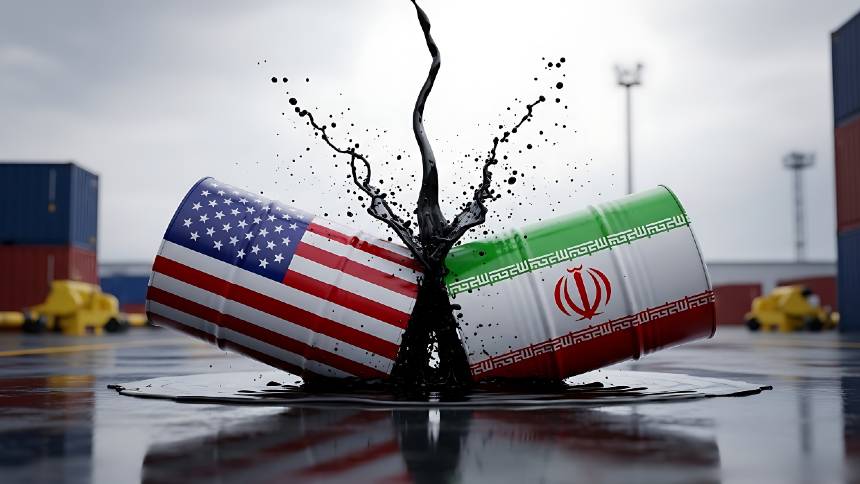

The United States launched a military offensive against strategic targets in Iran on Saturday, February 28, marking the most serious escalation of the conflict between the two countries in decades. President Donald Trump confirmed that the American Armed Forces had begun what he described as "major combat operations," with attacks on military and government installations in different regions of the country, including Tehran.
According to American authorities and reports from international agencies, the action was coordinated with Israel and targeted structures linked to the Iranian nuclear program and the regime's military command. In response, Iran launched retaliatory attacks against American and Israeli positions in the Middle East, increasing the risk of a large-scale regional conflict.
US military strikes against targets in Iran have once again placed geopolitical risk at the center of investment decisions, with oil as the main barometer of tension and global markets in defensive mode.
Investors have begun pricing in a scenario of escalation in the Middle East, a region that concentrates some of the most sensitive assets in the global economy. The fear lies not only in the direct damage of the offensive, but above all in the domino effect it could have on energy flows, supply chains, and global inflation.
From the first hours after the bombings were confirmed, analysts and managers began to treat the episode not as a "production event," but as a "bottleneck event," a direct reference to the Strait of Hormuz, through which a significant portion of the world's seaborne oil passes.
According to analysts interviewed by CNBC , the mere possibility of disruption or threat to shipping in the region is enough to generate a significant risk premium in oil prices. Unlike one-off supply shocks, this is a systemic risk with the potential to affect global flows in a chain reaction.
Oil prices had been rising in previous days precisely because of the growing perception of conflict, a movement that is likely to gain traction as markets reopen with full liquidity next week.
According to Capital Economics, which conducts macroeconomic analysis and research, prolonged disruptions in Iranian production or in the Strait of Hormuz could push the price of oil to $100, consequently raising natural gas prices.
This rise in oil prices could add 0.6 to 0.7 percentage points to average global inflation. This could destabilize a global economy already weakened by trade conflicts, encourage major central banks to halt interest rate cuts, or even lead some to raise them.
The impact is not limited to commodities. The US attack triggered "risk-off" mode in global financial markets. Investors should seek assets considered safe havens, such as the dollar, gold, and Japanese yen, while riskier assets, stocks, emerging market currencies, and credit may enter the correction radar.
Historically, episodes of tension in the Middle East produce rapid and often asymmetrical movements. The pattern observed in previous conflicts suggests that the initial reaction tends to be one of risk aversion, followed by a recalibration as it becomes clearer whether or not there will be a prolonged escalation.
Nevertheless, managers warn that the current moment is more delicate than other recent shocks. The world is already operating under high interest rates, inflation is still sensitive to energy shocks, and global supply chains are less resilient than before the pandemic. Structurally more expensive oil could reignite inflationary pressures precisely when central banks are lowering rates.
For the market, the central question is not just military, but political: how far is the US willing to sustain a prolonged operation? And how will Iran respond? Each new statement, military move, or diplomatic signal tends to translate into additional volatility in asset prices.
In the short term, three factors are capturing the market's attention. The first is how Iran will respond. Any sign of retaliation affecting energy infrastructure or shipping routes could amplify the shock to oil prices.
Another sensitive point is the Strait of Hormuz. Even without a formal blockade, the increased risk could raise insurance costs, freight, and risk premiums. And finally, how will the major economies react? The positions of Europe, China, and producing countries will be crucial in calibrating expectations.
The consensus among analysts is that the coming days will be marked by high volatility. More than balance sheet numbers or macroeconomic indicators, the market will operate guided by headlines. And, in such scenarios, oil prices tend to speak louder than any discourse.