

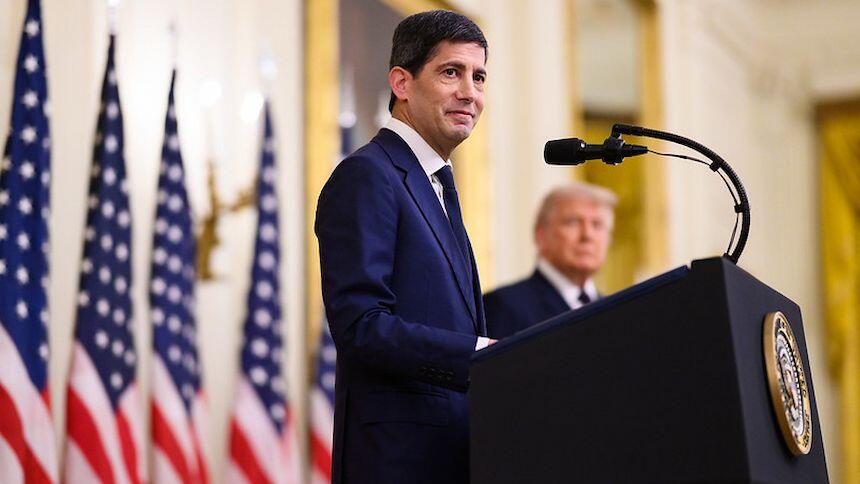
Kevin Warsh made his debut as head of monetary policy at the Federal Reserve (Fed) on Wednesday, June 17. He not only defied the White House's requests for interest rate cuts, but also revised the committee's projections in the opposite direction – the decision to maintain rates was unanimous.
With interest rates remaining unchanged in the 3.5% to 3.75% range for the fourth consecutive time, the Fed's quarterly projections report raised the median year-end interest rate expectation from 3.4% to 3.8%, now implying a 0.25 percentage point increase—rather than a decrease—by the end of the year.
The Fed's revised projections are driven by expectations of more persistent inflation in the United States this year. In its quarterly report, the committee raised its estimate for PCE from 2.7% to 3.6% in 2026. The projection for core PCE, which excludes food and energy, also rose from 2.7% to 3.3%.
The review comes amid a new round of pressure on energy prices, triggered by the conflict in the Middle East and the closure of the Strait of Hormuz, one of the main global oil export routes.
Given the deteriorating inflation projections, Warsh reinforced the Fed's commitment to the 2% target. "We have the capacity and commitment to bring inflation back to the 2% target. That's exactly what we're going to do," he stated.
The Fed chairman also said he saw no reason to discuss changes to the target "until we have re-established our commitment and our ability to achieve it."
The new Fed chairman did not submit his own projections for the quarterly report, in line with his past criticisms of the document's current format. However, he said he encouraged other committee members to maintain their estimates.
In commenting on the so-called dot plot , Warsh also attempted to downplay the indicator's importance as a firm signal regarding the Fed's next steps.
"I reviewed the points and, when I saw the submissions, I noticed that they were all done in pencil — the kind with large erasers," he stated.
According to Warsh, the committee members understand that the situation "is changing very rapidly" and do not feel bound by projections "six weeks from now or six days from now."
The message reinforces the contrast with the pressure exerted by the White House on the Fed. Warsh was chosen by Donald Trump to replace Jerome Powell after months of criticism from the American president regarding the conduct of monetary policy , amid repeated calls for interest rate cuts.
When nominating Warsh to the Fed in January, Trump went so far as to say it would be inappropriate to ask Warsh if he would cut interest rates, but stated he was confident his nominee favored reducing the cost of credit.
Although the decision maintained the cautious approach inherited from Powell, Warsh has already given the first signs of how he intends to lead the Fed. The first change appeared in the statement announcing the decision, which was shorter and more direct, without forward guidance —the signaling used by the monetary authority to guide markets on its next steps.
"Financial markets function better when they react to incoming data than when the question becomes: how will the Federal Reserve react to this information?" Warsh asked.
According to him, forward guidance is not appropriate for the "current monetary policy environment." After the decision, the market reaction was immediate. Stable around 7,510 points during the morning, the S&P 500 reversed course after the decision and Warsh's interview, closing down 1.21% at 7,420.10 points.
In the interest rate market, the movement was in the opposite direction, with the 10-year Treasury yield renewing its daily highs, signaling that investors have begun to price in a tighter monetary policy.
Copom decides to cut the Selic rate.
On the evening of Wednesday, June 17th, the Monetary Policy Committee (Copom) of the Central Bank decided to reduce the basic interest rate in Brazil from 14.50% to 14.25% per year, continuing the cycle of calibrating monetary policy at a gradual pace.
The decision to cut 0.25 percentage points was taken unanimously by the seven members present, led by President Gabriel Galípolo. The main backdrop justifying the caution was the combination of inflation above the target and still unanchored inflation expectations for 2026 and 2027 (at 5.30% and 4.10%, respectively), according to the Focus survey.
Domestically, the Copom (Monetary Policy Committee) acknowledged that the prolonged period of contractionary interest rates has already "produced evidence of transmission of the slowdown in economic activity, but noted that the labor market remains resilient and more cyclical sectors regained traction in the first quarter."
In the external scenario, the Central Bank committee pointed to the uncertainty surrounding the terms of the ceasefire in the Middle East (even with the announcement of the official agreement between the US and Iran) as a factor of volatility for asset and commodity prices, requiring a more conservative stance from emerging countries.
The Committee left the door open for different interest rate trajectories, without clearly signaling the pace of the next steps.
(Updated report on Wednesday, June 17, at 7:15 PM)