


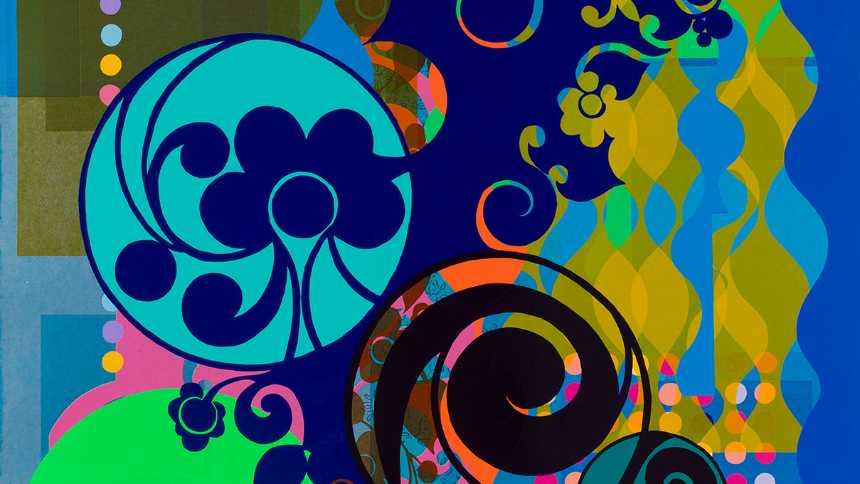

Spirals, volutes, floral elements, beaded necklaces, streamers. Whether in painting, collage, or printmaking, Beatriz Milhazes ' visual repertoire is immediately recognizable. Inspired by nature and popular festivals, the artist creates compositions in which colors, shapes, and ornaments overlap, preserving the strength of her language across different media.
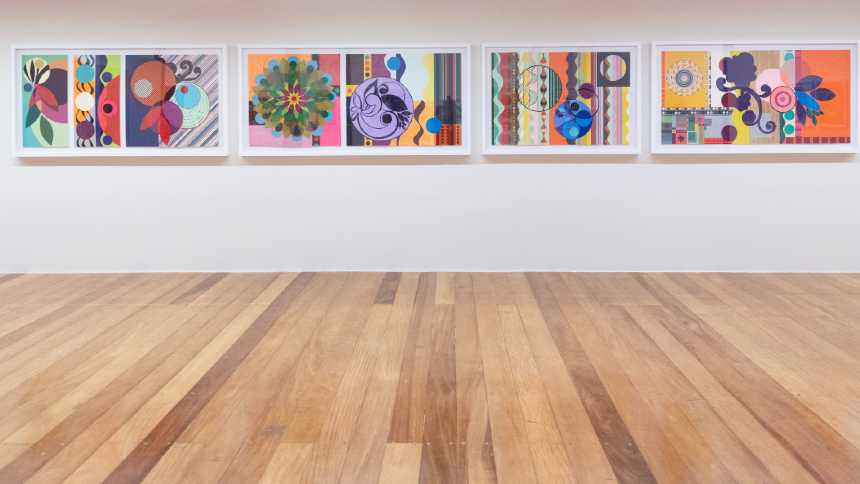
This universe is present in Beatriz Milhazes: prints from the collection of the Pinacoteca de São Paulo , on display at Estação Pinacoteca . The exhibition brings together 27 prints produced between 1996 and 2019 in partnership with the American Jean-Paul Russell, founder of Durham Press, one of the most prestigious printmaking workshops and publishers in the world.
“I would say it was a magical encounter, one of the most important of my life,” the artist tells NeoFeed . “Jean-Paul and I share the same passion for what we do. His sensitivity and respect for the artist's language are something that contributed to the success of our partnership.”
In 1996, after holding his first exhibition in New York and taking the first steps in an international career that would solidify in the following years, Milhazes was looking for a printer capable of translating his already recognizable visual vocabulary into printmaking.
The first professional she approached rejected the proposal. He considered the project excessively complex, expensive, and lacking market prospects in the United States. At the time, the painter was still relatively unknown outside of Brazil. This assessment, however, would prove to be wrong.
Twelve years later, in 2008, The Magician was sold for US$1.05 million at a Sotheby's auction in New York, making Milhazes the first contemporary Brazilian artist to surpass the million-dollar mark at an international auction. Russell, although he also could not have foreseen this outcome, accepted the challenge.
Right after finishing high school, the printer began working with Rupert Jasen Smith, a long-time collaborator of Andy Warhol , Frank Stella, and Robert Rauschenberg, and one of the most important names in American screen printing. It was in this environment of intense technical experimentation that he developed the knowledge that, years later, would allow him to convert Milhazes' complex compositions into prints.
“My pictorial language, with so many layers, complex compositions, and a diverse chromatic structure, presented challenges for the development of the prints,” comments the artist.
Milhazes sought to preserve the characteristics of his work while simultaneously exploring the possibilities offered by printmaking. “It was a great technical challenge, an exercise in generosity for the printer, and an investment for the studio. And Jean-Paul accepted taking that risk,” he adds.
Layers and more layers
The artist is one of the leading names of the so-called Generation 80, a group that repositioned painting at the center of Brazilian artistic production and gained prominence in the art market. Instead of reinforcing the characteristic gestural quality of painting, Milhazes began to investigate ways of erasing it. Between the end of the 1980s and the beginning of the 1990s, she developed the monotransfer technique.
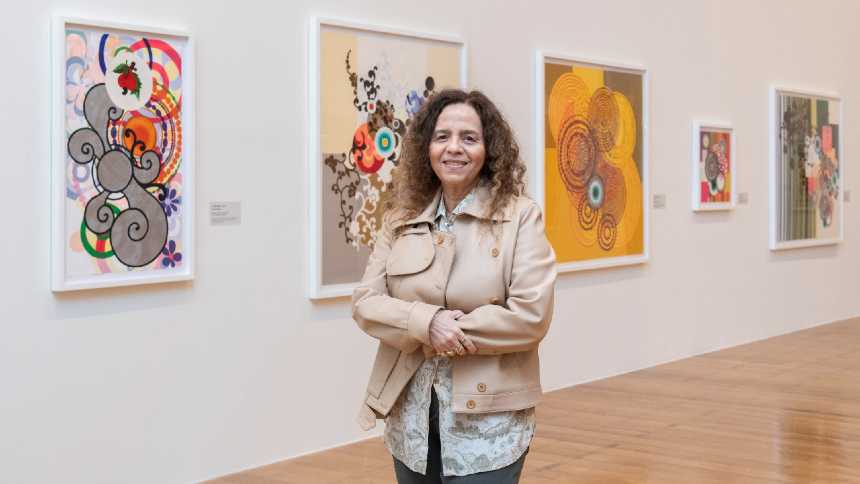
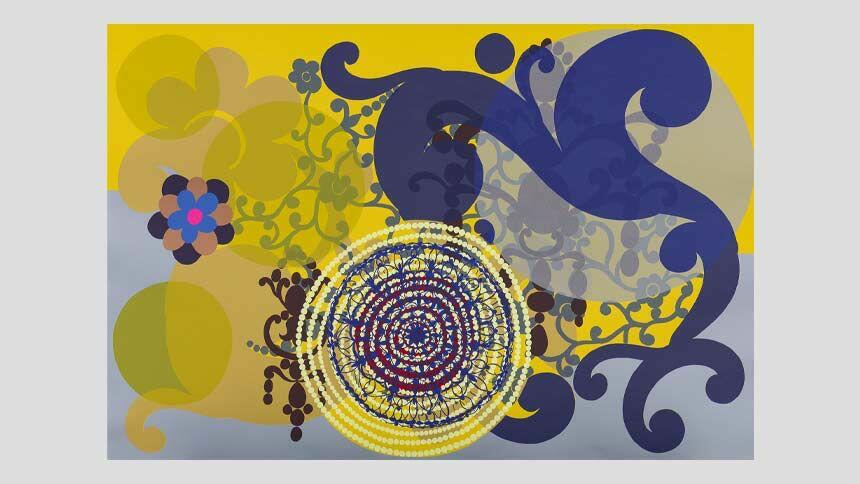
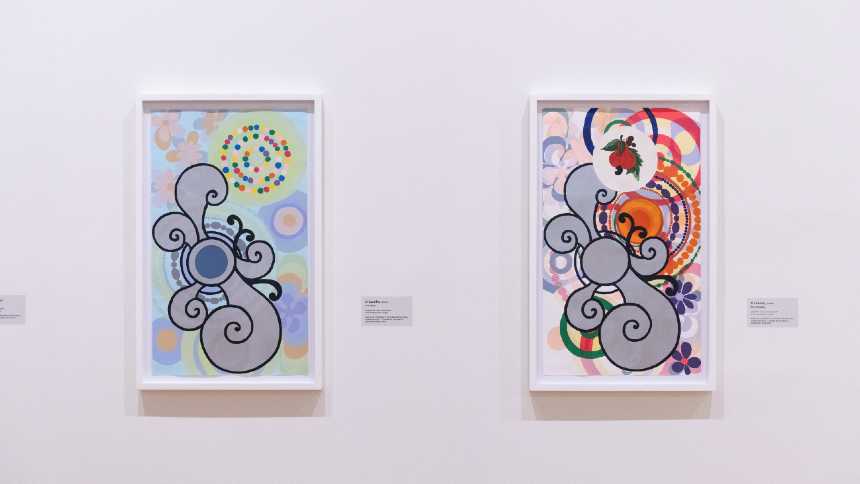
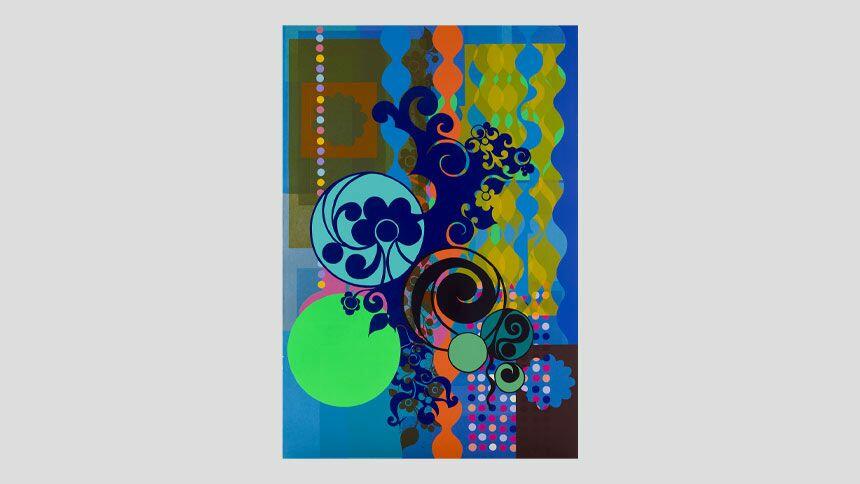
The process involves painting the elements of the composition, inverted, onto a sheet of plastic and then transferring this layer to the canvas. Instead of emphasizing the brushstroke, the artist reduces the traces of manual skill and creates a kind of collage of the painting itself.
This same principle of layered construction reappears in the prints. "Beatriz's work operates through summation," summarizes Renato Menezes, curator of the exhibition, to NeoFeed . The way this summation happens, however, changes completely from one technique to another.
"While painting is fatal—what you've pasted can't be removed—printmaking results from a long sequence of experiments and superimpositions of matrices before arriving at the final version," he explains. A single print can bring together around 50 layers of silkscreen and up to 150 woodblock matrices, highlighting the technical complexity of its production.
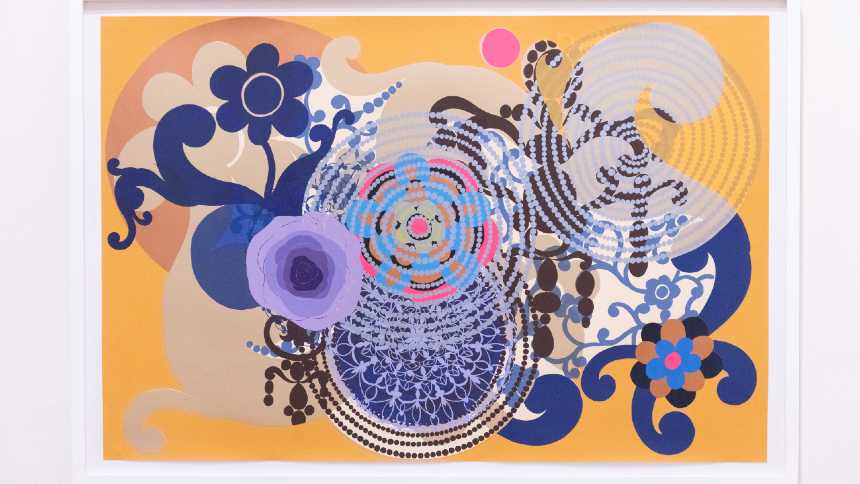
Viewed together, the series reveals the recurrence of certain forms. In Wild Grape and Woman's Head , two of the artist's earliest prints, produced in 1996, a blue arabesque occupies a prominent place in the first composition. In the second, the same form remains partially obscured by flowers and circular elements.
The layering principle also guides the construction of colors. In Figo (2006), cited by Menezes as one of the most complex prints in the exhibition, the blues are not pre-defined colors. They result from the successive printing of layers of yellows and greens. "A painter mixes the paint on the palette. In printmaking, the colors are mixed through layering," explains the curator.
Female graphic thinking
Figo , Sábado , Cabeça de mulher , Espelho — the titles chosen by Milhazes evoke characters, objects, and situations from everyday life. None of these images, however, can be recognized among the shapes, colors, and arabesques of the engravings. His work is linked to abstraction.
According to Menezes, some of these names come from a list kept by the artist; others emerged from conversations with Jean-Paul Russell during the creative process.
"She is a very rigorous artist, very faithful to her vocabulary of forms and to her principles. At the same time, she has the wisdom to deal with those less rational, less harsh elements, which are the titles."
In general, the title functions as a key to understanding the work, offering the viewer a clue to interpret it. Milhazes, however, follows a different path.
By naming his prints with references that seem unrelated to the images presented, he breaks the expectation of correspondence between word and representation.
Menezes also emphasizes that the artist's decision to donate this set of prints to the Pinacoteca was deliberate. The institution is the only one in the world to hold this complete collection of prints and already has in its collection works by artists such as Renina Katz and Maria Bonomi, unavoidable names in Brazilian printmaking.
As the curator defines it: "Beatriz is yet another name that joins the collection, strengthening this line of research linked to female graphic design in Brazil."