

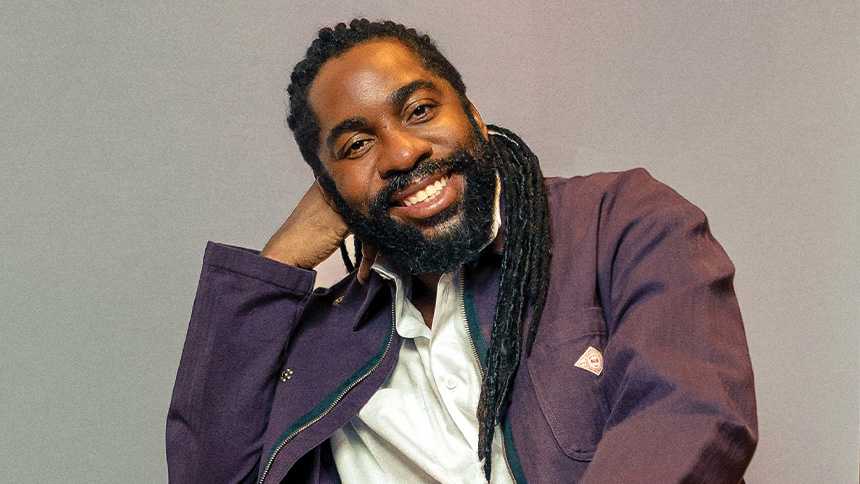

When Lázaro Ramos first visited Rio de Janeiro at age 12 with his father, Ivan, he pointed to a group of buildings on the waterfront: “It must be beautiful to live here.” Today, at 47, he tells Velvet this story from inside one of those buildings, where he moved during the pandemic with his wife, Taís Araújo, and their children, João Vicente and Maria Antônia.
There, an ecumenical altar hints at the number of beliefs and activities he encompasses. “Lázaro, are you religious?” I ask. “I’m from Bahia,” he replies, laughing. “I’m a mix of everything, from a family with a religious culture. My great-aunt raised me in Candomblé, my maternal grandfather was a pastor in the Assembly of God, my father is agnostic, my mother was a Spiritist, and I chose to do catechism to become Catholic,” he adds.
With over three decades of a career full of projects, he can say he's reached places he never imagined. Here, he recounts the beginning of his journey on the stages of Salvador, his migration to film at the start of the century, and his (well) planned and successful career in television.
Furthermore, his life as a writer runs parallel to his work—he has already written 11 books, including children's books, biographies, and works for adults. This sheer volume of work led to burnout in 2021 and taught him to start saying "no" to some things. "Since then, I've been doing everything better," he says.
Amidst filming for "A Nobreza do Amor ," a 6 PM telenovela on Globo, Lázaro talks in this interview about his first antagonist role, fatherhood, and his approach to life.
Lázaro, this is the first time you've played a villain in a telenovela, Jendal. How has that experience been on television? Do you feel that there's still a reaction on the streets from telenovela characters?
Look, I'm even surprising myself, because I generally play very likeable characters. Charismatic, friendly, funny. And this one is different. It's good, because it's cathartic. Many people say they hate Jendal, but love Lázaro. They have memories of scenes, of details. After years without doing soap operas, doing more film and directing, in the week it aired, I already noticed the affection of a different audience, with many more children and housewives. But he's a villain, and you can't use so much charisma that you forget the character is doing reprehensible things. I think I found a tone: I play the villain, people like to watch, but they have a critical sense towards him. That was my biggest challenge.
But let's go back a bit and talk about other challenges. You started with the Olodum Theater Group. What was that artistic beginning like?
I was extremely shy and had great difficulty communicating when I started doing theater at school. The daughter of my school's principal worked at the local SBT television network and sometimes needed children. I would go. I had never seen a play before, but I felt good doing it. However, I wanted to be a doctor. I thought being a doctor made people happy. That's when my group of friends from the theater went to register for the Olodum Theater Group. When I got there, I saw those actors… I remember the first day of the theater workshop. Singing lessons, music lessons, acting, playing instruments. I found it so precious and it felt like my place. It's a feeling I had never had before in my life.
How did your father react?
My father was worried because the theater market in Bahia was very restricted. Even the actors in the Bando group at that time had to have other professions. I studied clinical pathology to have a profession, support myself, and do theater at the same time.
"I love to talk. I'm very curious; I miss my flight because I'm chatting at the airport. At home, with my family, we've always been like that."
And fame only came a few years later? What was it like leaving the band to become known in Brazil?
Vladimir [Brichta] and Wagner [Moura] , my dear friends, were doing a show called A Máquina in 2000. They recommended me for the cast; I dropped out of biochemistry school and went. And then the great magic happened. During those three weeks of shows, I was called to audition for several films, such as Uma Onda no Ar , O Homem do Ano , Carandiru , Madame Satã , O Homem que Copiava , Cidade de Deus, and As Três Marias . And I got all seven. It was a very interesting moment for Brazilian cinema. I debuted in both O Homem que Copiava and Madame Satã in the same year. What a privilege! Two completely different characters.
That's how Brazil discovered you. Were you always confident enough to face these new challenges?
I arrived terrified, but with a lot of enthusiasm, because I've always been a movie fanatic. I'd seen The Goonies and Ferris Bueller's Day Off dozens of times. My lifelong dream was to live in that place, but I didn't know it was a possible place. This generation of filmmakers embraced me and gave me something that changed my career: a variety of different characters. Generally, actors with my physical characteristics ended up very confined to the same type of character. I thought that was really cool. People didn't recognize that the guy from The Man Who Copied was the guy from Madame Satã .
And how does television fit into this story?
Television came into my life because of João Falcão, the director of A Máquina , who was making Sexo Frágil and brought in his theater group. It was a landmark. And only then came Foguinho, in Cobras e Lagartos , a character I had always wanted to play. I started to become an actor who had the recognition and prestige of film and the popularity of television.
“When I was invited to do The Machine in Rio, I didn’t accept. Wagner convinced me, and that’s why I’m so grateful to him, because he really changed our lives. He made us become a family that thought about theater and art all day long.”
At what point did you realize that television had changed your life?
Everything changed; I started needing to walk around with bodyguards. Children would come up and be fascinated, as if I were a children's idol. That was all new to me. I went to Angola to be a judge for Miss Angola, and when I arrived at the airport, there was a crowd to greet me. There were about 12 boys there who looked like me, with mustaches dyed blond.
But you continued to notice this connection when you played the heartthrob who slept with many women in Insensato Coração as well…
Nowadays I talk about Insensato Coração with a lot of maturity. Because it was a lesson in how much my authorship is what makes me a different kind of artist. Today I put my artistic opinion into what I produce. In that telenovela, by Gilberto Braga, I believed in the present. I read the text and just wanted to obey, I didn't think about narrative strategy. At that time, the public didn't receive someone with my face very well playing a desirable man. So, at first, I felt very bad. But the work team didn't abandon me; the author didn't change anything in the text.
What made you realize that those criticisms didn't represent the entire audience?
Gradually, I adjusted the character's tone and, despite the existing criticism, something beautiful happened: I was leaving the studio after a period of much negative criticism, and there were two young people who looked like me waiting to tell me not to pay attention to those who spoke badly, because they were enjoying it. "Because you are us," they said. Those two don't know what they did for me. And then I started doing the soap opera for those two young people. Soon after that I did Lado a Lado as the protagonist, and it was without any rejection, a successful soap opera that won an Emmy.
You've always been discreet, but today you and Taís have a public life and are one of the most important couples in Brazil. When did you realize it was important to talk about yourself and racial issues, for example?
It was a change, you know? Because, at first, I didn't want anyone to know anything about me. I thought the character had to be the focus. Nobody needed to know what I did for a living, how I dressed. But time passes, and we've become a reference couple. People get very curious.
“I want to be a present father, who will give good advice, help his wife, share all the tasks. That was an intellectual concept for me. When it came through affection, the pleasure I had in bathing him, singing to him… I thought I needed to tell people that being a father is awesome.”
Did this curiosity end up focusing too much on racial issues?
What bothered me was that, because I had opinions, because I studied and knew how to talk about racial issues, the only curiosity I received was about that subject. But, at the same time, I felt that few people had the opportunity to hold a microphone in their hand to provoke thought, to share information. It was a conflict. If, on the one hand, few people had the opportunity to speak, on the other hand, I didn't want to only talk about that.
How did you find the balance?
To balance things out, I used a lot of trickery. I started provoking him during the conversation, saying things like, "You're reducing this character to just race, but let me talk about the creative process." For example, Foguinho is a character I studied Charlie Chaplin for.
Yes, there's a lot of research behind all your work. And do you know where your social awareness comes from?
My father didn't give me a bicycle, but he gave me the encyclopedia . He didn't talk to me about studying, but he put me in a private school. And when I joined the theater group, I met Zebrinha, a great choreographer. He introduced me to theses, artists, professionals, perspectives, and I became more politically aware. His great political act was seeing these talented young people, Black or from the periphery, and giving them a boost of encouragement and information.
Zebrinha was like a second father to you, but being a father also reoriented your life, didn't it? You always knew you'd be good at it?
My preparation for fatherhood was, first and foremost, intellectual. I didn't have much of a reference point for what kind of father I would be. But I knew I couldn't be an absent father. During Taís's pregnancy, I didn't understand anything about what it meant to be a father. When João was born, I thought: "I need to have a job, I need to be an example, will I be able to support this child, will I be able to bathe him?" I was terrified of everything. Today I talk a lot about responsible, present fatherhood. As time went by, I began to understand emotionally what that role entails, and it was great because it came with pleasure. It's challenging, it's difficult, it tests you all the time. But it's great.
And what is the most challenging phase at the moment?
They are now entering adolescence, and I haven't yet transitioned them from children to teenagers. I still want to treat them like little children. I'm learning something new, understanding their needs and autonomy. Another difficulty was that I thought I had to teach them firmness and resilience, but affection and feelings… I didn't have much repertoire or vocabulary for that. I developed it little by little. My father was very present, but he wasn't the type to hug or talk about feelings.
What was your relationship with him like?
He gave me advice about ethics, about justice. But he didn't talk about doubt, about dating, about uncertainties. And it's very beautiful because I remember the day we unlocked that. I think that fact transformed me into a different father. We never fought, but that day we were arguing and I said, "But you never hugged me." Then he said, "Because I'm shy, I was waiting for you to hug me." I gave him a long hug, it was so beautiful, and I even started recognizing my grandfatherly actions.
“Throughout my career as a creator, I’ve met several people who have been generous enough to stand by me and support me if I needed it, but who have never silenced my originality. That’s really cool.”
Was it your role as a father that led you to write children's literature? What was that process like?
The first books I wrote were for the child I once was. To write about the subjects I wish I had discussed in my childhood but didn't have access to. So, the first book was about the responsible use of technology. Books for us to recognize ourselves as heroes and protagonists. After my children were born, I started writing for the adults I wanted them to become. To plant seeds in them. Those are about friendship, creativity, the right to play, and the joy of play.
Is this how the desire to write was born?
I've always written. I was shy, and the way I put my ideas into the world was on paper, but I felt that what I wrote had no value and I didn't show it to anyone.
What helped you overcome that block?
I only had the courage to show one of my texts because of unemployment. I came to do "A Máquina" here in Rio de Janeiro and returned to Bahia with no space for me in the theater. I had no work and, one sleepless night, I wrote an entire play based on the cultural movement on the island where my family comes from. The next day, I showed it to my friends. They thought it was good and we staged it. If I hadn't been unemployed, I would never have shown a text to anyone. And from then on, I started writing constantly, showing it, and publishing it.
Was it the same with the Provisional Measure , the desire to govern?
There, I offered it to several director friends of mine; everyone had their own projects and nobody wanted to do it. I started organizing a text, a script, and showed it to Daniel Filho, asking him to help me produce it. He said I had to direct it and that he would help me, but he never gave an opinion. He only spoke to reassure me. " Medida Provisória" is a linguistic experiment. It doesn't obey cinematic rules, but I was aware of what I was doing for the moment Brazil was living through: to provoke a discussion so that people would leave the cinema and talk.
Do you think Brazilian cinema has undergone a significant change post-pandemic? Has Brazil also learned to be more mainstream?
For me, it's a very positive thing. We went through a dry spell, especially after the pandemic, because the only viable way for most production companies to make a living was to provide services to streaming services. Many production companies started being supervised by streaming management, which has specific criteria.
What cannot be left out of this discussion?
To understand Brazilian identity, we also have to talk about Brazilian comedies. These are films that speak about our reality, with technical excellence, great acting, and that touch us deeply; we're not trying to imitate anyone. Each film has its own sales language; we have the right to have two million viewers for one film and 100,000 for another.
Lazarus, you've said that your place is wherever you dream of being. Are you where you dreamed of being?
Wow, I'm beyond that. For a long time, my choices were more about proving something than about excelling in my profession. Nowadays, I'm not trying to prove anything to anyone. I have communication goals, topics I want to talk about, and I dedicate myself to doing that, but I have a much greater certainty and confidence. I used to be insecure, afraid of scarcity, of not getting other invitations, of no one calling me for anything anymore. Now I'm occupying this space with this tranquility; it's a unique experience.
* Christian Gebara is the president of Vivo and artistic director of Velvet magazine.