

Milan — Five decades after his death, Man Ray (1890-1976) returns to the center of contemporary debate in Italy . The Gio Marconi gallery, in collaboration with the Fondazione Marconi, presents Man Ray: M for Dictionary , an exhibition that reorganizes his work based on language as a structural system.
The exhibition is anchored in the artist's presentation at Studio Marconi in Milan in 1969. More than just a lifetime exhibition, that moment marked the beginning of his recognition outside the traditional 20th-century axis ( New York and Paris ), when his production began to shift from photographic surrealism to a broader field linked to syntax, the object, and the idea of system.
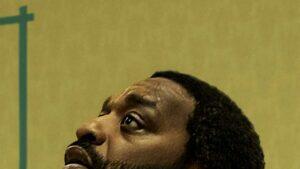
The new 2026 exhibition revisits and celebrates this turning point. For curator Yuval Etgar, understanding Man Ray's work lies precisely in this dimension of the continuous use and transformation of images. "The artist was very economical in his universe and, once he created a figure, he continued to work on it for years, extracting new and sometimes even contradictory meanings," he said in an interview with NeoFeed .
The event in Milan plays a significant role in the critical reception of Man Ray. The name Marconi has always been associated with intellectual curatorship in post-war Italy, where exhibitions functioned as active interpretations of the history of modern art. On display until July 24th, the exhibition brings together photography, objects, paintings, and drawings in a transversal reading that abandons linear chronology and opera as a visual vocabulary.
The project stems from the idea that the artist's production articulates word, object, and meaning as a whole. In this sense, Etgar proposes that Man Ray should not be limited to just a practice of representation, but should be understood as someone who planned in terms of codes — "He didn't want to be seen only as a photographer and didn't remember those terms," says the curator.
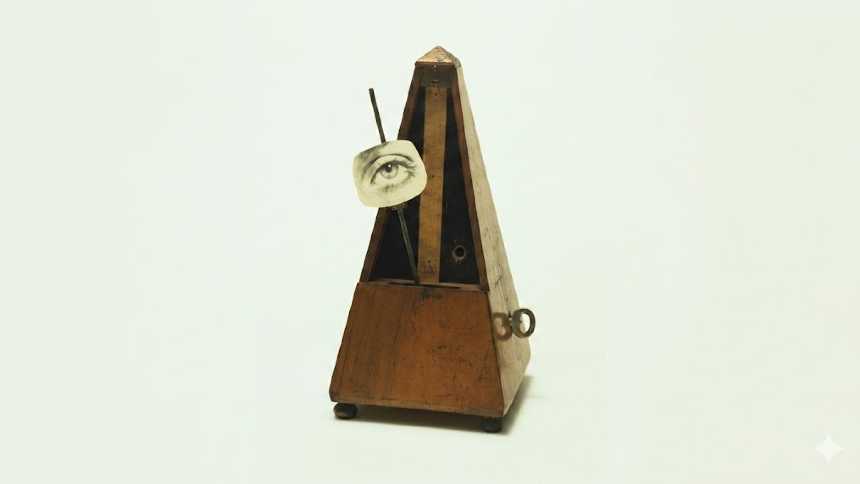
In this sense, one of the most emblematic works presented in the exhibition is Object to Be Destroyed , a metronome with a paper drawing of an eye pasted on, marking the beats of time. The piece has been recreated several times.
The first conception, in 1923, was intended to be a kind of silent witness in Man Ray's studio, observing him as he painted. In a second version, from 1932, the original drawing was replaced by the image of the eye of Lee Miller (1907-1977), photographer and former partner.
In this gesture, the work, renamed Object of Destruction , also takes on an affective and disruptive dimension. The artist even described it as a form of symbolic attack, "dismantling" the image of his former muse in his own production.
This creation comes with instructions — as radical as her romance with Miller: "Cut out the eye from a photograph of someone who was loved but is no longer seen. Fix the eye to the pendulum of a metronome and adjust the weight to the necessary tempo. Let it run until it reaches its limit. With a well-aimed hammer blow, try to destroy the whole thing in one go."
In 1957, during an exhibition, a group of students defied these instructions and destroyed the creation, which was subsequently reconstructed and transformed into multiples, financed with funds obtained from insurance. Thus, Man Ray came to be renamed Indestructible Object . The piece in Milan is precisely one of these reconstructed versions.
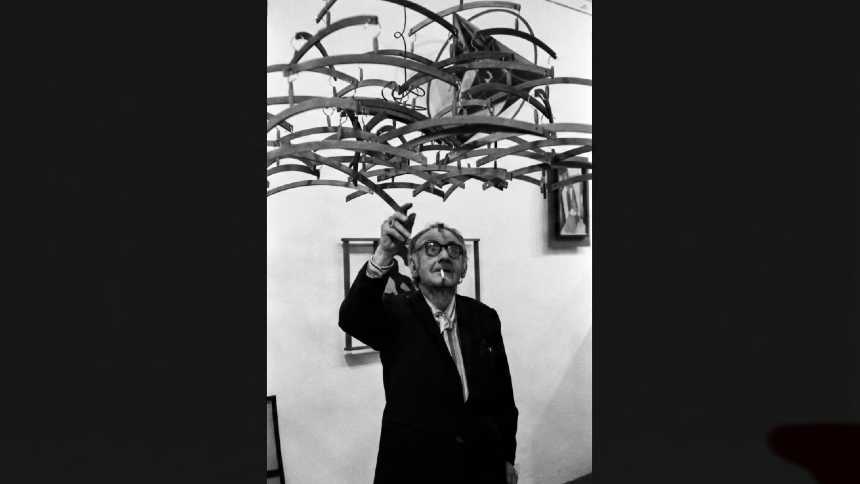
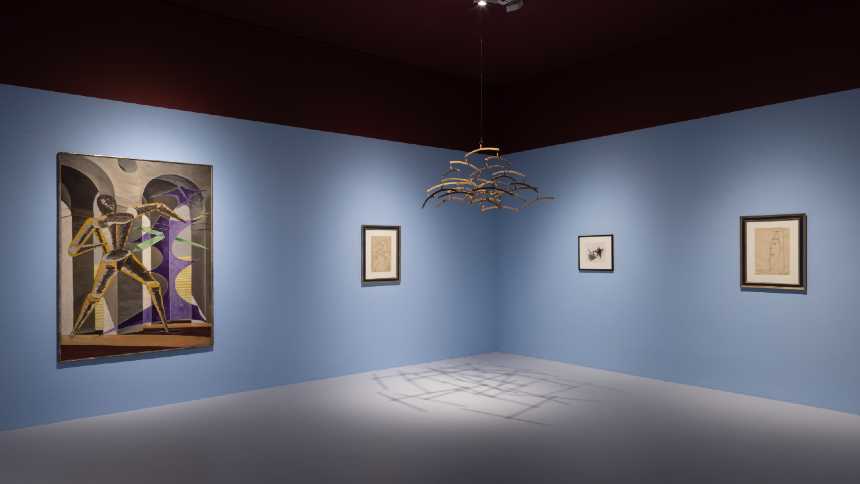

The exhibition is structured into five categories — The Alphabet , Light Writing , Body Language , Goals , and Mathematical Objects — which function as entries in an expanded dictionary.
This logic directly relates to Alphabet for Adults , a series in which each letter unfolds into associations between words and images, creating games where language ceases to be descriptive and becomes productive.
In this context, Etgar suggests that the central axis of Man Ray's work is his relationship with visual structures. He states that "the thread that runs through his entire career is his fascination with language as a medium. Titles, stories, and the use of text are not complementary, but essential."
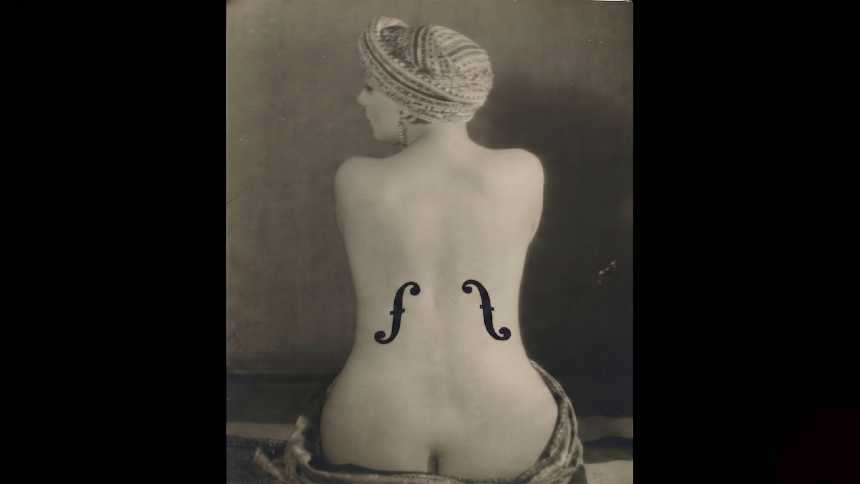
Among the most emblematic works is Le Violon d'Ingres , from 1924 ( Ingres' Violin ), one of the most recognizable images of Surrealism. In it, the nude body of Kiki de Montparnasse (Alice Prin, 1901-1953) is photographed from behind, with "f"-shaped openings painted on her skin, transforming her back into the instrument's soundbox. This is a description of the method of displacing objects and bodies from their original functions.
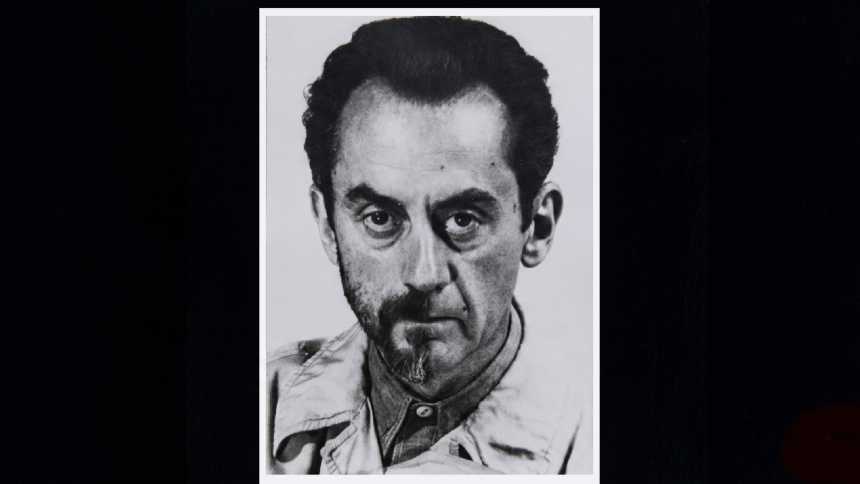
Man Ray also built one of the most important galleries of avant-garde portraits, photographing Marcel Duchamp (1887-1968), André Breton (1896-1966), Paul Éluard (1895-1952), and Louis Aragon (1897-1982).
Another fundamental work is L'Énigme d'Isidore Ducasse , from 1920 ( The Enigma of Isidore Ducasse ), in which an unidentified artifact is completely wrapped in a blanket and tied with ropes, remaining hidden and only suggested in form. The title refers to Isidore Ducasse (Count of Lautréamont, 1846-1870), a central figure in Surrealism.
Instead of illustrating the encounter of dissonant elements, Man Ray transforms concealment into language. In this logic, meaning does not arise from revelation, but from transposition, and the viewer comes to complete the creation.
Born Emmanuel Radnitzky in Philadelphia to Russian Jewish immigrants, he discovered European avant-garde movements and met Marcel Duchamp (1887-1968) in Ridgefield, New Jersey. In 1913, at the Armory Show in New York, which introduced American audiences to artists like Pablo Picasso (1881-1973), he met Marcel Duchamp (1887-1968), whose concept of the readymade (a common item transformed into art) would be decisive.
In 1921, Man Ray moved to Paris and joined the Surrealist and Dadaist circles, becoming a leading figure in the movements. The artist even said he hated photography, but this contradiction ultimately solidified his central position in the history of modern art.
In today's world, dominated by the massive circulation of images, this practice appears as an anticipation of fragmentation, reproduction, and remix processes—especially in radiography, a technique in which images are produced without a camera, through the direct exposure of elements onto photosensitive paper.
In this sense, M for Dictionary proposes a critical inversion: Man Ray is not presented merely as a photographer, but as an operator of visual language, whose work does not represent the world, but reorganizes its systems of meaning.