

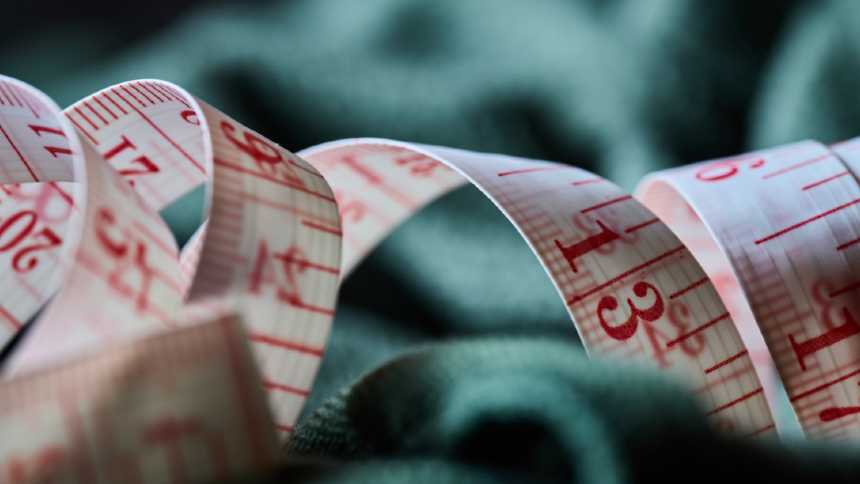
Protagoras (490 BC - 415 BC) summarizes one of the pillars of Western thought in the phrase "man is the measure of all things." In his conception, there is no universal absolute truth. Everything depends on how each of us perceives reality.
The metaphorical measure of the Greek philosopher served as a starting point for the new book by Canadian scientist Vaclav Smil, The Size of Things — An Explanation of the World .
In the book, Smil shows how size defines the functioning of almost all natural and human systems. And how, often without us realizing it, it organizes how we live—and think.
Author of acclaimed books such as How the World Works and Numbers Don't Lie, and one of Bill Gates' favorite writers, Smil also investigates the human obsession with measuring the world — "whether explicitly using real physical units, or implicitly, comparing someone or something to a standard or a mental image," he says.
Initially, the scientist explores the orders of magnitude of life. The comparison between the size of bacteria (0.0001 centimeters at most) and that of blue whales (up to 30 meters) illustrates Smil's central thesis: changes in scale are not only quantitative, but also qualitative.
It's not hard to imagine why. If a bacterium were 30 million times larger, reaching the dimensions of a whale, it wouldn't survive—its cellular organization wouldn't be able to sustain such a gigantic structure. The same logic applies to the whale: its biology, with trillions of cells and specialized organs, depends on a set of mechanisms incompatible with the microscale.
As Smil points out, size imposes functional limits. It's not just a number on a ruler, but the condition that allows something to exist—or not. And this rule extends to virtually all processes that shape life, the Earth, technological advances, societies, and economies.
Skyscrapers over 300 or 800 meters, for example, require complex solutions to withstand weight, wind, and vibration. In this case, the benefits do not increase linearly with height. As buildings gain more and more floors, an increasing proportion of their volume needs to be dedicated to supporting structures, elevators, and technical systems. Thus, the taller the building, the smaller its usable area.
The logic of efficiency and viability applies to nations. To explain the importance of "size" in the economy and infrastructure, Smil resorts to scale.
Modern societies operate with massive flows of matter. The production of steel, cement, and plastics, reaching billions of tons annually, reflects how the sheer scale of industrial operations is a determining factor in our wealth—and, in many cases, our poverty.


In practice, however, increasing in size is not just about producing more: it's about profoundly transforming the economy, society, and the environment.
Agriculture illustrates the issue well, and Smil's study allows for some contextual observations. To feed a growing population, it was necessary to intensify the use of resources—with more fertilizers, mechanization, and energy.
More food was produced, that's true, but ecological damage increased due to limitations imposed by nature itself: the soil doesn't expand and water isn't infinite. And all of this involves measurement, size, dimension.
Conversely, there is the reduction in the size of electronic components. Miniaturization has enabled "enormous" achievements in computing and, paradoxically, has made larger and more complex systems possible—from communication networks to data centers and global digital infrastructures.
Now, however, chips face physical and energy limitations: the heat generated by processing, high energy consumption, and the effects of physics at the nanoscale hinder further gains, showing that size reduction cannot be maintained indefinitely. At some point, says Smil, the advance slows down and stabilizes.
Even size is relative.
It must also be considered, as the scientist demonstrates, that the very notion of magnitude is relative. Human knowledge depends on the quantification of the world, but not only on that. What we consider large or small is also related to our sensory experience.
Thus, size is not merely an objective fact, but something interpreted through each individual's perception—which echoes Protagoras' thesis.
A 90-square-meter apartment, for example, may seem spacious to someone coming from a smaller residence. For someone accustomed to larger spaces, however, it tends to feel cramped. The measurement is the same—but how each person perceives reality directly impacts their perception of size.
Despite its apparent objectivity, measurement can be more complex and less precise than it seems. Smil uses the "coastline paradox," a classic among geographers and mathematicians, to demonstrate this: often, there is no single, definitive value, since the result depends on the criteria adopted in the measurement.
If we measure, for example, the length of the Brazilian coast using units of 100 kilometers, the "size" of the coastline will be smaller than that obtained with measurements based on units of 50 kilometers. When the "ruler" is smaller, details previously ignored, such as the curves of the beaches, are taken into account.
Therefore, there is no absolute "real length": it is merely a reflection of the scale we choose to observe the world.
This difficulty in measurement becomes more critical in social and economic contexts. GDP and income indicators often do not include, for example, data on informality—whose activities are left out of official records. Measurement, says Smil, “while essential, can be limited and subject to significant inaccuracies.”
Understanding the size of things is not just a mathematical exercise, but also a path to understanding the world, how we live and think — and, consequently, our own limitations as individuals, as a society, and as a nation.