

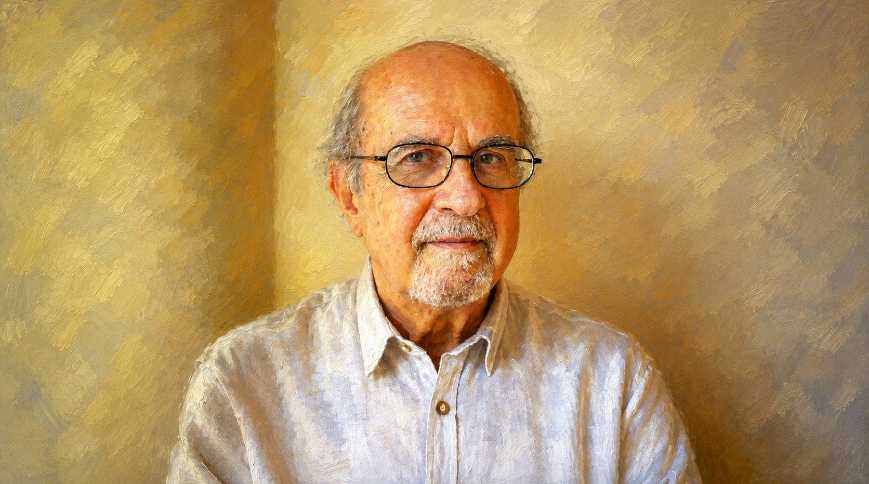
In *The Mirror and the Table — Memories of Childhood and Youth* , published in 2022, journalist and writer Roberto Pompeu de Toledo acknowledges that his narrative is not exclusively based on facts he recalls. By employing literary elements, he navigates the boundary between autobiography and fiction. He thus constructs a quasi-novel in which he narrates family stories remembered through inherited objects.
Now, in his new book, Winter Memorial: A Portrait of the Artist in Old Age , published by Objetiva, Toledo uses the same approach to reflect on aging and how the life of an 82-year-old widower can be full of disappointments, but also of new discoveries and joys; especially if illuminated by literature.
“I am a well of memories,” he writes. “I forget some things, but I remember many more.” For Toledo, memory is the opposite of death. And the things, places, and people that our minds retain are of incalculable richness. Written in “homage to a great love,” as the author defines it, the work is a celebration of life.
With a narrative capable of moving and inspiring readers of all ages, Toledo joins the ranks of the best authors who, in recent decades, have dedicated themselves to writing about aging and existence. Among them are the Argentinian Ernesto Sábato, the Americans Philip Roth and Charles Bukowski, and the Brazilian Boris Fausto.
In this interview with NeoFeed , the journalist discusses the creative and writing process of Winter's Memorial . See the main excerpts below:
Is the new book about a love story?
It's also about a love story, but not only about that. Let's say it's a portrait of a person in old age, which embodies a love story that is part of their life.
How long did it take for the idea to mature, for the decision to be made to write her memoirs, and to include the loss of Maria Isabel two years ago?
The account of Maria Isabel's illness and loss came quickly to be written. I wrote it immediately after her passing, to capture the heat of what I was experiencing and feeling. Later, I refined everything, summarized it, and included it in the book. This undertaking resulted in a small book I titled * Pain* , but I didn't want to publish it. It was too intimate and too sad. I ended up including parts of that book in the initial chapters of *Winter Memorial *.
What was the process like in finding the narrative voice for the book? Were there initial versions that were more confessional or more detached than the one that reached the reader?
There were no different initial versions. The narrative, somewhat truncated, in which I try to follow the flow of a scattered thought characteristic of the elderly, was born in a rush, without me having planned it. I then discovered that this was the only possible way to write the book as I wished.
You focus on your wife's presence in your life, starting with her illness, with digressions to other periods. Why did you choose this chronological inversion or fragmentation instead of telling your marriage story from beginning to end?
My purpose was not to tell the story of a marriage, but rather a process of aging, of which the death of my wife was the trigger. The chronological fragmentation also fits into the purposes of the truncated narrative.
"The fact that there are humorous passages serves the purpose of showing that humor has its place in the life and mind of an old man."
The death of his wife is the event that triggers the narrative. At what point did his experience with illness and grief cease to be merely a personal experience and become literary material for a book?
I think resorting to a true story stems from my lack of talent for writing fiction. What I would really like is to be a novelist. I lack the talent to invent stories, however. Therefore, I stick with my own story as raw material for writing. It was the same in my previous book, The Mirror and the Table, in which the focus is on memories from my youth.
When writing about real people and intimate relationships, how did you establish the boundaries between fidelity to memory and the needs of narrative construction?
I consciously didn't set any limits when I started writing. As I did so, the memories fell into place in the narrative as they came. Of course, there's a process of selecting facts and episodes involved, but that resolves itself.
The book deals with old age without falling into either idealization or discouragement.
From the beginning it was clear to me that I wouldn't just write about suffering and pain. The book had to be broader. The fact that there are humorous passages serves the purpose of showing that humor has its place in the life and mind of an old man.
Memory is one of the major themes of the book. Was there any research involved, or did you rely on recollection and its gaps?
What I did was research authors who wrote about old age in different eras, such as Simone de Beauvoir and Norberto Bobbio, who are widely cited in my text. But, unlike my previous book, this time I didn't have diaries, photos, or letters to rely on.
At some point, were you afraid that your memory would betray you?
I don't think so. Of course, memory is a treacherous beast, full of tricks, sometimes omitting, other times inventing. But that's its business. I hope that, when it fails, it does so for the better. That is, to improve, not worsen, the memory.
You have a well-established career as a journalist, historian, and essayist. What changed in your work method when writing a book so directly and intensely linked to your personal experience?
I wanted to write about more visceral things. The work in journalism or history is all objective; I wanted to write about things that moved me. The text becomes freer, no longer bound by certain canons that regulate historical or journalistic writing.
At various points, literature on aging tends to take on a tone of final reflection. Did you feel you were writing a farewell or a continuation?
I thought I was writing about the opposite side of life from my previous book, about my youth. I don't know if this will be a farewell. I hope not.
To what extent was writing also a way of reconnecting with his wife?
Before writing this book, I wrote a fresh account of Maria Isabel's illness and death. Upon finishing it, I felt very sad. "Of course, you've lost her again," said the psychoanalyst I was seeing at the time. That's it, we live with the dead through writing. And we even lose them again when we stop writing about them.
After finishing the book, were there any discoveries about yourself, about memory, or about old age that surprised you and that perhaps weren't clear before the writing process?
You always learn something in a process like this, of writing. But, of course, there's always a lot left to learn about memory, old age, and about yourself.
What do you hope younger readers will find in a book that speaks so profoundly about old age, loss, and the passage of time?
I don't know what to expect from this segment of the audience. But I would be very pleased if these young people found something that touched them.