


Beijing and Shanghai - Upon disembarking in China , first-time travelers are given a glimpse of what they will find in the country. At the immigration counter, after handing over their passport to an officer, digitized voices take over and conduct the dialogue in each tourist's native language.
More than just a resource, the example above illustrates how the country is establishing itself as the main counterpoint to the billions of dollars invested by the Western world, particularly the United States , in projects that are often grandiose, futuristic, and still not very practical.
From the fact that over 90% of transactions are made via QR code on smartphones, to the enormous fleet of electric cars in metropolises like Beijing and Shanghai, China has been gaining traction in applying technologies like artificial intelligence (AI) in the real world. And in the wake of substantial volumes of digital data.
“Unlike the US, where most leaders are lawyers, in China, a large portion are engineers,” says Samuel Liao, director of Yingke Law Brazil and regional director for the Chinese firm, one of the largest law firms in the world, in Latin America. “They are much more focused on what needs to be done.”
At the invitation of the Caldeira Institute and Invest RS, NeoFeed visited innovation hubs and companies in Beijing and Shanghai during the month of May. And, in the span of a week, it got a small glimpse of how the country is developing this vision in practice.
One of the things that stood out was the omnipresence of cameras on the avenues and buildings of both cities. These devices incorporate features ranging from the most mundane, such as access control, to behavioral analysis and the identification of faces in a crowd in milliseconds.
One of the names behind these devices is Megvii, a Chinese computer vision and facial recognition startup that has attracted investors such as the Bank of China Group Investment and Alibaba and has been valued at US$4 billion, making it one of the country's first unicorns.
Founded in 2011 by three students from Tsinghua University, the company gained traction precisely through the large-scale application of AI in the physical world, in places like subways, airports, retail stores, and industries. And in areas such as security, mobility, retail, logistics, and smart cities.
Their systems help manage, for example, traffic and traffic lights, as well as detect accidents, garbage accumulation, and faulty wiring. On another front, the company is also behind facial recognition payments and robots that automate processes in distribution centers.
From robotics to enterprise AI
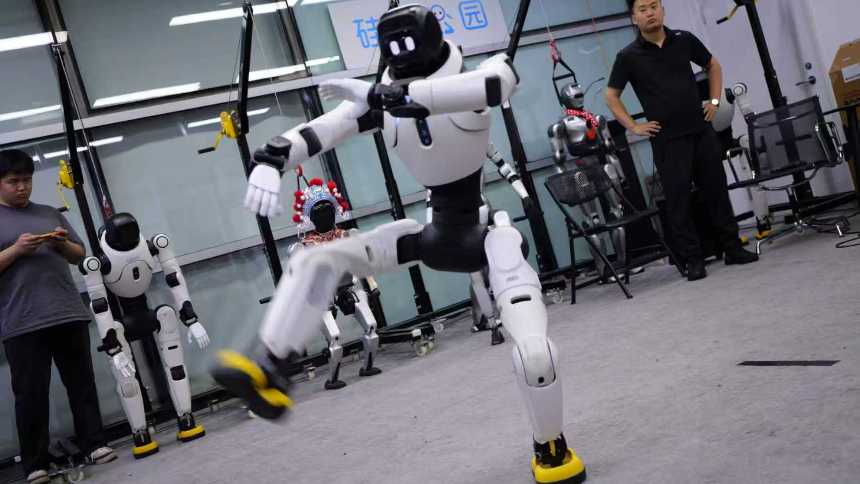
Robots were also one of the attractions during the visit to TusPark , the innovation ecosystem of Tsinghua University that was the birthplace of Megvii. In this case, however, what set the tone for the brief presentation were the dances and martial arts moves performed by two models in one of the hub's many rooms.
Juggling aside, robotics is one of China's strategic priorities, as expressed in the latest Five-Year Plan released about two months ago by the local government. And this is reflected in numbers such as the universe of more than 300 companies dedicated to this field in the country.
In March of this year, in another move reinforcing the focus on this area, China inaugurated the world's first factory in Guangdong province where an automated line operated by robots is responsible for producing humanoid robots – one unit every thirty minutes.
Speed and robotics also stood out during the visit to Xiaomi 's electric car factory in Beijing. At the facility, dominated by approximately 700 AI-powered robots and boasting a 91% automation rate, the company produces a vehicle every 76 seconds.
Some figures also stand out at TusPark, the innovation hub that connects academia with startups, large companies, investors, and the government—a mechanism widely adopted in the country that also helps to understand how China has advanced rapidly in this arena in recent years.
Created in 1994 with the idea of bringing technology developed by academia to the market, this ecosystem is connected to a network of more than 300 parks and incubators in 80 cities across 50 countries. It has already given rise to more than 40 unicorns and more than 100 IPOs.
Founded in 2014, 4Paradigm was one of the companies that left TusPark to ring the bell at an initial public offering (IPO). In this case, in 2023, on the Hong Kong Stock Exchange, where the company is currently valued at HK$14.8 billion (US$1.8 billion).
With revenues projected at around US$1 billion in 2025, the company is one of China's leading names in enterprise AI, serving over 160 companies. These include the five state-owned banks, as well as groups such as BYD , Lenovo, DHL, Pizza Hut , KFC, TCL , and Zegna.
The company operates in more than ten industries, including finance. And, with customized applications developed based on its own clients' data, which is already highly digitized, it is quite advanced in this corporate offering, something that American rivals such as Anthropic and OpenAI are still exploring.
However, at least in its rhetoric, 4Paradigm's thesis is not to compete with these companies. Rather, it aims to be a complementary offering to their peers, specifically in the area of enterprise AI applications and agents, something that, in the company's view, a generic AI model cannot address.
As part of the "five-layer AI cake" concept, formulated by Jensen Huang, co-founder and CEO of Nvidia , 4Paradigm argues that Chinese companies are better suited to the energy and applications segments, while American companies are better suited to chips, infrastructure, and AI models.
The fact is that, speeches and theories aside, these arguments have so far failed to convince American competitors. As a result, 4Paradigm was included on the United States' trade blacklist in 2023. As an alternative, the startup has been expanding into Southeast Asia and the Middle East.
The AI Tiger
In this context, the company adopting a less conciliatory tone in its competition with American companies is MiniMax, a startup that is part of the so-called "Four Tigers of AI" in China, specializing in Large Language Models (LLMs), the engines behind artificial intelligence.
MiniMax develops models capable of creating content in formats such as text, images, audio, video, and music. It also promotes the idea that its portfolio is much cheaper than rivals like OpenAI, without sacrificing quality compared to these and other competitors.
This thesis resonated with investors, including Alibaba and Tencent , and also in the capital markets. The company held its IPO in January of this year on the Hong Kong Stock Exchange, raising US$690 million and seeing its shares rise 55% on the first trading day.
Founded in 2021 and currently valued at HK$145.6 billion (US$18.5 billion), the company, unlike most of its compatriots, was born with global aspirations. And today, it has a base of over 200 million active users in more than 200 countries.
MiniMax, however, has a parallel with other Chinese companies. The startup has also been facing problems beyond the Great Wall. In one of these entanglements, the company was sued by studios such as Disney, Universal, and Warner Bros. in a California court.
The allegation is that the company improperly used films and series from these studios to train Hailuo AI, its AI-powered video creation platform. This allegedly involved cloning and copying famous characters from these companies' franchises.
In the latest chapter of this saga, a U.S. district judge rejected MiniMax's arguments and allowed the case to proceed, opening the door to potential heavy sanctions for the Chinese company.
Aside from this imbroglio, Samuel Liao, a Brazilian lawyer of Taiwanese descent who has lived in China for years, emphasizes that it is necessary to change the perception that the Western world, for the most part, still holds about the country.
“Back then, China opened its market and allowed foreign investors to enter, but always through partnerships with a local company,” he says. “The fact is that they learned the technology and absorbed that know-how . And China is no longer a country that copies. Now, it exports everything.”
In numbers
Some data helps translate this Chinese roadmap into numbers. In 2025, the country recorded a record trade surplus of US$1.18 trillion, a 20% increase over 2024. Exports totaled US$3.77 trillion, an annual expansion of 5.5%.
This latest figure was reported in a context where the trade war with the United States intensified and, as an alternative, China sought greater diversification of destinations, with a greater focus on Africa and Southeast Asia.
As part of this figure, exports of high-tech goods, which include robots and cutting-edge equipment, grew by 13%. Meanwhile, exports of electric vehicles, lithium batteries, and photovoltaic products increased by 27%.
Other indicators, compiled by the World Bank, also show how the country has evolved in this arena. Taking into account the export of high technology, China jumped from a volume of US$ 594.7 billion in 2016 to US$ 825 billion in 2023.
The new five-year plan, outlining the country's guiding principles for the period 2026 to 2030, reinforces the Chinese government's perception that technology will be a central pillar in the geopolitical landscape and in disputes with the US. This is particularly true in areas such as AI, robotics, biotechnology, and digital infrastructure.
In an indication of how this direction will translate into investments, Bloomberg reported this week that China is preparing a 2 trillion yuan ($295 billion) plan to build AI data centers across the country over the next five years.
As a basis for comparison, the group of American big tech companies formed by Alphabet, Meta, Microsoft, and Amazon plans to spend up to US$725 billion in 2026 alone on data center infrastructure for AI.