


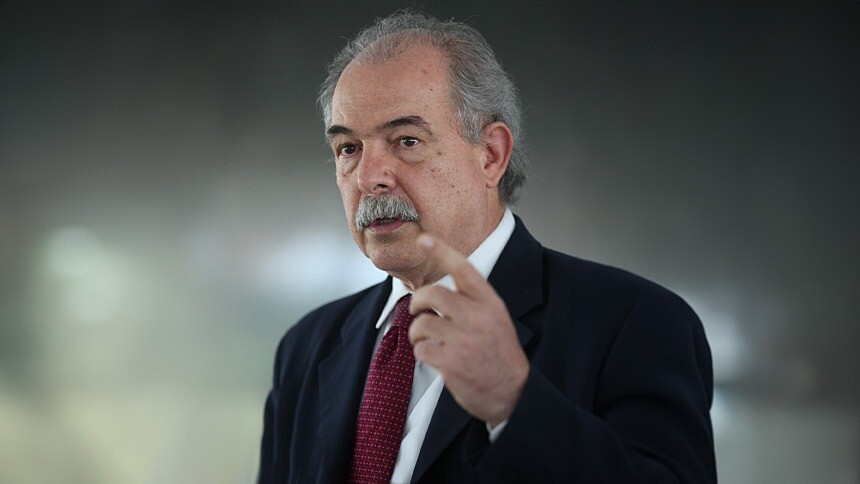
The president of the National Bank for Economic and Social Development (BNDES), Aloizio Mercadante (PT), stated that the case of Banco Master, owned by Daniel Vorcaro and liquidated in November by the Central Bank (BC), is "the biggest financial crime in the history of Brazil" and placed the blame on the former president of the BC, Roberto Campos Neto.
The statement was made during a panel at the Esfera Brasil Forum, held this Saturday at the Jequitimar Hotel in Guarujá, on the coast of São Paulo. Mercadante was alongside the chairman of BTG Pactual, André Esteves, and the minister of the Federal Court of Accounts (TCU), Bruno Dantas.
"The authorization came from the previous administration [now led by Gabriel Galípolo, who oversaw the liquidation]. Because Ilan Goldfajn's administration [who presided over the Central Bank between June 2016 and February 2019] did not authorize Daniel Vorcaro to enter as a relevant banker in the system."
In practice, according to Mercadante, it is clear that there were episodes of omission and complicity. "So much so that two directors are currently wearing electronic ankle monitors."
A major problem is that, as a result, the cost of the scandal falls directly on the Brazilian financial system, which needs to cover the R$ 52 billion with resources from the Credit Guarantee Fund (FGC).
“Of this total, 18% is paid by Itaú, 18% by Bradesco, 15% comes from Banco do Brasil, another 15% from Caixa, and so on, impacting the financial system. Then the Central Bank has to release the compulsory deposit to cushion this impact, which goes against the monetary policy's goal of combating inflation,” explains Mercadante.
According to the president of BNDES, in addition to the lack of oversight of Banco Master itself, there is a worrying situation regarding fintechs. He believes this becomes "an instrument for money laundering, where crime hides because it's below the Central Bank's radar."
And Mercadante sees a possible new crisis, which is not yet priced in, and which needs to be subject to scrutiny, namely the funds. "Reag is just the tip of the iceberg, because there is no control. The guy puts a fund on the balance sheet, which he says how much it's worth, and it's worth nothing, and creates a pyramid scheme."
In this sense, he sees a need for changes in the structure of the Central Bank and the Securities and Exchange Commission (CVM). For him, it is necessary to have more autonomy to curb new cases of financial crimes more quickly and efficiently.
"The Securities and Exchange Commission (CVM) and the Central Bank cannot continue as they are. They need restructuring, which includes valuing public servants. They need to be given autonomy and power. And the financial system needs to help solve this, because, ultimately, it pays the bill."
According to Esteves, it is unacceptable that "an insignificant bank caused a R$ 50 billion hole in the Credit Guarantee Fund (FGC)." "Furthermore, it also created a R$ 12 billion hole in BRB and R$ 4 billion in pension funds. There is no doubt that the control mechanisms were not clear," said Esteves.
According to the banker, a situation like this creates an even bigger problem, which is the generation of a parallel market "outside the lines" of any control body in the country. And it prevents organized crime from entering formal sectors of the economy.
“What worries me is not exactly the economy, but rather a war between institutional and non-institutional sectors in Brazil. Today, 20% of the fuel market in Brazil has become informal. How is that possible?” asks the chairman of the BTG board.
Asked if his bank erred in showing interest in acquiring Banco Master, Esteves denied any mistake. The bank did buy assets from BRB, but distanced itself from any association with Vorcaro's liquidated institution.
“Obviously there was no mistake, on the contrary. When we felt things were getting out of control, we tried to position ourselves accordingly. But our role is to ensure that Brazil doesn't lose this war. We're talking about militias, people who kill. We can't get used to or accept this,” Esteves states.