

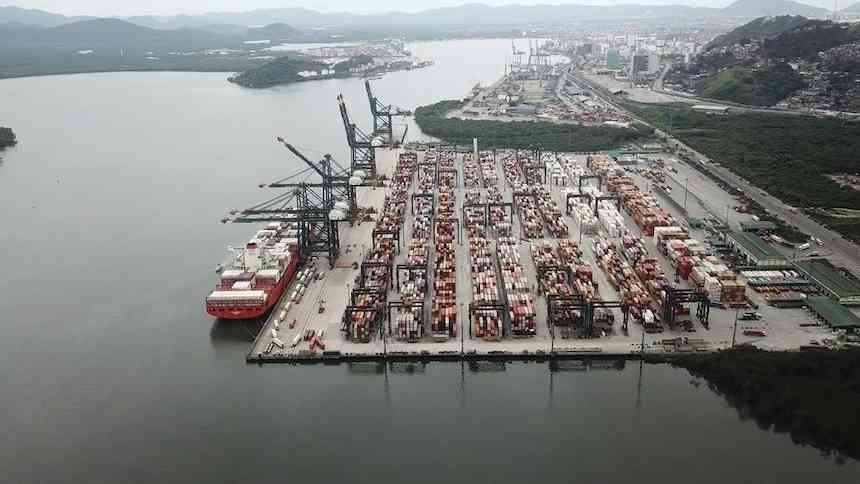
Responsible for handling one-third of Brazil's trade balance, the port of Santos will invest R$ 800 million to increase the draft (depth) of the channel from 15 meters to 16 meters.
The expansion of just one meter will guarantee the port an increase of up to 20% in the handling capacity of all cargoes. The contract with the winning bidder, the Belgian company Jan De Nul, will be signed next month.
The topic was discussed during a panel at the Esfera Brasil Forum, held at the Jequitimar Hotel in Guarujá, on the coast of São Paulo, this Saturday, May 23rd.
“Ships measuring 366 meters depend on high tide and 80% cargo capacity. With the increased draft, this vessel will have access at all times, regardless of the tide, and at full capacity. This changes the game,” says Anderson Pomini, president of the Santos Port Authority (APS), which manages the terminal, in an interview with NeoFeed after the panel.
Normally, ships measuring 366 meters, which are the largest in operation today, have a capacity of up to 20,000 containers, equivalent to 10,000 trucks lined up. And, with the new depth, it will be possible to bring in all of this volume at once.
“In practice, this extra meter will mean greater efficiency, accessibility, and security in the entry and exit of these large ships. The economic impact of this will be very significant,” he explains.
Once this stage is completed in 2028, APS plans to further advance to 17 meters, which, according to Pomini, is the maximum permitted capacity for the Santos channel. “When we deepen it, it can impact the edges. Originally, the port of Santos had an eight-meter draft. And we are already at 15 meters,” he states.
According to the president of APS, the work will begin in early 2027 and should last two years, with a completion deadline by the end of 2028. This means that part of the work on the canal will be done in conjunction with the construction of the Santos-Guarujá tunnel, which was tendered last year.
But, according to Pomini, there is no conflict, in engineering terms, that would prevent the two projects from moving forward together.
“When the tunnel excavation begins, the port channel dredging schedule will take this into account. The tunnel ceiling will be 21 meters below the water level, and it will be 860 meters long, connecting the two cities,” he explains.
This means that vehicles passing through the tunnel, when it is completed in 2030, will be five meters above the "bottom of the port channel," taking into account the 16-meter draft.
Mega auction to take place later this year.
At the event promoted by Esfera Brasil, the Minister of Ports and Airports, Tomé Franca, also spoke about a topic directly related to the growth of the port of Santos, which is the auction of the mega container terminal, called Tecon Santos 10.
There was a major impasse regarding the model and whether foreign terminals, which already operate in Santos, could participate in the bidding process. Within the government, there were those who argued that they could not compete, so as not to create a super player in the sector. But the opposite prevailed in the government.
"What the Ministry of Ports and Airports is advocating today is what the Civil House says, which decided to open the auction to all companies. It was expected that there would be a broad discussion about this," says the minister.
The Federal Court of Accounts (TCU) even blocked the bidding process, arguing that it would be necessary to restrict access for those who could compete for the area in Santos.
The Ministry of Ports and Airports recently forwarded this new assessment of full reopening to the National Agency for Waterway Transportation (Antaq), which will also issue its opinion.
In the market, the assessment is that the pressure from large companies, such as Maersk and MSC, which currently control Brasil Terminal Portuário (BTP) through a joint venture and operate in the port of Santos, prevailed.
Among the largest terminals in the port of Santos are Santos Brasil, now controlled by the French company CMA CGM, and DP World, owned by Dubai World.
According to the minister, the trend is for the tender to be published at the beginning of the second semester, between July and August, even though it is close to the election period. In his view, this would allow enough time to hold the auction on the B3 stock exchange by December.
"This is the largest undertaking in the port sector in Brazil, which will move the port of Santos from 48th to 15th position worldwide in container handling, increasing its operational capacity by 50%," says the minister.
“Our focus is to hold the auction in 2026. That's why we have to publish the tender by August. If the project is maintained as it is, we will succeed. Our focus is on delivery. Brazil's infrastructure is in a hurry,” Franca concludes.