

The highly anticipated and unprecedented auction for battery-based energy storage reserves (BESS), whose bidding process was launched earlier this month by the Ministry of Mines and Energy (MME), has the potential to generate R$ 20 billion in investments from the main companies in the Brazilian electricity sector.
Large companies in the sector, such as Axia, ISA Energia, Auren, Eneva, Weg, Newave Energia, Petrobras, Matrix, Taesa, including companies involved in generation, distribution, equipment supply, among others, have already publicly expressed interest in securing part of the contracts that will be up for grabs.
Initially, the federal government anticipated contracting 2 gigawatts (GW) of energy for this purpose, but since the volume contracted in the last auction for reserve energy from thermal power plants, held in March, was below expectations, the new estimate is between 5 GW and 6 GW. The exact figure should be determined closer to the bidding process.
According to the decree published by the government on June 3rd, two bidding processes will be held, one on December 2nd and the other on December 4th. The first will require local content, and the second, two days later, will be broader, with the prospect of participation from foreign technology suppliers, such as giants BYD and Tesla.
In the case of the expanded bidding process, there will be no requirement for a factory to be built in the country. This division of projects had already been promised by Minister Alexandre Silveira last year. However, there is still no certainty about the percentage allocated exclusively to Brazilian companies.
According to information obtained by NeoFeed , the federal government is currently discussing a level of content to be manufactured in Brazil for the equipment that will be offered, which varies in the order of 20% to 40%.
However, there are differing opinions within the Presidential Palace. While the Civil House advocates for a higher percentage, technicians from the Ministry of Mines and Energy (MME) and the Ministry of Development, Industry, Trade and Services (MDIC) have argued that the priority should be the successful outcome of the auctions, attracting the largest possible number of companies and investments.
The Brazilian National Bank for Economic and Social Development (BNDES) is also participating in discussions about the criteria. The main reason is that the financial institution will reserve at least R$ 27 billion, originating from the Climate Fund (aimed at projects that reduce greenhouse gas emissions), to finance not only projects directly destined for the auction, but also future investments throughout the energy storage chain.
In a recent podcast appearance, the acting National Secretary for Energy Transition and Planning at the Ministry of Mines and Energy (MME), Lorena Perim, explained that the auction addresses a need to meet increased energy demand and ensure energy security.
“The reserve auction for BESS comes to complement this scenario and introduce storage reasoning into the system. We need to think not only about generating energy, but also about shifting it to the appropriate times,” he stated.
The two auctions foresee so-called Reserve Capacity Power contracts and will be valid for 15 years. The winning bidders will have to guarantee the supply of the agreed volume starting August 1, 2028. The Ministry of Mines and Energy (MME), however, has already indicated that this date could be brought forward, depending on how the process progresses.
The project registration period began on June 15th and will run until July 31st. Applications must be submitted according to the rules established by the Energy Research Company (EPE), which is linked to the Ministry of Mines and Energy (MME).
An important requirement is that companies must use new batteries and demonstrate the availability of at least 30 megawatts (MW) of battery power. These new systems must also guarantee continuous operation for up to four consecutive hours, with an efficiency of at least 85%. And the maximum time for a full recharge must be up to six hours.
Most of these projects should come from sustainable energy sources, such as wind and solar. The reserve auction is seen as an important way to mitigate the impact of curtailment , which refers to forced cuts in solar and wind power generation by the National Electric System Operator (ONS) to avoid compromising the entire grid.
This partly explains the high level of interest from companies in this new modality. Smaller-scale initiatives are already starting to take shape through projects in various regions of Brazil.
Responsible for 17% of the national generation capacity, Axia (formerly Eletrobras) completed, on June 17th, in the municipality of Casa Nova, Bahia, a smart hybrid plant that combines wind power generation, photovoltaic energy, a battery energy storage system, and a data center.
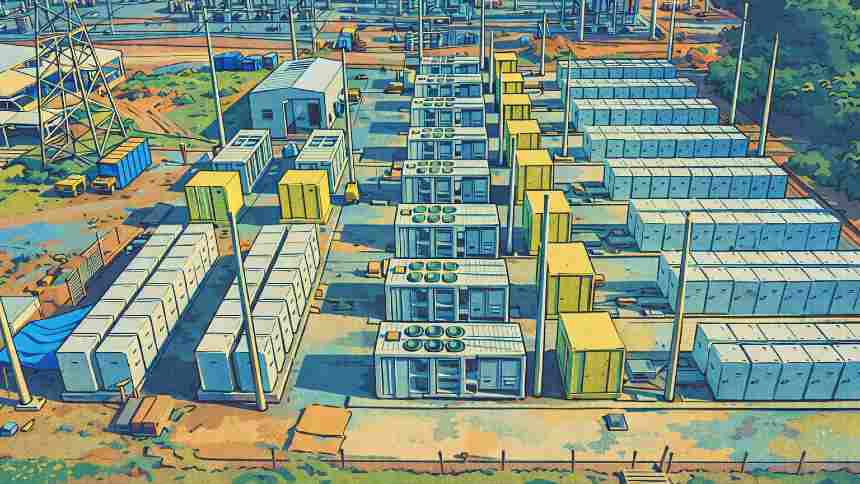
The Axia unit, which represents an investment of R$ 85 million, comprises a 1 MW photovoltaic plant, a 1.5 MW wind turbine, a 1 MW lithium battery bank (BESS) with 1.4 MWh of energy storage capacity, and a 1 MW data center.
In April, Pacto Energia, based in Paraná state, became the first distributor in the country to close a contract to receive a battery energy storage system. The supply is from Matrix Energia, a company that may be among the participants in the auction.
With an investment of R$ 30 million, the Paraná energy distribution company now has 10 high-performance batteries, totaling a storage capacity of 20 MW, in equipment installed in the city of Coronel Vivida.
Cheaper energy
According to Fábio Lima, executive director of the Brazilian Association of Energy Storage Solutions (Absae), an entity that brings together the main companies in the electricity sector, there is a fundamental point in the success of the auction, which is the real possibility of a drop in the cost of energy compared to that supplied by thermoelectric plants.
“It’s during peak consumption times that we activate thermal power plants, which are more expensive and generate the red flag on the electricity bill. They should only be activated in essential moments, such as in cases of water crisis,” he states in an interview with NeoFeed .
According to Absae, for every 1 GW contracted annually in the battery energy reserve capacity auction, the cost is R$ 4.6 billion lower than the same volume contracted in natural gas-fired power plants. “The focus of the auction will be system stability and price. As a consequence, it reduces curtailment ,” says Lima. In practice, battery energy “jumps ahead” of other sources.
According to the executive, the sector, in general, received the initial auction guidelines positively. Part of the rules were discussed directly by the association with the federal government, which listened to the demands.
“It’s an auction with a fixed revenue and a duration of 15 years, which is what the sector requested. High-quality batteries will be contracted, with incentives for the national industry, but without closing the market, allowing participation from everyone,” Lima adds.
According to him, Brazil is currently at great risk of losing control of its electrical system due to the difficulty in guaranteeing energy demand. "We need more load at noon and cheap energy in the late afternoon. That's what batteries will do."
Federal Deputy Arnaldo Jardim (Cidadania-SP) states that Minister Silveira is expected to release another decree, with further details about the auction, by August. In the congressman's view, it is essential that Brazil actually completes this stage.
“It is essential to have reliable energy and power in a system where renewable [energy sources] have grown. For this, capacity auctions are indispensable. There will be great national and international interest, as we are already seeing,” he explains.
Owner of the first large-scale battery storage system in national transmission, in operation since 2022 at the Registro substation in São Paulo, ISA Energia has the auction on its radar, but states that the analysis will take its financial discipline into account.
"The initiative increases the stability and efficiency of the system and enables the expansion of renewable sources. In this context, the company considers the auction scheduled for December to be positive, given the role of the BESS (Battery Energy Storage System) in strengthening the electrical system," the company stated in a press release.
The model in Registro required investments of R$ 146 million and serves approximately two million residents of the South Coast of São Paulo.
Ricardo Lisboa, founding partner of Delta Energia, revealed to NeoFeed that the company also intends to submit a project to participate in the battery auction. Initially, the intention is to better understand this market in order to grow, based on new competitions.
“If we decide to participate, it must be from the minimum power volume [30 MW]. We will learn more about the sector. It is an important solution from which Delta cannot be disconnected,” says Lisboa.
Without electoral contamination
The CEO of Absae confirms that there was an expectation for the bidding process to take place earlier, and not in the last month of the current administration. Even so, he believes that the political calendar should not affect the progress of the competition, nor interrupt the next steps after the winners are declared.
“It could have been sooner, but it took the necessary time. We trust that there will be stability within the technical team involved. The National Electric Energy Agency (Aneel), which will conduct the auction, is not subject to the government's schedule. And that is fundamental,” says Lima. “There is nothing ideological about contracting energy through batteries. It's a necessity.”
The CEO says there is still a challenge to be discussed with the government, which is the reduction of taxes on equipment. For imported equipment, taxes reach 80%. In the case of domestically produced equipment, the rate reaches 50%.
“The total taxation of BESS is a problem that needs to be solved. With tax reform, things are starting to improve. But it is a market that should be encouraged because it is an essential instrument for energy security,” he says.
Ideally, according to him, the taxation should be similar to that of a photovoltaic panel or a wind turbine, which is between 15% and 20%. "That's not what the State should be collecting revenue from."
The fact is that the financial market is also viewing the opportunities that will arise from the auction favorably. A study conducted by Elos Ayta, at the request of NeoFeed , shows that since the Ministry of Mines and Energy (MME) released the guidelines for the auction, publicly traded companies linked to the electricity sector have seen an increase in their share prices.
From June 3rd to the present, the B3 Electric Energy Index (Ieeletrica), which reflects the average performance of the most traded shares in the sector in the country, has registered a 1% increase. Over the course of 2026, the appreciation reaches 3%.