

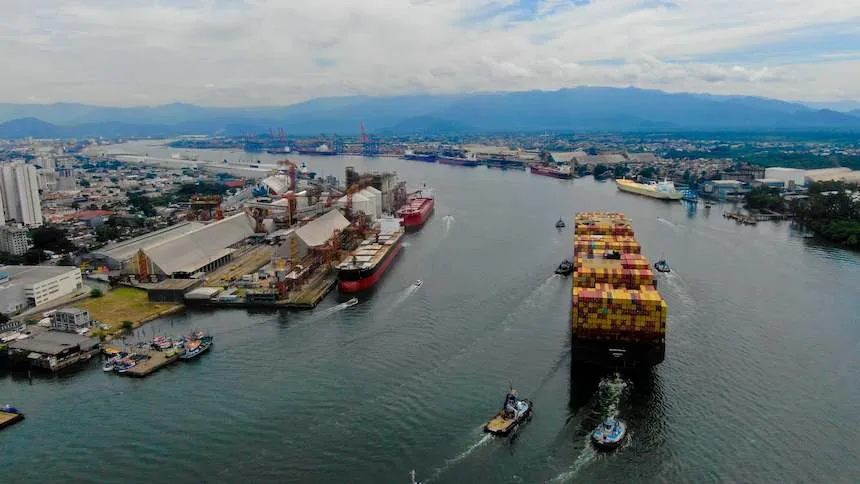
Just before starting construction on the Santos-Guarujá tunnel , the Santos Port Authority (APS) signed a contract with the Valenciaport Foundation (which manages the Spanish port) for the implementation of a decarbonization plan and an Energy Master Plan (PDE) for the Port of Santos .
The goal of the plan, which is expected to be completed in 2026, is to reduce greenhouse gas emissions from operations at the largest port complex in Latin America. This includes activities of APS (the port authority), port terminals, ships operating in the port, and rail and road transport modes.
At least 20,000 trucks circulate daily through the port terminal areas, including the locations that are part of the 32 lease agreements with companies such as Santos Brasil , DP World, Brasil Terminal Portuário, Eldorado Brasil, Marimex, Bracell, Copersucar, among others.
For Anderson Pomini, president of the Santos Port Authority, the biggest challenge in this decarbonization process is integrating the private sector, which operates in the terminal, to embark on this journey with the public company, linked to the Ministry of Ports and Airports.
“Santos is already a major highlight in terms of port infrastructure, responsible for handling 30% of Brazil's trade balance. But this good infrastructure brings with it the emission of thousands of tons of CO². And we need to create actions to reduce this impact,” says Pomini, in an interview with NeoFeed .
“We hired the Foundation to conduct a detailed inventory. We need to know what kind of port we will have in 20 years, with efficiency, technology, and in the pursuit of energy transition,” he added.
On Monday, October 27th, APS counted 120 ships docked, with 65 at the quay and 55 in the anchorage area – locations slightly further from the terminals where vessels await authorization to proceed. According to the administrator, today only 10% of the world's ships are adapted for non-fossil fuels, such as hydrogen.
Even without a defined plan yet, the Port of Santos has already begun adopting actions to encourage sustainable practices in its operations. The main one is associated with a package of tariff discounts for companies that register lower emissions.
A decree signed by the president of APS in early October of this year adopted a tariff reduction schedule ranging from 4% to 20%, according to the Port Efficiency and Sustainability Index (IESP), developed by APS.
In the first half of 2025, the operator of the Port of Santos recorded revenue of R$ 1 billion, a 13.4% increase compared to the same period in 2024. Of this amount, R$ 300 million (equivalent to 30%) came from port fees.
It is precisely on this point that Pomini believes he can move forward with the concessionaires to minimize the impacts of emissions from fossil fuels from the outset. For those who already have a contract, the idea is to provide incentives. For new terminals, the aim is to include it as a requirement in the tender.
“In the case of the Port of Santos, we have been working on this tariff incentive to minimize this impact. The way forward is to get the entire logistics chain to adhere to this plan,” says Pomini.
Even though this action may initially mean a loss of revenue in the tariff category, Pomini believes that the environmental benefit compensates for this initiative.
“As a public port, one of our goals is to offer these conditions to companies. Ships that demonstrate a reduction in CO² emissions receive this discount to access our channel. This revenue reduction has the clear objective of helping to decarbonize the terminal,” he says.
“This is an investment. And now we want to expand this to trucks and cars that travel through the port, in addition to integrating the approximately 150,000 people who work directly and indirectly at the Port of Santos,” says the president.
Tunnel timeline
The implementation of the Santos-Guarujá tunnel itself, once completed (scheduled for 2031), should contribute to reducing emissions.
According to the executive, of the 20,000 trucks, approximately 5,000 travel about 45 kilometers to transport cargo from both sides of the port (between Santos and Guarujá). This represents the emission of 70,000 tons of CO². With the tunnel, this emission will cease to exist.
In early September, the Portuguese construction company Mota-Engil won the auction , held at B3, for the construction of the tunnel, which will be 1.5 kilometers long, with 870 meters below the port channel. The next step now is the signing of the contract, which, according to Pomini, will take place in December. "By January 2026, we will have the construction site implemented."
The project will cost R$ 6.8 billion and will be divided between the federal and state governments. The company will have the right to collect revenue from toll charges, projected at R$ 6.15 for cars, R$ 3.07 for motorcycles, and R$ 18.35 for trucks.
On Thursday, October 23, the Federal Court of Accounts (TCU) requested an audit plan for the federal funds that will be allocated to the tunnel.